

related to the individual densities and volumes of
its constituent elements using (7.15).
Taking the time derivative of the right-hand
side of (7.15) with volume and density of each
element considered constant gives (7.16), the
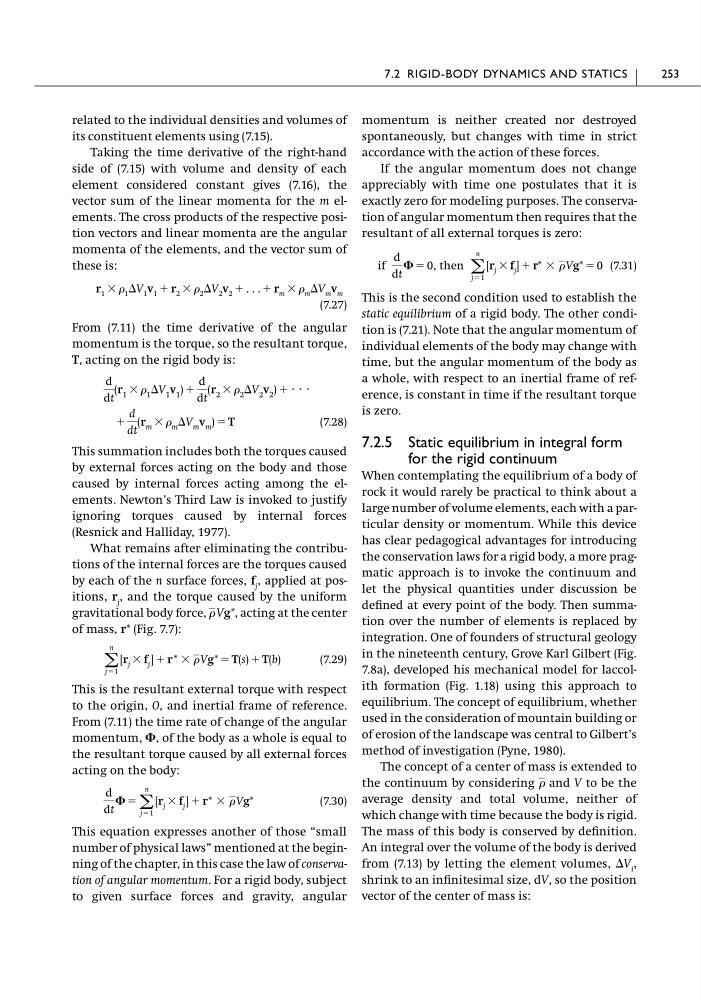
vector sum of the linear momenta for the m elements. The cross products of the respective position vectors and linear momenta are the angular
momenta of the elements, and the vector sum of
these is:
(7.27)
From (7.11) the time derivative of the angular
momentum is the torque, so the resultant torque,
T, acting on the rigid body is:
(7.28)
This summation includes both the torques caused
by external forces acting on the body and those
caused by internal forces acting among the elements. Newton’s Third Law is invoked to justify
ignoring torques caused by internal forces
(Resnick and Halliday, 1977).
What remains after eliminating the contributions of the internal forces are the torques caused
by each of the n surface forces, f j , applied at positions, r j , and the torque caused by the uniform
gravitational body force, Vg*, acting at the center
of mass, r* (Fig. 7.7):
(7.29)
This is the resultant external torque with respect
to the origin, O, and inertial frame of reference.
From (7.11) the time rate of change of the angular
momentum, ⌽, of the body as a whole is equal to
the resultant torque caused by all external forces
acting on the body:
(7.30)
This equation expresses another of those “small
number of physical laws” mentioned at the beginning of the chapter, in this case the law of conservation of angular momentum. For a rigid body, subject
to given surface forces and gravity, angular
d
dt
⌽ ϭ ͚
n
jϭ1
[r j ϫ f j ] ϩ r* ϫ Vg*
͚
n
jϭ1
[r j ϫ f j ] ϩ r * ϫ Vg * ϭ T(s) ϩ T(b)
ϩ
d
dt
(r m ϫ m ⌬V m v m ) ϭ T
d
dt
(r 1 ϫ 1 ⌬V 1 v 1 ) ϩ
d
dt
(r 2 ϫ 2 ⌬V 2 v 2 ) ϩ · · ·
ϫ m ⌬V m v m
r 1 ϫ 1 ⌬V 1 v 1 ϩ r 2 ϫ 2 ⌬V 2 v 2 ϩ . . . ϩ r m
momentum is neither created nor destroyed
spontaneously, but changes with time in strict
accordance with the action of these forces.
If the angular momentum does not change
appreciably with time one postulates that it is
exactly zero for modeling purposes. The conservation of angular momentum then requires that the
resultant of all external torques is zero:
(7.31)
This is the second condition used to establish the
static equilibrium of a rigid body. The other condition is (7.21). Note that the angular momentum of
individual elements of the body may change with
time, but the angular momentum of the body as
a whole, with respect to an inertial frame of reference, is constant in time if the resultant torque
is zero.
7.2.5 Static equilibrium in integral form
for the rigid continuum
When contemplating the equilibrium of a body of
rock it would rarely be practical to think about a
large number of volume elements, each with a particular density or momentum. While this device
has clear pedagogical advantages for introducing
the conservation laws for a rigid body, a more pragmatic approach is to invoke the continuum and
let the physical quantities under discussion be
defined at every point of the body. Then summation over the number of elements is replaced by
integration. One of founders of structural geology
in the nineteenth century, Grove Karl Gilbert (Fig.
7.8a), developed his mechanical model for laccolith formation (Fig. 1.18) using this approach to
equilibrium. The concept of equilibrium, whether
used in the consideration of mountain building or
of erosion of the landscape was central to Gilbert’s
method of investigation (Pyne, 1980).
The concept of a center of mass is extended to
the continuum by considering and V to be the
average density and total volume, neither of
which change with time because the body is rigid.
The mass of this body is conserved by definition.
An integral over the volume of the body is derived
from (7.13) by letting the element volumes, ⌬V i ,
shrink to an infinitesimal size, dV, so the position
vector of the center of mass is:
if
d
dt
⌽ ϭ 0, then ͚
n
jϭ1
[r j ϫ f j ] ϩ r* ϫ Vg* ϭ 0
7.2 RIGID-BODY DYNAMICS AND STATICS
253
its constituent elements using (7.15).
Taking the time derivative of the right-hand
side of (7.15) with volume and density of each
element considered constant gives (7.16), the
vector sum of the linear momenta for the m elements. The cross products of the respective position vectors and linear momenta are the angular
momenta of the elements, and the vector sum of
these is:
(7.27)
From (7.11) the time derivative of the angular
momentum is the torque, so the resultant torque,
T, acting on the rigid body is:
(7.28)
This summation includes both the torques caused
by external forces acting on the body and those
caused by internal forces acting among the elements. Newton’s Third Law is invoked to justify
ignoring torques caused by internal forces
(Resnick and Halliday, 1977).
What remains after eliminating the contributions of the internal forces are the torques caused
by each of the n surface forces, f j , applied at positions, r j , and the torque caused by the uniform
gravitational body force, Vg*, acting at the center
of mass, r* (Fig. 7.7):
(7.29)
This is the resultant external torque with respect
to the origin, O, and inertial frame of reference.
From (7.11) the time rate of change of the angular
momentum, ⌽, of the body as a whole is equal to
the resultant torque caused by all external forces
acting on the body:
(7.30)
This equation expresses another of those “small
number of physical laws” mentioned at the beginning of the chapter, in this case the law of conservation of angular momentum. For a rigid body, subject
to given surface forces and gravity, angular
d
dt
⌽ ϭ ͚
n
jϭ1
[r j ϫ f j ] ϩ r* ϫ Vg*
͚
n
jϭ1
[r j ϫ f j ] ϩ r * ϫ Vg * ϭ T(s) ϩ T(b)
ϩ
d
dt
(r m ϫ m ⌬V m v m ) ϭ T
d
dt
(r 1 ϫ 1 ⌬V 1 v 1 ) ϩ
d
dt
(r 2 ϫ 2 ⌬V 2 v 2 ) ϩ · · ·
ϫ m ⌬V m v m
r 1 ϫ 1 ⌬V 1 v 1 ϩ r 2 ϫ 2 ⌬V 2 v 2 ϩ . . . ϩ r m
momentum is neither created nor destroyed
spontaneously, but changes with time in strict
accordance with the action of these forces.
If the angular momentum does not change
appreciably with time one postulates that it is
exactly zero for modeling purposes. The conservation of angular momentum then requires that the
resultant of all external torques is zero:
(7.31)
This is the second condition used to establish the
static equilibrium of a rigid body. The other condition is (7.21). Note that the angular momentum of
individual elements of the body may change with
time, but the angular momentum of the body as
a whole, with respect to an inertial frame of reference, is constant in time if the resultant torque
is zero.
7.2.5 Static equilibrium in integral form
for the rigid continuum
When contemplating the equilibrium of a body of
rock it would rarely be practical to think about a
large number of volume elements, each with a particular density or momentum. While this device
has clear pedagogical advantages for introducing
the conservation laws for a rigid body, a more pragmatic approach is to invoke the continuum and
let the physical quantities under discussion be
defined at every point of the body. Then summation over the number of elements is replaced by
integration. One of founders of structural geology
in the nineteenth century, Grove Karl Gilbert (Fig.
7.8a), developed his mechanical model for laccolith formation (Fig. 1.18) using this approach to
equilibrium. The concept of equilibrium, whether
used in the consideration of mountain building or
of erosion of the landscape was central to Gilbert’s
method of investigation (Pyne, 1980).
The concept of a center of mass is extended to
the continuum by considering and V to be the
average density and total volume, neither of
which change with time because the body is rigid.
The mass of this body is conserved by definition.
An integral over the volume of the body is derived
from (7.13) by letting the element volumes, ⌬V i ,
shrink to an infinitesimal size, dV, so the position
vector of the center of mass is:
if
d
dt
⌽ ϭ 0, then ͚
n
jϭ1
[r j ϫ f j ] ϩ r* ϫ Vg* ϭ 0
7.2 RIGID-BODY DYNAMICS AND STATICS
253