

problems in structural geology. For example,
density contrasts among typical rock types found
in the Earth’s crust could cause variations in g,
but common densities only range from about 2 ϫ
10
3 to 3 ϫ 10
3 kg m
Ϫ3 (Clark, 1966). Similarly,
although g changes with distance from the center
of the Earth, most of our attention in structural
geology is focused on the outer shell of the Earth
with a thickness less than 100 km, relative to the
Earth’s radius of over 6000 km. The difference
between the equatorial radius (about 6378 km)
and the polar radius (about 6357 km) is only
21 km, and the difference between the highest
mountain peak (almost 9 km above sea level) and
the deepest parts of the ocean floor (about 11 km
below sea level) is only about 20 km. Neither of
these differences is large compared to the radius
of Earth. Thus, the variations in g within the crust
are likely to be small, so we treat the magnitude
and direction of the gravitational field as uniform
in space and constant in time.
It is convenient from a computational point of
view to replace the action of all the body forces,
w i , with the resultant force acting at a center of
gravity. The center of gravity and the center of
mass are coincident if the gravity field over the
body is uniform in magnitude. The resultant body
force (weight) of the body is:
(7.24)
Here the acceleration of gravity is treated as a constant, g*, with a magnitude g* ϭ 9.8 m s
Ϫ2 . This
body force can be thought of as acting at the
center of gravity, which is the center of mass. For
a non-uniform acceleration of gravity the center of
gravity and center of mass may not be coincident.
As a consequence of the discrete surface forces
(7.22) and the uniform gravity field (7.24), the conservation of linear momentum (7.20) is written:
(7.25)
If the sum of the surface forces and the weight in
each coordinate direction is zero, the time rate of
change of the linear momentum is zero. For
the rigid body this means that the velocity of the
center of mass does not change with time and the
surface and body forces are related as:
d
dt
P ϭ V
d
dt
v* ϭ ͚
n
jϭ1
f j ϩ Vg*
F(b) ϭ ͚
m
iϭ1
w i ϭ Vg*
(7.26)
This is a restatement of (7.21) and represents the
first condition for static equilibrium of the rigid
body subject to discrete surface forces and a
uniform gravitational acceleration.
7.2.4 Conservation of angular
momentum
When calculating the angular momentum for an
isolated particle all forces act at the point where
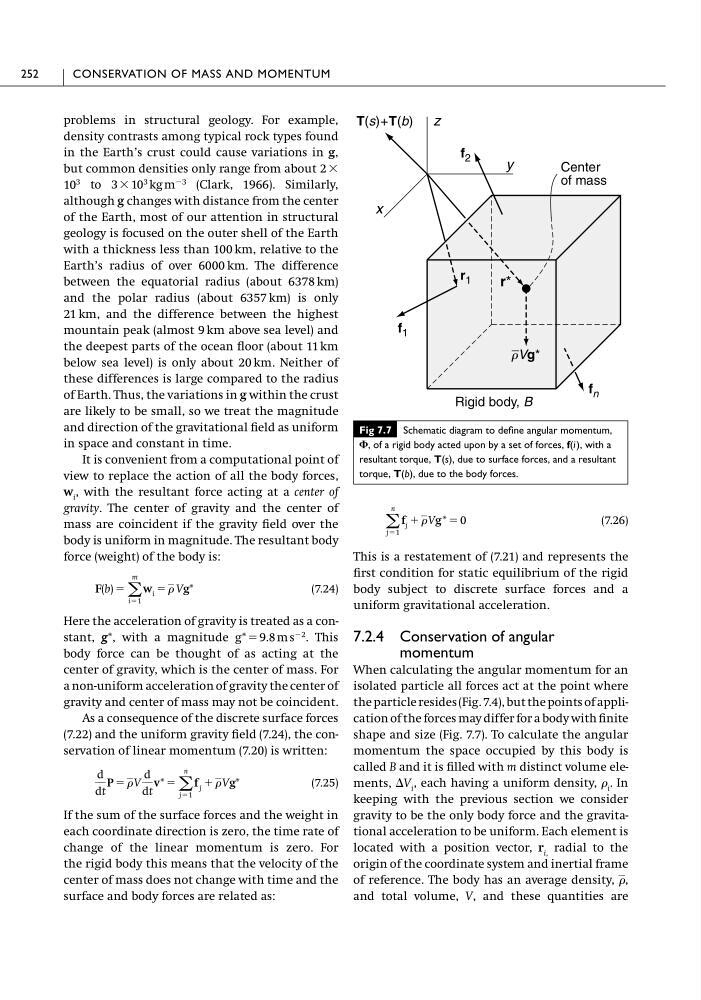
the particle resides (Fig. 7.4), but the points of application of the forces may differ for a body with finite
shape and size (Fig. 7.7). To calculate the angular
momentum the space occupied by this body is
called B and it is filled with m distinct volume elements, ⌬V i , each having a uniform density, i . In
keeping with the previous section we consider
gravity to be the only body force and the gravitational acceleration to be uniform. Each element is
located with a position vector, r i, radial to the
origin of the coordinate system and inertial frame
of reference. The body has an average density, ,
and total volume, V, and these quantities are
͚
n
jϭ1
f j ϩ Vg * ϭ 0
252
CONSERVATION OF MASS AND MOMENTUM
Fig 7.7 Schematic diagram to define angular momentum,
⌽, of a rigid body acted upon by a set of forces, f(i ), with a
resultant torque, T(s), due to surface forces, and a resultant
torque, T(b), due to the body forces.
x
y
z
Rigid body, B
r*
Center
of mass
f n
r 1
T(s)+T(b)
f 2
f 1
rVg*
_
density contrasts among typical rock types found
in the Earth’s crust could cause variations in g,
but common densities only range from about 2 ϫ
10
3 to 3 ϫ 10
3 kg m
Ϫ3 (Clark, 1966). Similarly,
although g changes with distance from the center
of the Earth, most of our attention in structural
geology is focused on the outer shell of the Earth
with a thickness less than 100 km, relative to the
Earth’s radius of over 6000 km. The difference
between the equatorial radius (about 6378 km)
and the polar radius (about 6357 km) is only
21 km, and the difference between the highest
mountain peak (almost 9 km above sea level) and
the deepest parts of the ocean floor (about 11 km
below sea level) is only about 20 km. Neither of
these differences is large compared to the radius
of Earth. Thus, the variations in g within the crust
are likely to be small, so we treat the magnitude
and direction of the gravitational field as uniform
in space and constant in time.
It is convenient from a computational point of
view to replace the action of all the body forces,
w i , with the resultant force acting at a center of
gravity. The center of gravity and the center of
mass are coincident if the gravity field over the
body is uniform in magnitude. The resultant body
force (weight) of the body is:
(7.24)
Here the acceleration of gravity is treated as a constant, g*, with a magnitude g* ϭ 9.8 m s
Ϫ2 . This
body force can be thought of as acting at the
center of gravity, which is the center of mass. For
a non-uniform acceleration of gravity the center of
gravity and center of mass may not be coincident.
As a consequence of the discrete surface forces
(7.22) and the uniform gravity field (7.24), the conservation of linear momentum (7.20) is written:
(7.25)
If the sum of the surface forces and the weight in
each coordinate direction is zero, the time rate of
change of the linear momentum is zero. For
the rigid body this means that the velocity of the
center of mass does not change with time and the
surface and body forces are related as:
d
dt
P ϭ V
d
dt
v* ϭ ͚
n
jϭ1
f j ϩ Vg*
F(b) ϭ ͚
m
iϭ1
w i ϭ Vg*
(7.26)
This is a restatement of (7.21) and represents the
first condition for static equilibrium of the rigid
body subject to discrete surface forces and a
uniform gravitational acceleration.
7.2.4 Conservation of angular
momentum
When calculating the angular momentum for an
isolated particle all forces act at the point where
the particle resides (Fig. 7.4), but the points of application of the forces may differ for a body with finite
shape and size (Fig. 7.7). To calculate the angular
momentum the space occupied by this body is
called B and it is filled with m distinct volume elements, ⌬V i , each having a uniform density, i . In
keeping with the previous section we consider
gravity to be the only body force and the gravitational acceleration to be uniform. Each element is
located with a position vector, r i, radial to the
origin of the coordinate system and inertial frame
of reference. The body has an average density, ,
and total volume, V, and these quantities are
͚
n
jϭ1
f j ϩ Vg * ϭ 0
252
CONSERVATION OF MASS AND MOMENTUM
Fig 7.7 Schematic diagram to define angular momentum,
⌽, of a rigid body acted upon by a set of forces, f(i ), with a
resultant torque, T(s), due to surface forces, and a resultant
torque, T(b), due to the body forces.
x
y
z
Rigid body, B
r*
Center
of mass
f n
r 1
T(s)+T(b)
f 2
f 1
rVg*
_