

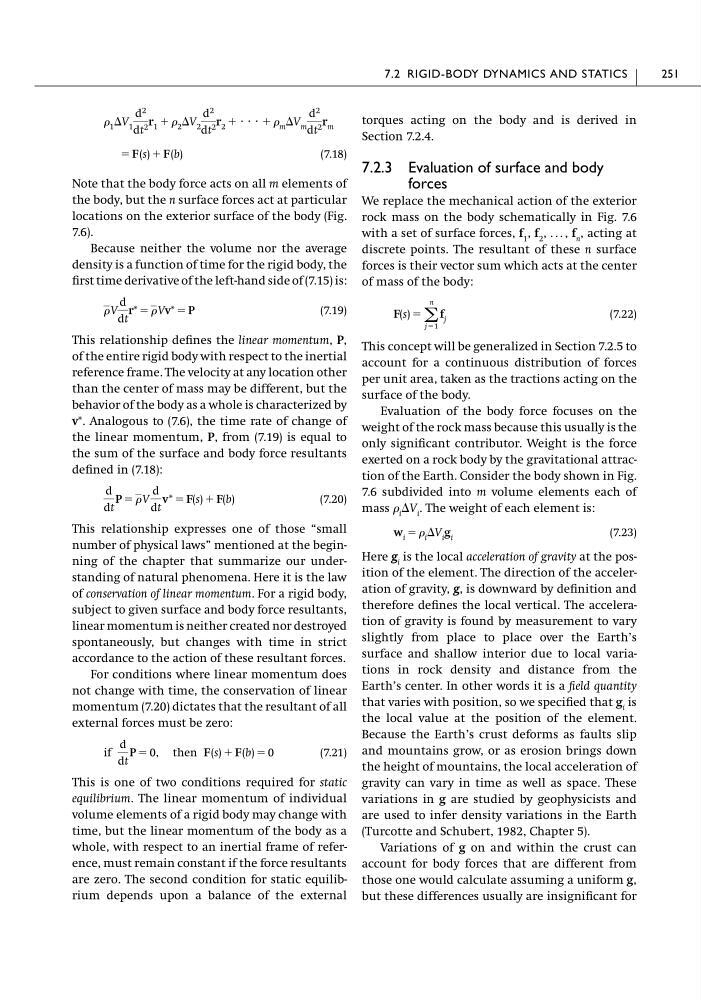
(7.18)
Note that the body force acts on all m elements of
the body, but the n surface forces act at particular
locations on the exterior surface of the body (Fig.
7.6).
Because neither the volume nor the average
density is a function of time for the rigid body, the
first time derivative of the left-hand side of (7.15) is:
(7.19)
This relationship defines the linear momentum, P,
of the entire rigid body with respect to the inertial
reference frame. The velocity at any location other
than the center of mass may be different, but the
behavior of the body as a whole is characterized by
v*. Analogous to (7.6), the time rate of change of
the linear momentum, P, from (7.19) is equal to
the sum of the surface and body force resultants
defined in (7.18):
(7.20)
This relationship expresses one of those “small
number of physical laws” mentioned at the beginning of the chapter that summarize our understanding of natural phenomena. Here it is the law
of conservation of linear momentum. For a rigid body,
subject to given surface and body force resultants,
linear momentum is neither created nor destroyed
spontaneously, but changes with time in strict
accordance to the action of these resultant forces.
For conditions where linear momentum does
not change with time, the conservation of linear
momentum (7.20) dictates that the resultant of all
external forces must be zero:
(7.21)
This is one of two conditions required for static
equilibrium. The linear momentum of individual
volume elements of a rigid body may change with
time, but the linear momentum of the body as a
whole, with respect to an inertial frame of reference, must remain constant if the force resultants
are zero. The second condition for static equilibrium depends upon a balance of the external
if
d
dt
P ϭ 0, then F (s) ϩ F (b) ϭ 0
d
dt
P ϭ V
d
dt
v* ϭ F(s) ϩ F(b)
V
d
dt
r* ϭ Vv* ϭ P
ϭ F (s) ϩ F (b)
1 ⌬V 1
d 2
dt 2 r 1 ϩ 2 ⌬V 2
d 2
dt 2 r 2 ϩ · · · ϩ m ⌬V m
d 2
dt 2 r m
torques acting on the body and is derived in
Section 7.2.4.
7.2.3 Evaluation of surface and body
forces
We replace the mechanical action of the exterior
rock mass on the body schematically in Fig. 7.6
with a set of surface forces, f 1 , f 2 , . . . , f n , acting at
discrete points. The resultant of these n surface
forces is their vector sum which acts at the center
of mass of the body:
(7.22)
This concept will be generalized in Section 7.2.5 to
account for a continuous distribution of forces
per unit area, taken as the tractions acting on the
surface of the body.
Evaluation of the body force focuses on the
weight of the rock mass because this usually is the
only significant contributor. Weight is the force
exerted on a rock body by the gravitational attraction of the Earth. Consider the body shown in Fig.
7.6 subdivided into m volume elements each of
mass i ⌬V i . The weight of each element is:
(7.23)
Here g i is the local acceleration of gravity at the position of the element. The direction of the acceleration of gravity, g, is downward by definition and
therefore defines the local vertical. The acceleration of gravity is found by measurement to vary
slightly from place to place over the Earth’s
surface and shallow interior due to local variations in rock density and distance from the
Earth’s center. In other words it is a field quantity
that varies with position, so we specified that g i is
the local value at the position of the element.
Because the Earth’s crust deforms as faults slip
and mountains grow, or as erosion brings down
the height of mountains, the local acceleration of
gravity can vary in time as well as space. These
variations in g are studied by geophysicists and
are used to infer density variations in the Earth
(Turcotte and Schubert, 1982, Chapter 5).
Variations of g on and within the crust can
account for body forces that are different from
those one would calculate assuming a uniform g,
but these differences usually are insignificant for
w i ϭ i ⌬V i g i
F(s) ϭ ͚
n
jϭ1
f j
7.2 RIGID-BODY DYNAMICS AND STATICS
251
Note that the body force acts on all m elements of
the body, but the n surface forces act at particular
locations on the exterior surface of the body (Fig.
7.6).
Because neither the volume nor the average
density is a function of time for the rigid body, the
first time derivative of the left-hand side of (7.15) is:
(7.19)
This relationship defines the linear momentum, P,
of the entire rigid body with respect to the inertial
reference frame. The velocity at any location other
than the center of mass may be different, but the
behavior of the body as a whole is characterized by
v*. Analogous to (7.6), the time rate of change of
the linear momentum, P, from (7.19) is equal to
the sum of the surface and body force resultants
defined in (7.18):
(7.20)
This relationship expresses one of those “small
number of physical laws” mentioned at the beginning of the chapter that summarize our understanding of natural phenomena. Here it is the law
of conservation of linear momentum. For a rigid body,
subject to given surface and body force resultants,
linear momentum is neither created nor destroyed
spontaneously, but changes with time in strict
accordance to the action of these resultant forces.
For conditions where linear momentum does
not change with time, the conservation of linear
momentum (7.20) dictates that the resultant of all
external forces must be zero:
(7.21)
This is one of two conditions required for static
equilibrium. The linear momentum of individual
volume elements of a rigid body may change with
time, but the linear momentum of the body as a
whole, with respect to an inertial frame of reference, must remain constant if the force resultants
are zero. The second condition for static equilibrium depends upon a balance of the external
if
d
dt
P ϭ 0, then F (s) ϩ F (b) ϭ 0
d
dt
P ϭ V
d
dt
v* ϭ F(s) ϩ F(b)
V
d
dt
r* ϭ Vv* ϭ P
ϭ F (s) ϩ F (b)
1 ⌬V 1
d 2
dt 2 r 1 ϩ 2 ⌬V 2
d 2
dt 2 r 2 ϩ · · · ϩ m ⌬V m
d 2
dt 2 r m
torques acting on the body and is derived in
Section 7.2.4.
7.2.3 Evaluation of surface and body
forces
We replace the mechanical action of the exterior
rock mass on the body schematically in Fig. 7.6
with a set of surface forces, f 1 , f 2 , . . . , f n , acting at
discrete points. The resultant of these n surface
forces is their vector sum which acts at the center
of mass of the body:
(7.22)
This concept will be generalized in Section 7.2.5 to
account for a continuous distribution of forces
per unit area, taken as the tractions acting on the
surface of the body.
Evaluation of the body force focuses on the
weight of the rock mass because this usually is the
only significant contributor. Weight is the force
exerted on a rock body by the gravitational attraction of the Earth. Consider the body shown in Fig.
7.6 subdivided into m volume elements each of
mass i ⌬V i . The weight of each element is:
(7.23)
Here g i is the local acceleration of gravity at the position of the element. The direction of the acceleration of gravity, g, is downward by definition and
therefore defines the local vertical. The acceleration of gravity is found by measurement to vary
slightly from place to place over the Earth’s
surface and shallow interior due to local variations in rock density and distance from the
Earth’s center. In other words it is a field quantity
that varies with position, so we specified that g i is
the local value at the position of the element.
Because the Earth’s crust deforms as faults slip
and mountains grow, or as erosion brings down
the height of mountains, the local acceleration of
gravity can vary in time as well as space. These
variations in g are studied by geophysicists and
are used to infer density variations in the Earth
(Turcotte and Schubert, 1982, Chapter 5).
Variations of g on and within the crust can
account for body forces that are different from
those one would calculate assuming a uniform g,
but these differences usually are insignificant for
w i ϭ i ⌬V i g i
F(s) ϭ ͚
n
jϭ1
f j
7.2 RIGID-BODY DYNAMICS AND STATICS
251