

(7.14)
The densities of the volume elements, i , are not
necessarily the same, so these equations account
for the spatial heterogeneity of density in
deformed rock masses such as that depicted in
Argand’s block diagram from the Penninic Alps
(Chapter 7, frontispiece). Given the structural
architecture as worked out by Argand, and the
densities of the individual rock units, as could be
determined by a standard laboratory procedure,
one could calculate the components of the center
of mass using (7.14) and similar expressions for
the y- and z-components.
7.2.2 Conservation of linear momentum
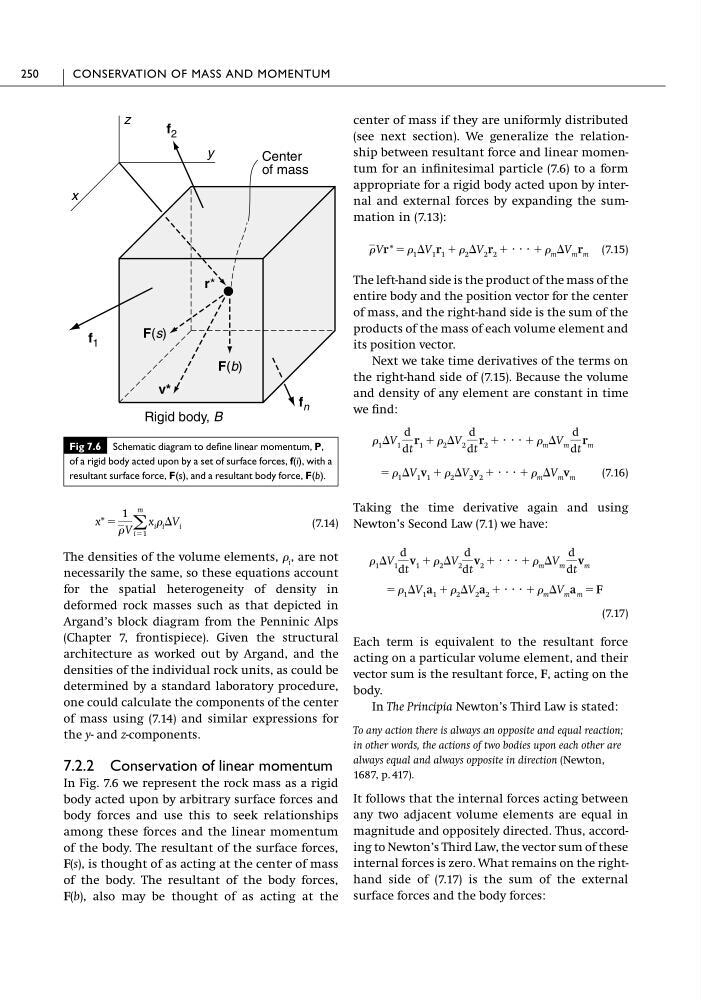
In Fig. 7.6 we represent the rock mass as a rigid
body acted upon by arbitrary surface forces and
body forces and use this to seek relationships
among these forces and the linear momentum
of the body. The resultant of the surface forces,
F(s), is thought of as acting at the center of mass
of the body. The resultant of the body forces,
F(b), also may be thought of as acting at the
x* ϭ
1
V ͚
m
iϭ1
x i i ⌬V i
center of mass if they are uniformly distributed
(see next section). We generalize the relationship between resultant force and linear momentum for an infinitesimal particle (7.6) to a form
appropriate for a rigid body acted upon by internal and external forces by expanding the summation in (7.13):
(7.15)
The left-hand side is the product of the mass of the
entire body and the position vector for the center
of mass, and the right-hand side is the sum of the
products of the mass of each volume element and
its position vector.
Next we take time derivatives of the terms on
the right-hand side of (7.15). Because the volume
and density of any element are constant in time
we find:
(7.16)
Taking the time derivative again and using
Newton’s Second Law (7.1) we have:
(7.17)
Each term is equivalent to the resultant force
acting on a particular volume element, and their
vector sum is the resultant force, F, acting on the
body.
In The Principia Newton’s Third Law is stated:
To any action there is always an opposite and equal reaction;
in other words, the actions of two bodies upon each other are
always equal and always opposite in direction (Newton,
1687, p. 417).
It follows that the internal forces acting between
any two adjacent volume elements are equal in
magnitude and oppositely directed. Thus, according to Newton’s Third Law, the vector sum of these
internal forces is zero. What remains on the righthand side of (7.17) is the sum of the external
surface forces and the body forces:
ϭ 1 ⌬V 1 a 1 ϩ 2 ⌬V 2 a 2 ϩ · · · ϩ m ⌬V m a m ϭ F
1 ⌬V 1
d
dt
v 1 ϩ 2 ⌬V 2
d
dt
v 2 ϩ · · · ϩ m ⌬V m
d
dt
v m
ϭ 1 ⌬V 1 v 1 ϩ 2 ⌬V 2 v 2 ϩ · · · ϩ m ⌬V m v m
1 ⌬V 1
d
dt
r 1 ϩ 2 ⌬V 2
d
dt
r 2 ϩ · · · ϩ m ⌬V m
d
dt
r m
Vr * ϭ 1 ⌬V 1 r 1 ϩ 2 ⌬V 2 r 2 ϩ · · · ϩ m ⌬V m r m
250
CONSERVATION OF MASS AND MOMENTUM
Fig 7.6 Schematic diagram to define linear momentum, P,
of a rigid body acted upon by a set of surface forces, f(i), with a
resultant surface force, F(s), and a resultant body force, F(b).
x
y
z
Rigid body, B
r*
Center
of mass
v*
f 1
F(s)
F(b)
f n
f 2
The densities of the volume elements, i , are not
necessarily the same, so these equations account
for the spatial heterogeneity of density in
deformed rock masses such as that depicted in
Argand’s block diagram from the Penninic Alps
(Chapter 7, frontispiece). Given the structural
architecture as worked out by Argand, and the
densities of the individual rock units, as could be
determined by a standard laboratory procedure,
one could calculate the components of the center
of mass using (7.14) and similar expressions for
the y- and z-components.
7.2.2 Conservation of linear momentum
In Fig. 7.6 we represent the rock mass as a rigid
body acted upon by arbitrary surface forces and
body forces and use this to seek relationships
among these forces and the linear momentum
of the body. The resultant of the surface forces,
F(s), is thought of as acting at the center of mass
of the body. The resultant of the body forces,
F(b), also may be thought of as acting at the
x* ϭ
1
V ͚
m
iϭ1
x i i ⌬V i
center of mass if they are uniformly distributed
(see next section). We generalize the relationship between resultant force and linear momentum for an infinitesimal particle (7.6) to a form
appropriate for a rigid body acted upon by internal and external forces by expanding the summation in (7.13):
(7.15)
The left-hand side is the product of the mass of the
entire body and the position vector for the center
of mass, and the right-hand side is the sum of the
products of the mass of each volume element and
its position vector.
Next we take time derivatives of the terms on
the right-hand side of (7.15). Because the volume
and density of any element are constant in time
we find:
(7.16)
Taking the time derivative again and using
Newton’s Second Law (7.1) we have:
(7.17)
Each term is equivalent to the resultant force
acting on a particular volume element, and their
vector sum is the resultant force, F, acting on the
body.
In The Principia Newton’s Third Law is stated:
To any action there is always an opposite and equal reaction;
in other words, the actions of two bodies upon each other are
always equal and always opposite in direction (Newton,
1687, p. 417).
It follows that the internal forces acting between
any two adjacent volume elements are equal in
magnitude and oppositely directed. Thus, according to Newton’s Third Law, the vector sum of these
internal forces is zero. What remains on the righthand side of (7.17) is the sum of the external
surface forces and the body forces:
ϭ 1 ⌬V 1 a 1 ϩ 2 ⌬V 2 a 2 ϩ · · · ϩ m ⌬V m a m ϭ F
1 ⌬V 1
d
dt
v 1 ϩ 2 ⌬V 2
d
dt
v 2 ϩ · · · ϩ m ⌬V m
d
dt
v m
ϭ 1 ⌬V 1 v 1 ϩ 2 ⌬V 2 v 2 ϩ · · · ϩ m ⌬V m v m
1 ⌬V 1
d
dt
r 1 ϩ 2 ⌬V 2
d
dt
r 2 ϩ · · · ϩ m ⌬V m
d
dt
r m
Vr * ϭ 1 ⌬V 1 r 1 ϩ 2 ⌬V 2 r 2 ϩ · · · ϩ m ⌬V m r m
250
CONSERVATION OF MASS AND MOMENTUM
Fig 7.6 Schematic diagram to define linear momentum, P,
of a rigid body acted upon by a set of surface forces, f(i), with a
resultant surface force, F(s), and a resultant body force, F(b).
x
y
z
Rigid body, B
r*
Center
of mass
v*
f 1
F(s)
F(b)
f n
f 2