

forces. The three components, F x , F y , and F z of the
resultant force are equal to the sum of the respective components of all forces acting on the particle. For example, the x-component is calculated as:
(7.2)
Here n is the total number of different forces and
a x is the x-component of acceleration. The components F y and F z follow by changing subscripts. Note
that the component of acceleration is directly proportional to the component of resultant force. Said
another way, the acceleration components are in
the same ratio as the resultant force components:
(7.3)
Therefore, the acceleration takes place in exactly
the same direction as the action of the resultant
force. This phenomenon is referred to as a linear
acceleration because it takes place in a line, the line
of action of the resultant force.
The relationship among force, mass, and acceleration expressed as Newton’s Second Law (7.1)
can be rearranged to place either acceleration or
force alone on the left-hand side of the equation.
Thus, one can think of either the acceleration or
the force as the dependent variable to be calculated given the mass and the other quantity. One
might conclude from this mathematical manipulation that acceleration of a particle causes a
force, or that application of a force on a particle
causes acceleration. Newton’s position on this
question of causality is suggested in a recent
translation of The Principia where the first and
second laws are written as:
Every body preserves in its state of being at rest or of moving
uniformly straight forward, except insofar as it is compelled
to change its state by forces impressed.
A change in motion is proportional to the motive force
impressed and takes place along the straight line in which
that force is impressed (Newton, 1687, p. 416).
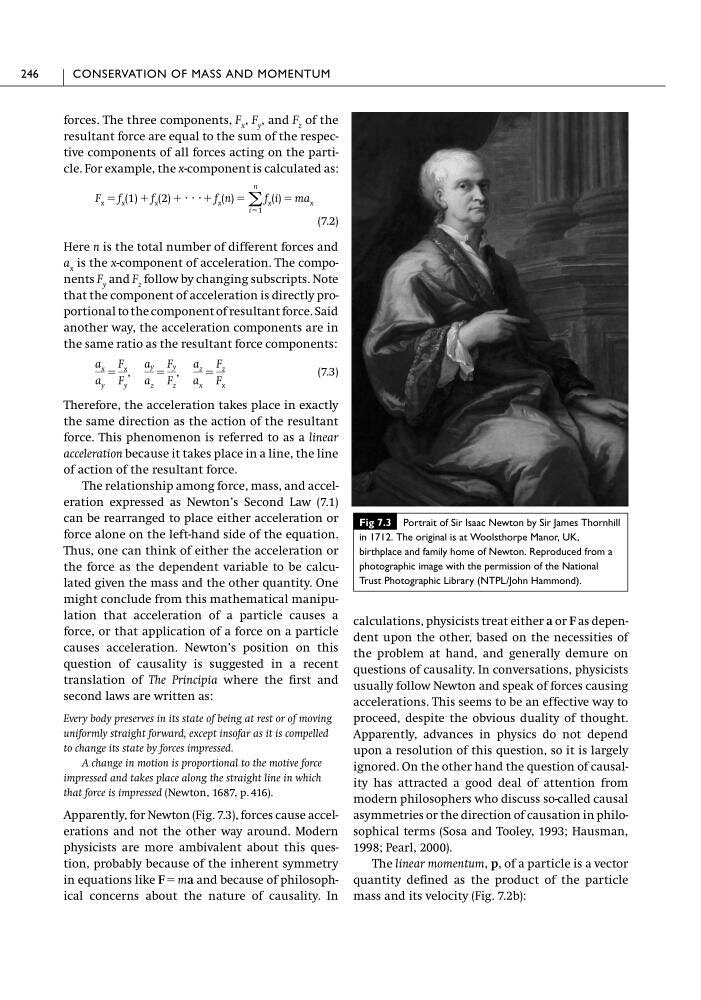
Apparently, for Newton (Fig. 7.3), forces cause accelerations and not the other way around. Modern
physicists are more ambivalent about this question, probably because of the inherent symmetry
in equations like F ϭ ma and because of philosophical concerns about the nature of causality. In
a x
a y
ϭ
F x
F y
,
a y
a z
ϭ
F y
F z
,
a z
a x
ϭ
F z
F x
F x ϭ f x (1) ϩ f x (2) ϩ · · · ϩ f x (n) ϭ ͚
n
iϭ1
f x (i) ϭ ma x
calculations, physicists treat either a or F as dependent upon the other, based on the necessities of
the problem at hand, and generally demure on
questions of causality. In conversations, physicists
usually follow Newton and speak of forces causing
accelerations. This seems to be an effective way to
proceed, despite the obvious duality of thought.
Apparently, advances in physics do not depend
upon a resolution of this question, so it is largely
ignored. On the other hand the question of causality has attracted a good deal of attention from
modern philosophers who discuss so-called causal
asymmetries or the direction of causation in philosophical terms (Sosa and Tooley, 1993; Hausman,
1998; Pearl, 2000).
The linear momentum, p, of a particle is a vector
quantity defined as the product of the particle
mass and its velocity (Fig. 7.2b):
246
CONSERVATION OF MASS AND MOMENTUM
Fig 7.3 Portrait of Sir Isaac Newton by Sir James Thornhill
in 1712. The original is at Woolsthorpe Manor, UK,
birthplace and family home of Newton. Reproduced from a
photographic image with the permission of the National
Trust Photographic Library (NTPL/John Hammond).
resultant force are equal to the sum of the respective components of all forces acting on the particle. For example, the x-component is calculated as:
(7.2)
Here n is the total number of different forces and
a x is the x-component of acceleration. The components F y and F z follow by changing subscripts. Note
that the component of acceleration is directly proportional to the component of resultant force. Said
another way, the acceleration components are in
the same ratio as the resultant force components:
(7.3)
Therefore, the acceleration takes place in exactly
the same direction as the action of the resultant
force. This phenomenon is referred to as a linear
acceleration because it takes place in a line, the line
of action of the resultant force.
The relationship among force, mass, and acceleration expressed as Newton’s Second Law (7.1)
can be rearranged to place either acceleration or
force alone on the left-hand side of the equation.
Thus, one can think of either the acceleration or
the force as the dependent variable to be calculated given the mass and the other quantity. One
might conclude from this mathematical manipulation that acceleration of a particle causes a
force, or that application of a force on a particle
causes acceleration. Newton’s position on this
question of causality is suggested in a recent
translation of The Principia where the first and
second laws are written as:
Every body preserves in its state of being at rest or of moving
uniformly straight forward, except insofar as it is compelled
to change its state by forces impressed.
A change in motion is proportional to the motive force
impressed and takes place along the straight line in which
that force is impressed (Newton, 1687, p. 416).
Apparently, for Newton (Fig. 7.3), forces cause accelerations and not the other way around. Modern
physicists are more ambivalent about this question, probably because of the inherent symmetry
in equations like F ϭ ma and because of philosophical concerns about the nature of causality. In
a x
a y
ϭ
F x
F y
,
a y
a z
ϭ
F y
F z
,
a z
a x
ϭ
F z
F x
F x ϭ f x (1) ϩ f x (2) ϩ · · · ϩ f x (n) ϭ ͚
n
iϭ1
f x (i) ϭ ma x
calculations, physicists treat either a or F as dependent upon the other, based on the necessities of
the problem at hand, and generally demure on
questions of causality. In conversations, physicists
usually follow Newton and speak of forces causing
accelerations. This seems to be an effective way to
proceed, despite the obvious duality of thought.
Apparently, advances in physics do not depend
upon a resolution of this question, so it is largely
ignored. On the other hand the question of causality has attracted a good deal of attention from
modern philosophers who discuss so-called causal
asymmetries or the direction of causation in philosophical terms (Sosa and Tooley, 1993; Hausman,
1998; Pearl, 2000).
The linear momentum, p, of a particle is a vector
quantity defined as the product of the particle
mass and its velocity (Fig. 7.2b):
246
CONSERVATION OF MASS AND MOMENTUM
Fig 7.3 Portrait of Sir Isaac Newton by Sir James Thornhill
in 1712. The original is at Woolsthorpe Manor, UK,
birthplace and family home of Newton. Reproduced from a
photographic image with the permission of the National
Trust Photographic Library (NTPL/John Hammond).