

p ϭ mv
(7.4)
Just as the force and acceleration have the same
direction, the linear momentum and velocity
have the same direction because their respective
components are in the same ratio, for example
p x /p y ϭ v x /v y .
Given constant resultant force acting on a particle of known mass, one can calculate its acceleration using (7.1). The instantaneous velocity of the
particle is found using the fact that the time rate
of change of velocity is the acceleration; so one
can integrate a constant acceleration over time to
calculate the changing velocity. In differential
form dv ϭ adt, and integrating:
(7.5)
This constant, v(0), is the velocity at the initial
time, t ϭ 0. Although we tend to think of time as
having no beginning or end in daily life, in idealizing these problems in mechanics we specify an
arbitrary beginning of a process at the initial
time. The velocity of a particle changes linearly
with time, if the acceleration is constant, and
from (7.4) we infer that the momentum changes
linearly with time under these same conditions.
Constant acceleration of a particle is, in turn,
associated with a constant resultant force.
The time rate of change of linear momentum
is equivalent to the resultant force acting on the
particle. This is demonstrated using (7.1) and (7.4)
as follows (Resnick and Halliday, 1977, p. 168):
(7.6)
Here it is understood that the particle mass does
not change with time.
7.1.2 Torque and angular momentum
The position of the particle with respect to the
origin of coordinates and inertial frame of reference plays no role in relating force and linear
momentum (7.6), but position is central in the
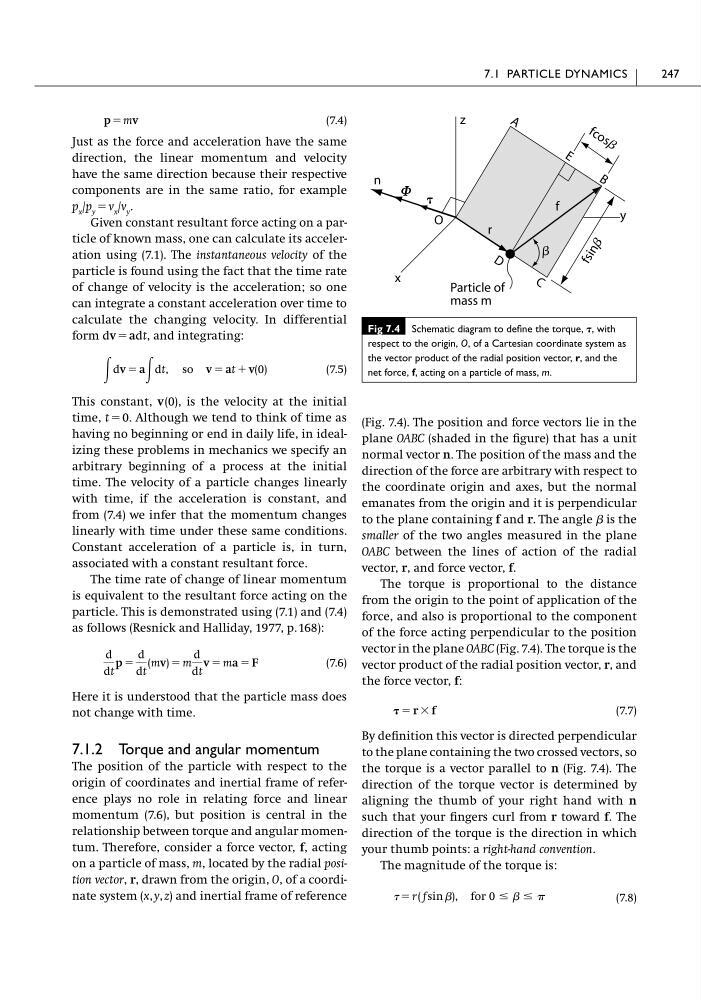
relationship between torque and angular momentum. Therefore, consider a force vector, f, acting
on a particle of mass, m, located by the radial position vector, r, drawn from the origin, O, of a coordinate system (x, y, z) and inertial frame of reference
d
dt
p ϭ
d
dt
(mv) ϭ m
d
dt
v ϭ ma ϭ F
͵ dv ϭ a ͵ dt, so v ϭ at ϩ v(0)
(Fig. 7.4). The position and force vectors lie in the
plane OABC (shaded in the figure) that has a unit
normal vector n. The position of the mass and the
direction of the force are arbitrary with respect to
the coordinate origin and axes, but the normal
emanates from the origin and it is perpendicular
to the plane containing f and r. The angle  is the
smaller of the two angles measured in the plane
OABC between the lines of action of the radial
vector, r, and force vector, f.
The torque is proportional to the distance
from the origin to the point of application of the
force, and also is proportional to the component
of the force acting perpendicular to the position
vector in the plane OABC (Fig. 7.4). The torque is the
vector product of the radial position vector, r, and
the force vector, f:
(7.7)
By definition this vector is directed perpendicular
to the plane containing the two crossed vectors, so
the torque is a vector parallel to n (Fig. 7.4). The
direction of the torque vector is determined by
aligning the thumb of your right hand with n
such that your fingers curl from r toward f. The
direction of the torque is the direction in which
your thumb points: a right-hand convention.
The magnitude of the torque is:
(7.8)
ϭ r ( f sin ), for 0 Յ  Յ
ϭ r ϫ f
7.1 PARTICLE DYNAMICS
247
Fig 7.4 Schematic diagram to define the torque, , with
respect to the origin, O, of a Cartesian coordinate system as
the vector product of the radial position vector, r, and the
net force, f, acting on a particle of mass, m.
x
y
z
A
B
C
D
E
O
f c o s 
n
⌽

f s i n 
Particle of
mass m
r
f
(7.4)
Just as the force and acceleration have the same
direction, the linear momentum and velocity
have the same direction because their respective
components are in the same ratio, for example
p x /p y ϭ v x /v y .
Given constant resultant force acting on a particle of known mass, one can calculate its acceleration using (7.1). The instantaneous velocity of the
particle is found using the fact that the time rate
of change of velocity is the acceleration; so one
can integrate a constant acceleration over time to
calculate the changing velocity. In differential
form dv ϭ adt, and integrating:
(7.5)
This constant, v(0), is the velocity at the initial
time, t ϭ 0. Although we tend to think of time as
having no beginning or end in daily life, in idealizing these problems in mechanics we specify an
arbitrary beginning of a process at the initial
time. The velocity of a particle changes linearly
with time, if the acceleration is constant, and
from (7.4) we infer that the momentum changes
linearly with time under these same conditions.
Constant acceleration of a particle is, in turn,
associated with a constant resultant force.
The time rate of change of linear momentum
is equivalent to the resultant force acting on the
particle. This is demonstrated using (7.1) and (7.4)
as follows (Resnick and Halliday, 1977, p. 168):
(7.6)
Here it is understood that the particle mass does
not change with time.
7.1.2 Torque and angular momentum
The position of the particle with respect to the
origin of coordinates and inertial frame of reference plays no role in relating force and linear
momentum (7.6), but position is central in the
relationship between torque and angular momentum. Therefore, consider a force vector, f, acting
on a particle of mass, m, located by the radial position vector, r, drawn from the origin, O, of a coordinate system (x, y, z) and inertial frame of reference
d
dt
p ϭ
d
dt
(mv) ϭ m
d
dt
v ϭ ma ϭ F
͵ dv ϭ a ͵ dt, so v ϭ at ϩ v(0)
(Fig. 7.4). The position and force vectors lie in the
plane OABC (shaded in the figure) that has a unit
normal vector n. The position of the mass and the
direction of the force are arbitrary with respect to
the coordinate origin and axes, but the normal
emanates from the origin and it is perpendicular
to the plane containing f and r. The angle  is the
smaller of the two angles measured in the plane
OABC between the lines of action of the radial
vector, r, and force vector, f.
The torque is proportional to the distance
from the origin to the point of application of the
force, and also is proportional to the component
of the force acting perpendicular to the position
vector in the plane OABC (Fig. 7.4). The torque is the
vector product of the radial position vector, r, and
the force vector, f:
(7.7)
By definition this vector is directed perpendicular
to the plane containing the two crossed vectors, so
the torque is a vector parallel to n (Fig. 7.4). The
direction of the torque vector is determined by
aligning the thumb of your right hand with n
such that your fingers curl from r toward f. The
direction of the torque is the direction in which
your thumb points: a right-hand convention.
The magnitude of the torque is:
(7.8)
ϭ r ( f sin ), for 0 Յ  Յ
ϭ r ϫ f
7.1 PARTICLE DYNAMICS
247
Fig 7.4 Schematic diagram to define the torque, , with
respect to the origin, O, of a Cartesian coordinate system as
the vector product of the radial position vector, r, and the
net force, f, acting on a particle of mass, m.
x
y
z
A
B
C
D
E
O
f c o s 
n
⌽

f s i n 
Particle of
mass m
r
f