

motion are specialized for the linear elastic solid
and the linear viscous fluid, two of the most useful
material behaviors in studies of structural geology.
Finally, we consider the equations of motion for a
body that experiences negligible accelerations
and derive the equations of equilibrium.
7.1 Particle dynamics
7.1.1 Force and linear momentum
Consider the motion of a single particle under the
action of applied forces (Resnick and Halliday,
1977, Chapter 5). In this idealized context a particle is considered to be an isolated quantity of mass
residing at a point: it has neither a size nor a shape.
Furthermore the mass is postulated to be constant
with respect to time, so conservation of mass is
satisfied by definition. The particle is positioned
with respect to a Cartesian coordinate system (x, y,
z) and kinematic quantities, such as velocity and
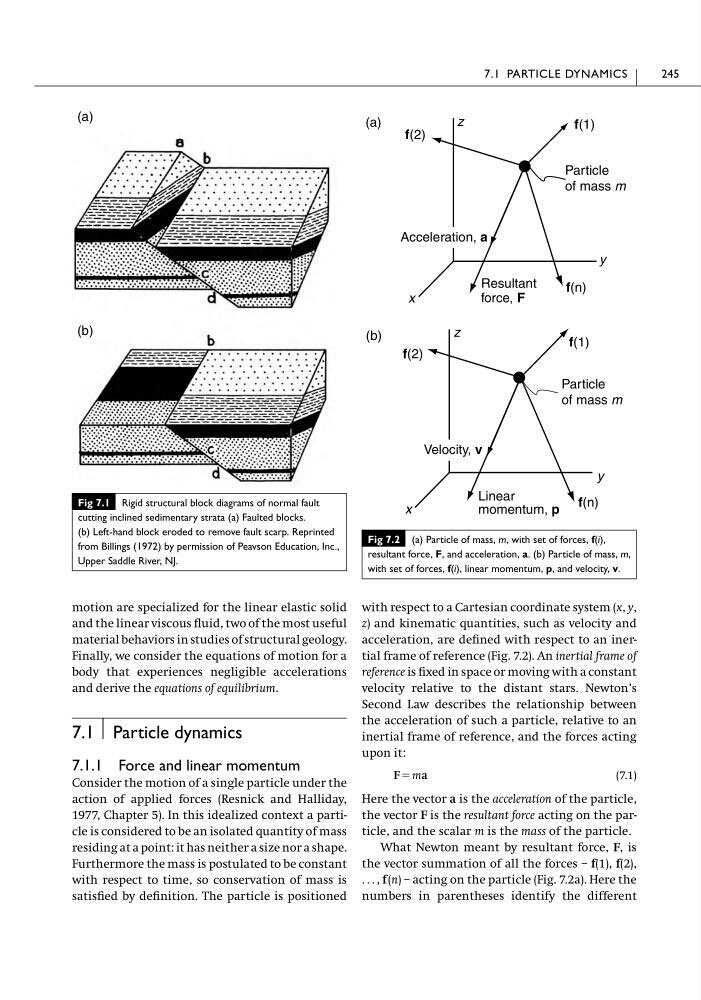
acceleration, are defined with respect to an inertial frame of reference (Fig. 7.2). An inertial frame of
reference is fixed in space or moving with a constant
velocity relative to the distant stars. Newton’s
Second Law describes the relationship between
the acceleration of such a particle, relative to an
inertial frame of reference, and the forces acting
upon it:
F ϭ ma
(7.1)
Here the vector a is the acceleration of the particle,
the vector F is the resultant force acting on the particle, and the scalar m is the mass of the particle.
What Newton meant by resultant force, F, is
the vector summation of all the forces – f(1), f(2),
. . . , f(n) – acting on the particle (Fig. 7.2a). Here the
numbers in parentheses identify the different
7.1 PARTICLE DYNAMICS
245
Fig 7.1 Rigid structural block diagrams of normal fault
cutting inclined sedimentary strata (a) Faulted blocks.
(b) Left-hand block eroded to remove fault scarp. Reprinted
from Billings (1972) by permission of Peavson Education, Inc.,
Upper Saddle River, NJ.
(a)
(b)
Fig 7.2 (a) Particle of mass, m, with set of forces, f(i),
resultant force, F, and acceleration, a. (b) Particle of mass, m,
with set of forces, f(i), linear momentum, p, and velocity, v.
x
y
z
x
y
z
(a)
(b)
Acceleration, a
Velocity, v
Particle
of mass m
f(2)
f(1)
Resultant
force, F
f(n)
f(2)
f(1)
Particle
of mass m
Linear
momentum, p
f(n)
and the linear viscous fluid, two of the most useful
material behaviors in studies of structural geology.
Finally, we consider the equations of motion for a
body that experiences negligible accelerations
and derive the equations of equilibrium.
7.1 Particle dynamics
7.1.1 Force and linear momentum
Consider the motion of a single particle under the
action of applied forces (Resnick and Halliday,
1977, Chapter 5). In this idealized context a particle is considered to be an isolated quantity of mass
residing at a point: it has neither a size nor a shape.
Furthermore the mass is postulated to be constant
with respect to time, so conservation of mass is
satisfied by definition. The particle is positioned
with respect to a Cartesian coordinate system (x, y,
z) and kinematic quantities, such as velocity and
acceleration, are defined with respect to an inertial frame of reference (Fig. 7.2). An inertial frame of
reference is fixed in space or moving with a constant
velocity relative to the distant stars. Newton’s
Second Law describes the relationship between
the acceleration of such a particle, relative to an
inertial frame of reference, and the forces acting
upon it:
F ϭ ma
(7.1)
Here the vector a is the acceleration of the particle,
the vector F is the resultant force acting on the particle, and the scalar m is the mass of the particle.
What Newton meant by resultant force, F, is
the vector summation of all the forces – f(1), f(2),
. . . , f(n) – acting on the particle (Fig. 7.2a). Here the
numbers in parentheses identify the different
7.1 PARTICLE DYNAMICS
245
Fig 7.1 Rigid structural block diagrams of normal fault
cutting inclined sedimentary strata (a) Faulted blocks.
(b) Left-hand block eroded to remove fault scarp. Reprinted
from Billings (1972) by permission of Peavson Education, Inc.,
Upper Saddle River, NJ.
(a)
(b)
Fig 7.2 (a) Particle of mass, m, with set of forces, f(i),
resultant force, F, and acceleration, a. (b) Particle of mass, m,
with set of forces, f(i), linear momentum, p, and velocity, v.
x
y
z
x
y
z
(a)
(b)
Acceleration, a
Velocity, v
Particle
of mass m
f(2)
f(1)
Resultant
force, F
f(n)
f(2)
f(1)
Particle
of mass m
Linear
momentum, p
f(n)