

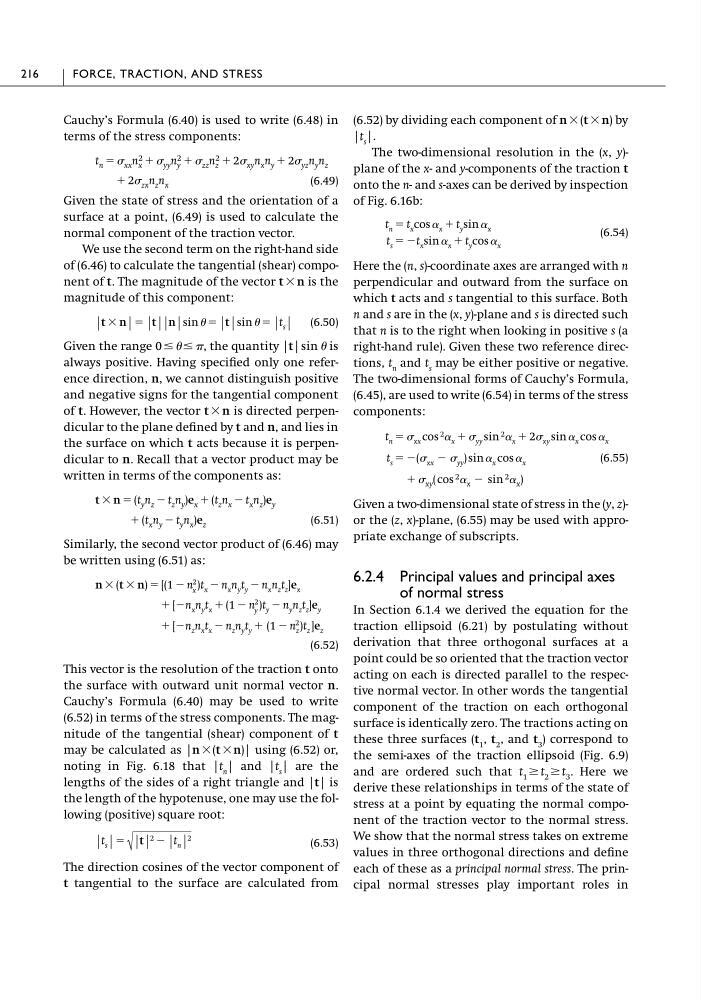
Cauchy’s Formula (6.40) is used to write (6.48) in
terms of the stress components:
(6.49)
Given the state of stress and the orientation of a
surface at a point, (6.49) is used to calculate the
normal component of the traction vector.
We use the second term on the right-hand side
of (6.46) to calculate the tangential (shear) component of t. The magnitude of the vector t ϫ n is the
magnitude of this component:
(6.50)
Given the range 0 Յ Յ , the quantity |t| sin is
always positive. Having specified only one reference direction, n, we cannot distinguish positive
and negative signs for the tangential component
of t. However, the vector t ϫ n is directed perpendicular to the plane defined by t and n, and lies in
the surface on which t acts because it is perpendicular to n. Recall that a vector product may be
written in terms of the components as:
(6.51)
Similarly, the second vector product of (6.46) may
be written using (6.51) as:
(6.52)
This vector is the resolution of the traction t onto
the surface with outward unit normal vector n.
Cauchy’s Formula (6.40) may be used to write
(6.52) in terms of the stress components. The magnitude of the tangential (shear) component of t
may be calculated as |n ϫ(t ϫn)| using (6.52) or,
noting in Fig. 6.18 that |t n | and |t s | are the
lengths of the sides of a right triangle and |t| is
the length of the hypotenuse, one may use the following (positive) square root:
(6.53)
The direction cosines of the vector component of
t tangential to the surface are calculated from
|t s | ϭ √ |t|
2 Ϫ |t n |
2
ϩ [Ϫn z n x t x Ϫ n z n y t y ϩ (1 Ϫ n
2
z )t z ]e z
ϩ [Ϫn x n y t x ϩ (1 Ϫ n
2
y
)t y Ϫ n y n z t z ]e y
n ϫ (t ϫ n) ϭ [(1 Ϫ n
2
x
)t x Ϫ n x n y t y Ϫ n x n z t z ]e x
ϩ (t x n y Ϫ t y n x )e z
t ϫ n ϭ (t y n z Ϫ t z n y )e x ϩ (t z n x Ϫ t x n z )e y
|t ϫ n| ϭ |t||n| sin ϭ |t| sin ϭ |t s |
ϩ 2 zx n z n x
t n ϭ xx n 2
x ϩ yy n 2
y ϩ zz n 2
z ϩ 2 xy n x n y ϩ 2 yz n y n z
(6.52) by dividing each component of n ϫ (t ϫ n) by
|t s |.
The two-dimensional resolution in the (x, y)plane of the x- and y-components of the traction t
onto the n- and s-axes can be derived by inspection
of Fig. 6.16b:
(6.54)
Here the (n, s)-coordinate axes are arranged with n
perpendicular and outward from the surface on
which t acts and s tangential to this surface. Both
n and s are in the (x, y)-plane and s is directed such
that n is to the right when looking in positive s (a
right-hand rule). Given these two reference directions, t n and t s may be either positive or negative.
The two-dimensional forms of Cauchy’s Formula,
(6.45), are used to write (6.54) in terms of the stress
components:
(6.55)
Given a two-dimensional state of stress in the (y, z)or the (z, x)-plane, (6.55) may be used with appropriate exchange of subscripts.
6.2.4 Principal values and principal axes
of normal stress
In Section 6.1.4 we derived the equation for the
traction ellipsoid (6.21) by postulating without
derivation that three orthogonal surfaces at a
point could be so oriented that the traction vector
acting on each is directed parallel to the respective normal vector. In other words the tangential
component of the traction on each orthogonal
surface is identically zero. The tractions acting on
these three surfaces (t 1 , t 2 , and t 3 ) correspond to
the semi-axes of the traction ellipsoid (Fig. 6.9)
and are ordered such that t 1 Ն t 2 Ն t 3 . Here we
derive these relationships in terms of the state of
stress at a point by equating the normal component of the traction vector to the normal stress.
We show that the normal stress takes on extreme
values in three orthogonal directions and define
each of these as a principal normal stress. The principal normal stresses play important roles in
ϩ xy ( cos 2 ␣ x Ϫ sin 2 ␣ x )
t s ϭ Ϫ( xx Ϫ yy ) sin ␣ x cos ␣ x
t n ϭ xx cos 2 ␣ x ϩ yy sin 2 ␣ x ϩ 2 xy sin ␣ x cos ␣ x
t n ϭ t x cos ␣ x ϩ t y sin ␣ x
t s ϭ Ϫt x sin ␣ x ϩ t y cos ␣ x
216
FORCE, TRACTION, AND STRESS
terms of the stress components:
(6.49)
Given the state of stress and the orientation of a
surface at a point, (6.49) is used to calculate the
normal component of the traction vector.
We use the second term on the right-hand side
of (6.46) to calculate the tangential (shear) component of t. The magnitude of the vector t ϫ n is the
magnitude of this component:
(6.50)
Given the range 0 Յ Յ , the quantity |t| sin is
always positive. Having specified only one reference direction, n, we cannot distinguish positive
and negative signs for the tangential component
of t. However, the vector t ϫ n is directed perpendicular to the plane defined by t and n, and lies in
the surface on which t acts because it is perpendicular to n. Recall that a vector product may be
written in terms of the components as:
(6.51)
Similarly, the second vector product of (6.46) may
be written using (6.51) as:
(6.52)
This vector is the resolution of the traction t onto
the surface with outward unit normal vector n.
Cauchy’s Formula (6.40) may be used to write
(6.52) in terms of the stress components. The magnitude of the tangential (shear) component of t
may be calculated as |n ϫ(t ϫn)| using (6.52) or,
noting in Fig. 6.18 that |t n | and |t s | are the
lengths of the sides of a right triangle and |t| is
the length of the hypotenuse, one may use the following (positive) square root:
(6.53)
The direction cosines of the vector component of
t tangential to the surface are calculated from
|t s | ϭ √ |t|
2 Ϫ |t n |
2
ϩ [Ϫn z n x t x Ϫ n z n y t y ϩ (1 Ϫ n
2
z )t z ]e z
ϩ [Ϫn x n y t x ϩ (1 Ϫ n
2
y
)t y Ϫ n y n z t z ]e y
n ϫ (t ϫ n) ϭ [(1 Ϫ n
2
x
)t x Ϫ n x n y t y Ϫ n x n z t z ]e x
ϩ (t x n y Ϫ t y n x )e z
t ϫ n ϭ (t y n z Ϫ t z n y )e x ϩ (t z n x Ϫ t x n z )e y
|t ϫ n| ϭ |t||n| sin ϭ |t| sin ϭ |t s |
ϩ 2 zx n z n x
t n ϭ xx n 2
x ϩ yy n 2
y ϩ zz n 2
z ϩ 2 xy n x n y ϩ 2 yz n y n z
(6.52) by dividing each component of n ϫ (t ϫ n) by
|t s |.
The two-dimensional resolution in the (x, y)plane of the x- and y-components of the traction t
onto the n- and s-axes can be derived by inspection
of Fig. 6.16b:
(6.54)
Here the (n, s)-coordinate axes are arranged with n
perpendicular and outward from the surface on
which t acts and s tangential to this surface. Both
n and s are in the (x, y)-plane and s is directed such
that n is to the right when looking in positive s (a
right-hand rule). Given these two reference directions, t n and t s may be either positive or negative.
The two-dimensional forms of Cauchy’s Formula,
(6.45), are used to write (6.54) in terms of the stress
components:
(6.55)
Given a two-dimensional state of stress in the (y, z)or the (z, x)-plane, (6.55) may be used with appropriate exchange of subscripts.
6.2.4 Principal values and principal axes
of normal stress
In Section 6.1.4 we derived the equation for the
traction ellipsoid (6.21) by postulating without
derivation that three orthogonal surfaces at a
point could be so oriented that the traction vector
acting on each is directed parallel to the respective normal vector. In other words the tangential
component of the traction on each orthogonal
surface is identically zero. The tractions acting on
these three surfaces (t 1 , t 2 , and t 3 ) correspond to
the semi-axes of the traction ellipsoid (Fig. 6.9)
and are ordered such that t 1 Ն t 2 Ն t 3 . Here we
derive these relationships in terms of the state of
stress at a point by equating the normal component of the traction vector to the normal stress.
We show that the normal stress takes on extreme
values in three orthogonal directions and define
each of these as a principal normal stress. The principal normal stresses play important roles in
ϩ xy ( cos 2 ␣ x Ϫ sin 2 ␣ x )
t s ϭ Ϫ( xx Ϫ yy ) sin ␣ x cos ␣ x
t n ϭ xx cos 2 ␣ x ϩ yy sin 2 ␣ x ϩ 2 xy sin ␣ x cos ␣ x
t n ϭ t x cos ␣ x ϩ t y sin ␣ x
t s ϭ Ϫt x sin ␣ x ϩ t y cos ␣ x
216
FORCE, TRACTION, AND STRESS