

theories of failure, fracture, and faulting of rock,
topics that we consider in later chapters.
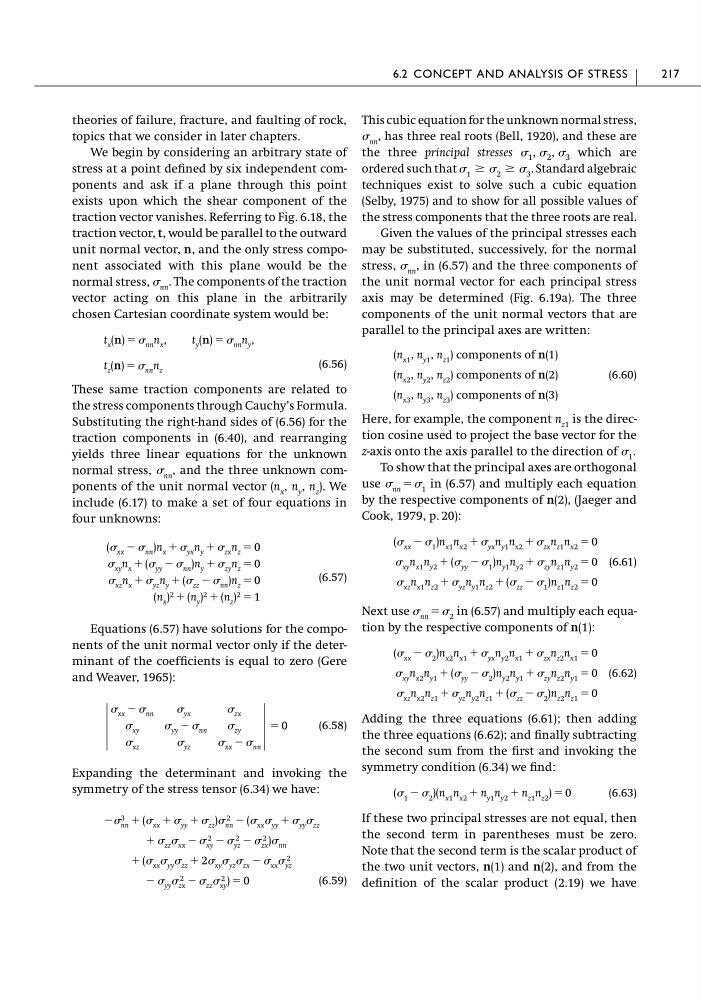
We begin by considering an arbitrary state of
stress at a point defined by six independent components and ask if a plane through this point
exists upon which the shear component of the
traction vector vanishes. Referring to Fig. 6.18, the
traction vector, t, would be parallel to the outward
unit normal vector, n, and the only stress component associated with this plane would be the
normal stress, � nn . The components of the traction
vector acting on this plane in the arbitrarily
chosen Cartesian coordinate system would be:
(6.56)
These same traction components are related to
the stress components through Cauchy’s Formula.
Substituting the right-hand sides of (6.56) for the
traction components in (6.40), and rearranging
yields three linear equations for the unknown
normal stress, � nn , and the three unknown components of the unit normal vector (n x , n y , n z ). We
include (6.17) to make a set of four equations in
four unknowns:
(6.57)
Equations (6.57) have solutions for the components of the unit normal vector only if the determinant of the coefficients is equal to zero (Gere
and Weaver, 1965):
(6.58)
Expanding the determinant and invoking the
symmetry of the stress tensor (6.34) we have:
(6.59)
� � yy � 2
zx � � zz � 2
xy ) � 0
� (� xx � yy � zz � 2� xy � yz � zx � � xx � 2
yz
� � zz � xx � � 2
xy � � 2
yz � � 2
zx )� nn
�� 3
nn � (� xx � � yy � � zz )� 2
nn � (� xx � yy � � yy � zz
|
� xx � � nn
� xy
� xz
� yx
� yy � � nn
� yz
� zx
� zy
� xx � � nn
|
� 0
(� xx � � nn )n x � � yx n y � � zx n z � 0
� xy n x � (� yy � � nn )n y � � zy n z � 0
� xz n x � � yz n y � (� zz � � nn )n z � 0
(n x ) 2 � (n y ) 2 � (n z ) 2 � 1
t z (n) � � nn n z
t x (n) � � nn n x , t y (n) � � nn n y ,
This cubic equation for the unknown normal stress,
� nn , has three real roots (Bell, 1920), and these are
the three principal stresses
which are
ordered such that
Standard algebraic
techniques exist to solve such a cubic equation
(Selby, 1975) and to show for all possible values of
the stress components that the three roots are real.
Given the values of the principal stresses each
may be substituted, successively, for the normal
stress, � nn , in (6.57) and the three components of
the unit normal vector for each principal stress
axis may be determined (Fig. 6.19a). The three
components of the unit normal vectors that are
parallel to the principal axes are written:
(6.60)
Here, for example, the component n z1 is the direction cosine used to project the base vector for the
z-axis onto the axis parallel to the direction of � 1 .
To show that the principal axes are orthogonal
use � nn � � 1 in (6.57) and multiply each equation
by the respective components of n(2), (Jaeger and
Cook, 1979, p. 20):
(6.61)
Next use � nn � � 2 in (6.57) and multiply each equation by the respective components of n(1):
(6.62)
Adding the three equations (6.61); then adding
the three equations (6.62); and finally subtracting
the second sum from the first and invoking the
symmetry condition (6.34) we find:
(6.63)
If these two principal stresses are not equal, then
the second term in parentheses must be zero.
Note that the second term is the scalar product of
the two unit vectors, n(1) and n(2), and from the
definition of the scalar product (2.19) we have
(� 1 � � 2 )(n x1 n x2 � n y1 n y2 � n z1 n z2 ) � 0
� xz n x2 n z1 � � yz n y2 n z1 � (� zz � � 2 )n z2 n z1 � 0
� xy n x2 n y1 � (� yy � � 2 )n y2 n y1 � � zy n z2 n y1 � 0
(� xx � � 2 )n x2 n x1 � � yx n y2 n x1 � � zx n z2 n x1 � 0
� xz n x1 n z2 � � yz n y1 n z2 � (� zz � � 1 )n z1 n z2 � 0
� xy n x1 n y2 � (� yy � � 1 )n y1 n y2 � � zy n z1 n y2 � 0
(� xx � � 1 )n x1 n x2 � � yx n y1 n x2 � � zx n z1 n x2 � 0
(n x3 , n y3 , n z3 ) components of n(3)
(n x2 , n y2 , n z2 ) components of n(2)
(n x1 , n y1 , n z1 ) components of n(1)
� 1 � � 2 � � 3 .
� 1 , � 2 , � 3
6.2 CONCEPT AND ANALYSIS OF STRESS
217
topics that we consider in later chapters.
We begin by considering an arbitrary state of
stress at a point defined by six independent components and ask if a plane through this point
exists upon which the shear component of the
traction vector vanishes. Referring to Fig. 6.18, the
traction vector, t, would be parallel to the outward
unit normal vector, n, and the only stress component associated with this plane would be the
normal stress, � nn . The components of the traction
vector acting on this plane in the arbitrarily
chosen Cartesian coordinate system would be:
(6.56)
These same traction components are related to
the stress components through Cauchy’s Formula.
Substituting the right-hand sides of (6.56) for the
traction components in (6.40), and rearranging
yields three linear equations for the unknown
normal stress, � nn , and the three unknown components of the unit normal vector (n x , n y , n z ). We
include (6.17) to make a set of four equations in
four unknowns:
(6.57)
Equations (6.57) have solutions for the components of the unit normal vector only if the determinant of the coefficients is equal to zero (Gere
and Weaver, 1965):
(6.58)
Expanding the determinant and invoking the
symmetry of the stress tensor (6.34) we have:
(6.59)
� � yy � 2
zx � � zz � 2
xy ) � 0
� (� xx � yy � zz � 2� xy � yz � zx � � xx � 2
yz
� � zz � xx � � 2
xy � � 2
yz � � 2
zx )� nn
�� 3
nn � (� xx � � yy � � zz )� 2
nn � (� xx � yy � � yy � zz
|
� xx � � nn
� xy
� xz
� yx
� yy � � nn
� yz
� zx
� zy
� xx � � nn
|
� 0
(� xx � � nn )n x � � yx n y � � zx n z � 0
� xy n x � (� yy � � nn )n y � � zy n z � 0
� xz n x � � yz n y � (� zz � � nn )n z � 0
(n x ) 2 � (n y ) 2 � (n z ) 2 � 1
t z (n) � � nn n z
t x (n) � � nn n x , t y (n) � � nn n y ,
This cubic equation for the unknown normal stress,
� nn , has three real roots (Bell, 1920), and these are
the three principal stresses
which are
ordered such that
Standard algebraic
techniques exist to solve such a cubic equation
(Selby, 1975) and to show for all possible values of
the stress components that the three roots are real.
Given the values of the principal stresses each
may be substituted, successively, for the normal
stress, � nn , in (6.57) and the three components of
the unit normal vector for each principal stress
axis may be determined (Fig. 6.19a). The three
components of the unit normal vectors that are
parallel to the principal axes are written:
(6.60)
Here, for example, the component n z1 is the direction cosine used to project the base vector for the
z-axis onto the axis parallel to the direction of � 1 .
To show that the principal axes are orthogonal
use � nn � � 1 in (6.57) and multiply each equation
by the respective components of n(2), (Jaeger and
Cook, 1979, p. 20):
(6.61)
Next use � nn � � 2 in (6.57) and multiply each equation by the respective components of n(1):
(6.62)
Adding the three equations (6.61); then adding
the three equations (6.62); and finally subtracting
the second sum from the first and invoking the
symmetry condition (6.34) we find:
(6.63)
If these two principal stresses are not equal, then
the second term in parentheses must be zero.
Note that the second term is the scalar product of
the two unit vectors, n(1) and n(2), and from the
definition of the scalar product (2.19) we have
(� 1 � � 2 )(n x1 n x2 � n y1 n y2 � n z1 n z2 ) � 0
� xz n x2 n z1 � � yz n y2 n z1 � (� zz � � 2 )n z2 n z1 � 0
� xy n x2 n y1 � (� yy � � 2 )n y2 n y1 � � zy n z2 n y1 � 0
(� xx � � 2 )n x2 n x1 � � yx n y2 n x1 � � zx n z2 n x1 � 0
� xz n x1 n z2 � � yz n y1 n z2 � (� zz � � 1 )n z1 n z2 � 0
� xy n x1 n y2 � (� yy � � 1 )n y1 n y2 � � zy n z1 n y2 � 0
(� xx � � 1 )n x1 n x2 � � yx n y1 n x2 � � zx n z1 n x2 � 0
(n x3 , n y3 , n z3 ) components of n(3)
(n x2 , n y2 , n z2 ) components of n(2)
(n x1 , n y1 , n z1 ) components of n(1)
� 1 � � 2 � � 3 .
� 1 , � 2 , � 3
6.2 CONCEPT AND ANALYSIS OF STRESS
217