

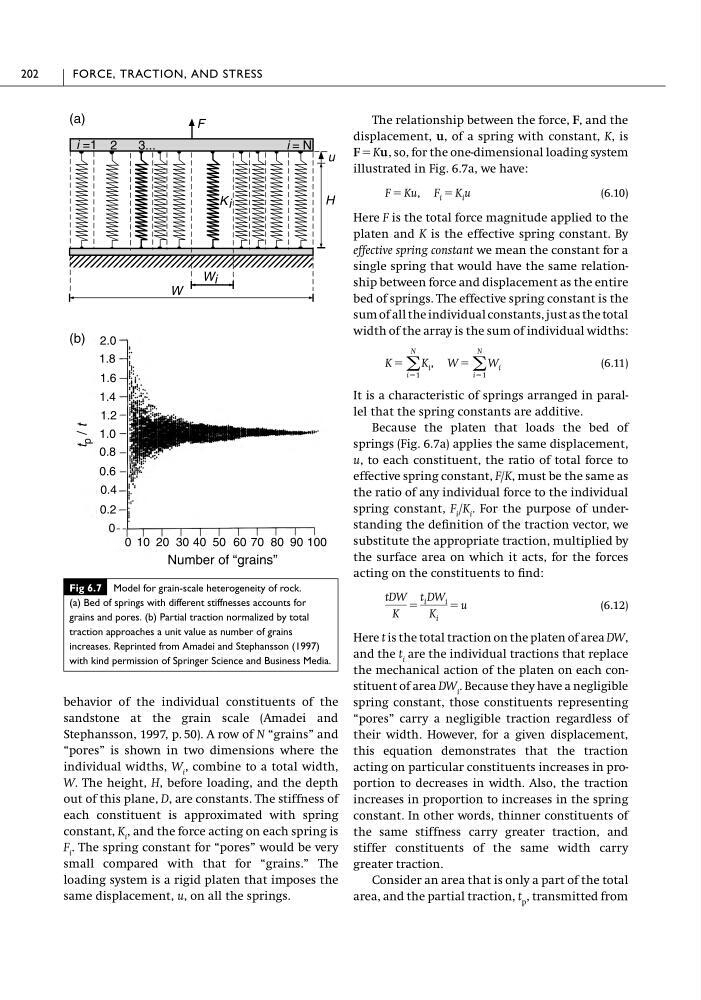
behavior of the individual constituents of the
sandstone at the grain scale (Amadei and
Stephansson, 1997, p. 50). A row of N “grains” and
“pores” is shown in two dimensions where the
individual widths, W i , combine to a total width,
W. The height, H, before loading, and the depth
out of this plane, D, are constants. The stiffness of
each constituent is approximated with spring
constant, K i , and the force acting on each spring is
F i . The spring constant for “pores” would be very
small compared with that for “grains.” The
loading system is a rigid platen that imposes the
same displacement, u, on all the springs.
The relationship between the force, F, and the
displacement, u, of a spring with constant, K, is
F ϭ Ku, so, for the one-dimensional loading system
illustrated in Fig. 6.7a, we have:
(6.10)
Here F is the total force magnitude applied to the
platen and K is the effective spring constant. By
effective spring constant we mean the constant for a
single spring that would have the same relationship between force and displacement as the entire
bed of springs. The effective spring constant is the
sum of all the individual constants, just as the total
width of the array is the sum of individual widths:
(6.11)
It is a characteristic of springs arranged in parallel that the spring constants are additive.
Because the platen that loads the bed of
springs (Fig. 6.7a) applies the same displacement,
u, to each constituent, the ratio of total force to
effective spring constant, F/K, must be the same as
the ratio of any individual force to the individual
spring constant, F i /K i . For the purpose of understanding the definition of the traction vector, we
substitute the appropriate traction, multiplied by
the surface area on which it acts, for the forces
acting on the constituents to find:
(6.12)
Here t is the total traction on the platen of area DW,
and the t i are the individual tractions that replace
the mechanical action of the platen on each constituent of area DW i . Because they have a negligible
spring constant, those constituents representing
“pores” carry a negligible traction regardless of
their width. However, for a given displacement,
this equation demonstrates that the traction
acting on particular constituents increases in proportion to decreases in width. Also, the traction
increases in proportion to increases in the spring
constant. In other words, thinner constituents of
the same stiffness carry greater traction, and
stiffer constituents of the same width carry
greater traction.
Consider an area that is only a part of the total
area, and the partial traction, t p , transmitted from
tDW
K
ϭ
t i DW i
K i
ϭ u
K ϭ ͚
N
iϭ1
K i , W ϭ ͚
N
iϭ1
W i
F ϭ Ku, F i ϭ K i u
202
FORCE, TRACTION, AND STRESS
Fig 6.7 Model for grain-scale heterogeneity of rock.
(a) Bed of springs with different stiffnesses accounts for
grains and pores. (b) Partial traction normalized by total
traction approaches a unit value as number of grains
increases. Reprinted from Amadei and Stephansson (1997)
with kind permission of Springer Science and Business Media.
W
W i
H
K i
i =1 2
3...
i = N
F
u
(a)
2.0
1.8
0.6
1.6
1.4
1.2
1.0
0.8
0.4
0.2
0
0 10 20 30 40 50 60 70 80 90 100
t
p /
t
Number of “grains”
(b)
sandstone at the grain scale (Amadei and
Stephansson, 1997, p. 50). A row of N “grains” and
“pores” is shown in two dimensions where the
individual widths, W i , combine to a total width,
W. The height, H, before loading, and the depth
out of this plane, D, are constants. The stiffness of
each constituent is approximated with spring
constant, K i , and the force acting on each spring is
F i . The spring constant for “pores” would be very
small compared with that for “grains.” The
loading system is a rigid platen that imposes the
same displacement, u, on all the springs.
The relationship between the force, F, and the
displacement, u, of a spring with constant, K, is
F ϭ Ku, so, for the one-dimensional loading system
illustrated in Fig. 6.7a, we have:
(6.10)
Here F is the total force magnitude applied to the
platen and K is the effective spring constant. By
effective spring constant we mean the constant for a
single spring that would have the same relationship between force and displacement as the entire
bed of springs. The effective spring constant is the
sum of all the individual constants, just as the total
width of the array is the sum of individual widths:
(6.11)
It is a characteristic of springs arranged in parallel that the spring constants are additive.
Because the platen that loads the bed of
springs (Fig. 6.7a) applies the same displacement,
u, to each constituent, the ratio of total force to
effective spring constant, F/K, must be the same as
the ratio of any individual force to the individual
spring constant, F i /K i . For the purpose of understanding the definition of the traction vector, we
substitute the appropriate traction, multiplied by
the surface area on which it acts, for the forces
acting on the constituents to find:
(6.12)
Here t is the total traction on the platen of area DW,
and the t i are the individual tractions that replace
the mechanical action of the platen on each constituent of area DW i . Because they have a negligible
spring constant, those constituents representing
“pores” carry a negligible traction regardless of
their width. However, for a given displacement,
this equation demonstrates that the traction
acting on particular constituents increases in proportion to decreases in width. Also, the traction
increases in proportion to increases in the spring
constant. In other words, thinner constituents of
the same stiffness carry greater traction, and
stiffer constituents of the same width carry
greater traction.
Consider an area that is only a part of the total
area, and the partial traction, t p , transmitted from
tDW
K
ϭ
t i DW i
K i
ϭ u
K ϭ ͚
N
iϭ1
K i , W ϭ ͚
N
iϭ1
W i
F ϭ Ku, F i ϭ K i u
202
FORCE, TRACTION, AND STRESS
Fig 6.7 Model for grain-scale heterogeneity of rock.
(a) Bed of springs with different stiffnesses accounts for
grains and pores. (b) Partial traction normalized by total
traction approaches a unit value as number of grains
increases. Reprinted from Amadei and Stephansson (1997)
with kind permission of Springer Science and Business Media.
W
W i
H
K i
i =1 2
3...
i = N
F
u
(a)
2.0
1.8
0.6
1.6
1.4
1.2
1.0
0.8
0.4
0.2
0
0 10 20 30 40 50 60 70 80 90 100
t
p /
t
Number of “grains”
(b)