

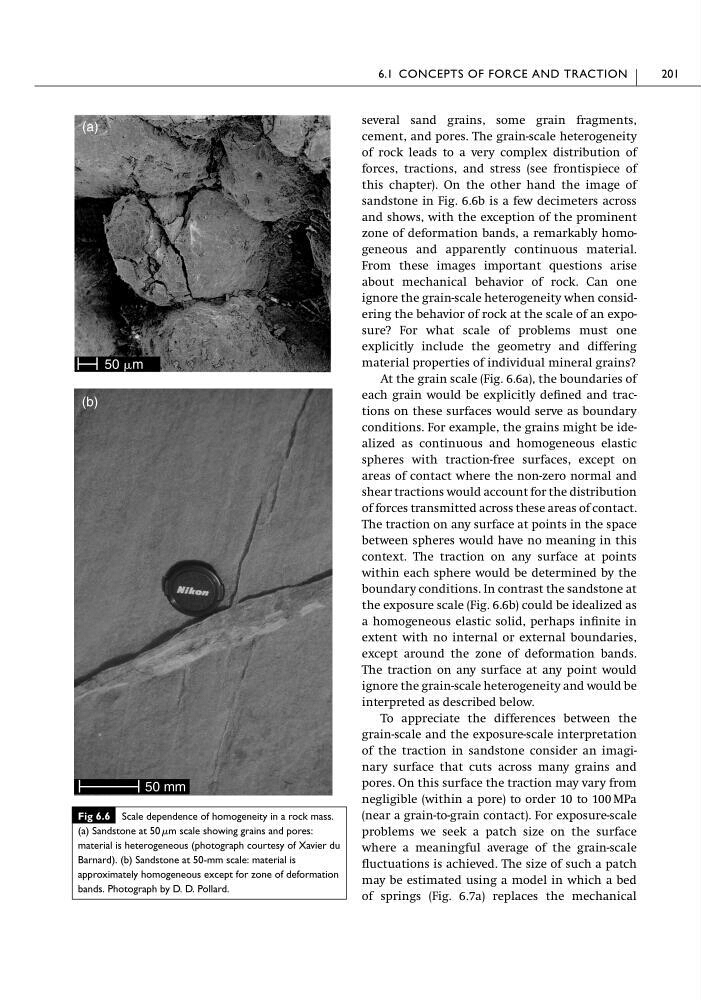
several sand grains, some grain fragments,
cement, and pores. The grain-scale heterogeneity
of rock leads to a very complex distribution of
forces, tractions, and stress (see frontispiece of
this chapter). On the other hand the image of
sandstone in Fig. 6.6b is a few decimeters across
and shows, with the exception of the prominent
zone of deformation bands, a remarkably homogeneous and apparently continuous material.
From these images important questions arise
about mechanical behavior of rock. Can one
ignore the grain-scale heterogeneity when considering the behavior of rock at the scale of an exposure? For what scale of problems must one
explicitly include the geometry and differing
material properties of individual mineral grains?
At the grain scale (Fig. 6.6a), the boundaries of
each grain would be explicitly defined and tractions on these surfaces would serve as boundary
conditions. For example, the grains might be idealized as continuous and homogeneous elastic
spheres with traction-free surfaces, except on
areas of contact where the non-zero normal and
shear tractions would account for the distribution
of forces transmitted across these areas of contact.
The traction on any surface at points in the space
between spheres would have no meaning in this
context. The traction on any surface at points
within each sphere would be determined by the
boundary conditions. In contrast the sandstone at
the exposure scale (Fig. 6.6b) could be idealized as
a homogeneous elastic solid, perhaps infinite in
extent with no internal or external boundaries,
except around the zone of deformation bands.
The traction on any surface at any point would
ignore the grain-scale heterogeneity and would be
interpreted as described below.
To appreciate the differences between the
grain-scale and the exposure-scale interpretation
of the traction in sandstone consider an imaginary surface that cuts across many grains and
pores. On this surface the traction may vary from
negligible (within a pore) to order 10 to 100 MPa
(near a grain-to-grain contact). For exposure-scale
problems we seek a patch size on the surface
where a meaningful average of the grain-scale
fluctuations is achieved. The size of such a patch
may be estimated using a model in which a bed
of springs (Fig. 6.7a) replaces the mechanical
6.1 CONCEPTS OF FORCE AND TRACTION
201
Fig 6.6 Scale dependence of homogeneity in a rock mass.
(a) Sandstone at 50m scale showing grains and pores:
material is heterogeneous (photograph courtesy of Xavier du
Barnard). (b) Sandstone at 50-mm scale: material is
approximately homogeneous except for zone of deformation
bands. Photograph by D. D. Pollard.
50 m
(a)
(b)
50 mm
cement, and pores. The grain-scale heterogeneity
of rock leads to a very complex distribution of
forces, tractions, and stress (see frontispiece of
this chapter). On the other hand the image of
sandstone in Fig. 6.6b is a few decimeters across
and shows, with the exception of the prominent
zone of deformation bands, a remarkably homogeneous and apparently continuous material.
From these images important questions arise
about mechanical behavior of rock. Can one
ignore the grain-scale heterogeneity when considering the behavior of rock at the scale of an exposure? For what scale of problems must one
explicitly include the geometry and differing
material properties of individual mineral grains?
At the grain scale (Fig. 6.6a), the boundaries of
each grain would be explicitly defined and tractions on these surfaces would serve as boundary
conditions. For example, the grains might be idealized as continuous and homogeneous elastic
spheres with traction-free surfaces, except on
areas of contact where the non-zero normal and
shear tractions would account for the distribution
of forces transmitted across these areas of contact.
The traction on any surface at points in the space
between spheres would have no meaning in this
context. The traction on any surface at points
within each sphere would be determined by the
boundary conditions. In contrast the sandstone at
the exposure scale (Fig. 6.6b) could be idealized as
a homogeneous elastic solid, perhaps infinite in
extent with no internal or external boundaries,
except around the zone of deformation bands.
The traction on any surface at any point would
ignore the grain-scale heterogeneity and would be
interpreted as described below.
To appreciate the differences between the
grain-scale and the exposure-scale interpretation
of the traction in sandstone consider an imaginary surface that cuts across many grains and
pores. On this surface the traction may vary from
negligible (within a pore) to order 10 to 100 MPa
(near a grain-to-grain contact). For exposure-scale
problems we seek a patch size on the surface
where a meaningful average of the grain-scale
fluctuations is achieved. The size of such a patch
may be estimated using a model in which a bed
of springs (Fig. 6.7a) replaces the mechanical
6.1 CONCEPTS OF FORCE AND TRACTION
201
Fig 6.6 Scale dependence of homogeneity in a rock mass.
(a) Sandstone at 50m scale showing grains and pores:
material is heterogeneous (photograph courtesy of Xavier du
Barnard). (b) Sandstone at 50-mm scale: material is
approximately homogeneous except for zone of deformation
bands. Photograph by D. D. Pollard.
50 m
(a)
(b)
50 mm