

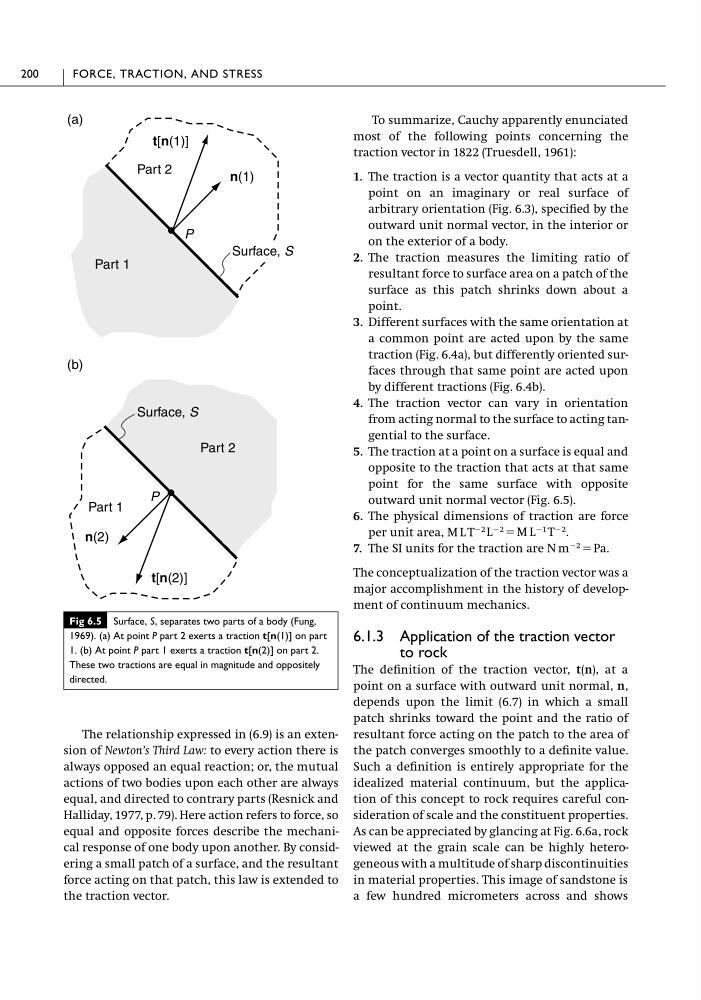
The relationship expressed in (6.9) is an extension of Newton’s Third Law: to every action there is
always opposed an equal reaction; or, the mutual
actions of two bodies upon each other are always
equal, and directed to contrary parts (Resnick and
Halliday, 1977, p. 79). Here action refers to force, so
equal and opposite forces describe the mechanical response of one body upon another. By considering a small patch of a surface, and the resultant
force acting on that patch, this law is extended to
the traction vector.
To summarize, Cauchy apparently enunciated
most of the following points concerning the
traction vector in 1822 (Truesdell, 1961):
1. The traction is a vector quantity that acts at a
point on an imaginary or real surface of
arbitrary orientation (Fig. 6.3), specified by the
outward unit normal vector, in the interior or
on the exterior of a body.
2. The traction measures the limiting ratio of
resultant force to surface area on a patch of the
surface as this patch shrinks down about a
point.
3. Different surfaces with the same orientation at
a common point are acted upon by the same
traction (Fig. 6.4a), but differently oriented surfaces through that same point are acted upon
by different tractions (Fig. 6.4b).
4. The traction vector can vary in orientation
from acting normal to the surface to acting tangential to the surface.
5. The traction at a point on a surface is equal and
opposite to the traction that acts at that same
point for the same surface with opposite
outward unit normal vector (Fig. 6.5).
6. The physical dimensions of traction are force
per unit area, M L T
Ϫ2 L
Ϫ2 ϭ M L
Ϫ1 T
Ϫ2 .
7. The SI units for the traction are N m
Ϫ2 ϭ Pa.
The conceptualization of the traction vector was a
major accomplishment in the history of development of continuum mechanics.
6.1.3 Application of the traction vector
to rock
The definition of the traction vector, t(n), at a
point on a surface with outward unit normal, n,
depends upon the limit (6.7) in which a small
patch shrinks toward the point and the ratio of
resultant force acting on the patch to the area of
the patch converges smoothly to a definite value.
Such a definition is entirely appropriate for the
idealized material continuum, but the application of this concept to rock requires careful consideration of scale and the constituent properties.
As can be appreciated by glancing at Fig. 6.6a, rock
viewed at the grain scale can be highly heterogeneous with a multitude of sharp discontinuities
in material properties. This image of sandstone is
a few hundred micrometers across and shows
200
FORCE, TRACTION, AND STRESS
Fig 6.5 Surface, S, separates two parts of a body (Fung,
1969). (a) At point P part 2 exerts a traction t[n(1)] on part
1. (b) At point P part 1 exerts a traction t[n(2)] on part 2.
These two tractions are equal in magnitude and oppositely
directed.
(a)
(b)
P
P
Part 1
Part 2
Part 1
Part 2
Surface, S
Surface, S
t[n(1)]
n(1)
n(2)
t[n(2)]
always opposed an equal reaction; or, the mutual
actions of two bodies upon each other are always
equal, and directed to contrary parts (Resnick and
Halliday, 1977, p. 79). Here action refers to force, so
equal and opposite forces describe the mechanical response of one body upon another. By considering a small patch of a surface, and the resultant
force acting on that patch, this law is extended to
the traction vector.
To summarize, Cauchy apparently enunciated
most of the following points concerning the
traction vector in 1822 (Truesdell, 1961):
1. The traction is a vector quantity that acts at a
point on an imaginary or real surface of
arbitrary orientation (Fig. 6.3), specified by the
outward unit normal vector, in the interior or
on the exterior of a body.
2. The traction measures the limiting ratio of
resultant force to surface area on a patch of the
surface as this patch shrinks down about a
point.
3. Different surfaces with the same orientation at
a common point are acted upon by the same
traction (Fig. 6.4a), but differently oriented surfaces through that same point are acted upon
by different tractions (Fig. 6.4b).
4. The traction vector can vary in orientation
from acting normal to the surface to acting tangential to the surface.
5. The traction at a point on a surface is equal and
opposite to the traction that acts at that same
point for the same surface with opposite
outward unit normal vector (Fig. 6.5).
6. The physical dimensions of traction are force
per unit area, M L T
Ϫ2 L
Ϫ2 ϭ M L
Ϫ1 T
Ϫ2 .
7. The SI units for the traction are N m
Ϫ2 ϭ Pa.
The conceptualization of the traction vector was a
major accomplishment in the history of development of continuum mechanics.
6.1.3 Application of the traction vector
to rock
The definition of the traction vector, t(n), at a
point on a surface with outward unit normal, n,
depends upon the limit (6.7) in which a small
patch shrinks toward the point and the ratio of
resultant force acting on the patch to the area of
the patch converges smoothly to a definite value.
Such a definition is entirely appropriate for the
idealized material continuum, but the application of this concept to rock requires careful consideration of scale and the constituent properties.
As can be appreciated by glancing at Fig. 6.6a, rock
viewed at the grain scale can be highly heterogeneous with a multitude of sharp discontinuities
in material properties. This image of sandstone is
a few hundred micrometers across and shows
200
FORCE, TRACTION, AND STRESS
Fig 6.5 Surface, S, separates two parts of a body (Fung,
1969). (a) At point P part 2 exerts a traction t[n(1)] on part
1. (b) At point P part 1 exerts a traction t[n(2)] on part 2.
These two tractions are equal in magnitude and oppositely
directed.
(a)
(b)
P
P
Part 1
Part 2
Part 1
Part 2
Surface, S
Surface, S
t[n(1)]
n(1)
n(2)
t[n(2)]