

vector X with components X i ϭ (X 1 , X 2 , X 3 ) in the
initial state that is located by position vector x with
components x i ϭ (x 1 , x 2 , x 3 ) in the current state. An
arbitrarily oriented material line extending from
that particle in the initial state along the infinitesimal vector, dX, with components (dX 1 , dX 2 , dX 3 ) is
translated, rotated, and stretched to lie along the
infinitesimal vector, dx, with components (dx 1 ,
dx 2 , dx 3 ) in the current state. Infinitesimal refers to
the fact that, if the vector were not infinitesimal in
length, the material line element would be curved
in the current state and the vector dx would not
provide an adequate representation. In other
words, the neighborhood of the particle is so
defined that the deformation within it is reasonably taken as homogeneous.
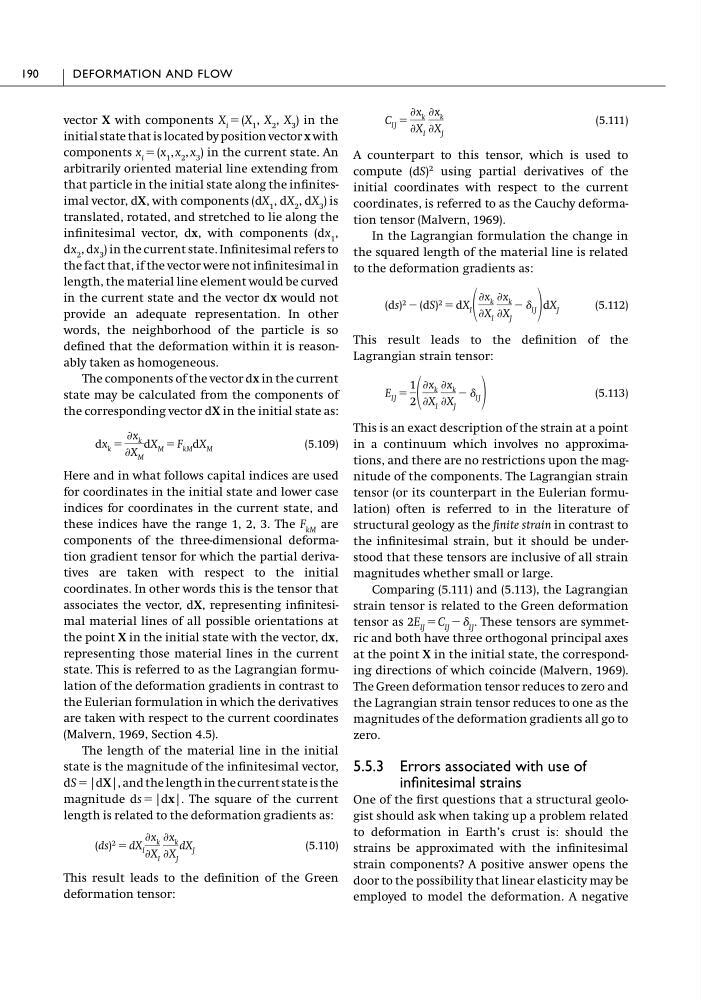
The components of the vector dx in the current
state may be calculated from the components of
the corresponding vector dX in the initial state as:
(5.109)
Here and in what follows capital indices are used
for coordinates in the initial state and lower case
indices for coordinates in the current state, and
these indices have the range 1, 2, 3. The F kM are
components of the three-dimensional deformation gradient tensor for which the partial derivatives are taken with respect to the initial
coordinates. In other words this is the tensor that
associates the vector, dX, representing infinitesimal material lines of all possible orientations at
the point X in the initial state with the vector, dx,
representing those material lines in the current
state. This is referred to as the Lagrangian formulation of the deformation gradients in contrast to
the Eulerian formulation in which the derivatives
are taken with respect to the current coordinates
(Malvern, 1969, Section 4.5).
The length of the material line in the initial
state is the magnitude of the infinitesimal vector,
dS ϭ |dX|, and the length in the current state is the
magnitude ds ϭ |dx|. The square of the current
length is related to the deformation gradients as:
(5.110)
This result leads to the definition of the Green
deformation tensor:
(ds) 2 ϭ dX I
Ѩx k
ѨX I
Ѩx k
ѨX J
dX J
dx k ϭ
Ѩx k
ѨX M
dX M ϭ F kM dX M
(5.111)
A counterpart to this tensor, which is used to
compute (dS)
2 using partial derivatives of the
initial coordinates with respect to the current
coordinates, is referred to as the Cauchy deformation tensor (Malvern, 1969).
In the Lagrangian formulation the change in
the squared length of the material line is related
to the deformation gradients as:
(5.112)
This result leads to the definition of the
Lagrangian strain tensor:
(5.113)
This is an exact description of the strain at a point
in a continuum which involves no approximations, and there are no restrictions upon the magnitude of the components. The Lagrangian strain
tensor (or its counterpart in the Eulerian formulation) often is referred to in the literature of
structural geology as the finite strain in contrast to
the infinitesimal strain, but it should be understood that these tensors are inclusive of all strain
magnitudes whether small or large.
Comparing (5.111) and (5.113), the Lagrangian
strain tensor is related to the Green deformation
tensor as 2E IJ ϭ C IJ Ϫ ␦ IJ . These tensors are symmetric and both have three orthogonal principal axes
at the point X in the initial state, the corresponding directions of which coincide (Malvern, 1969).
The Green deformation tensor reduces to zero and
the Lagrangian strain tensor reduces to one as the
magnitudes of the deformation gradients all go to
zero.
5.5.3 Errors associated with use of
infinitesimal strains
One of the first questions that a structural geologist should ask when taking up a problem related
to deformation in Earth’s crust is: should the
strains be approximated with the infinitesimal
strain components? A positive answer opens the
door to the possibility that linear elasticity may be
employed to model the deformation. A negative
E IJ ϭ
1
2
Ѩx k
ѨX I
Ѩx k
ѨX J
Ϫ ␦ IJ
(ds) 2 Ϫ (dS) 2 ϭ dX I
Ѩx k
ѨX I
Ѩx k
ѨX J
Ϫ ␦ IJ
dX J
C IJ ϭ
Ѩx k
ѨX I
Ѩx k
ѨX J
190
DEFORMATION AND FLOW
initial state that is located by position vector x with
components x i ϭ (x 1 , x 2 , x 3 ) in the current state. An
arbitrarily oriented material line extending from
that particle in the initial state along the infinitesimal vector, dX, with components (dX 1 , dX 2 , dX 3 ) is
translated, rotated, and stretched to lie along the
infinitesimal vector, dx, with components (dx 1 ,
dx 2 , dx 3 ) in the current state. Infinitesimal refers to
the fact that, if the vector were not infinitesimal in
length, the material line element would be curved
in the current state and the vector dx would not
provide an adequate representation. In other
words, the neighborhood of the particle is so
defined that the deformation within it is reasonably taken as homogeneous.
The components of the vector dx in the current
state may be calculated from the components of
the corresponding vector dX in the initial state as:
(5.109)
Here and in what follows capital indices are used
for coordinates in the initial state and lower case
indices for coordinates in the current state, and
these indices have the range 1, 2, 3. The F kM are
components of the three-dimensional deformation gradient tensor for which the partial derivatives are taken with respect to the initial
coordinates. In other words this is the tensor that
associates the vector, dX, representing infinitesimal material lines of all possible orientations at
the point X in the initial state with the vector, dx,
representing those material lines in the current
state. This is referred to as the Lagrangian formulation of the deformation gradients in contrast to
the Eulerian formulation in which the derivatives
are taken with respect to the current coordinates
(Malvern, 1969, Section 4.5).
The length of the material line in the initial
state is the magnitude of the infinitesimal vector,
dS ϭ |dX|, and the length in the current state is the
magnitude ds ϭ |dx|. The square of the current
length is related to the deformation gradients as:
(5.110)
This result leads to the definition of the Green
deformation tensor:
(ds) 2 ϭ dX I
Ѩx k
ѨX I
Ѩx k
ѨX J
dX J
dx k ϭ
Ѩx k
ѨX M
dX M ϭ F kM dX M
(5.111)
A counterpart to this tensor, which is used to
compute (dS)
2 using partial derivatives of the
initial coordinates with respect to the current
coordinates, is referred to as the Cauchy deformation tensor (Malvern, 1969).
In the Lagrangian formulation the change in
the squared length of the material line is related
to the deformation gradients as:
(5.112)
This result leads to the definition of the
Lagrangian strain tensor:
(5.113)
This is an exact description of the strain at a point
in a continuum which involves no approximations, and there are no restrictions upon the magnitude of the components. The Lagrangian strain
tensor (or its counterpart in the Eulerian formulation) often is referred to in the literature of
structural geology as the finite strain in contrast to
the infinitesimal strain, but it should be understood that these tensors are inclusive of all strain
magnitudes whether small or large.
Comparing (5.111) and (5.113), the Lagrangian
strain tensor is related to the Green deformation
tensor as 2E IJ ϭ C IJ Ϫ ␦ IJ . These tensors are symmetric and both have three orthogonal principal axes
at the point X in the initial state, the corresponding directions of which coincide (Malvern, 1969).
The Green deformation tensor reduces to zero and
the Lagrangian strain tensor reduces to one as the
magnitudes of the deformation gradients all go to
zero.
5.5.3 Errors associated with use of
infinitesimal strains
One of the first questions that a structural geologist should ask when taking up a problem related
to deformation in Earth’s crust is: should the
strains be approximated with the infinitesimal
strain components? A positive answer opens the
door to the possibility that linear elasticity may be
employed to model the deformation. A negative
E IJ ϭ
1
2
Ѩx k
ѨX I
Ѩx k
ѨX J
Ϫ ␦ IJ
(ds) 2 Ϫ (dS) 2 ϭ dX I
Ѩx k
ѨX I
Ѩx k
ѨX J
Ϫ ␦ IJ
dX J
C IJ ϭ
Ѩx k
ѨX I
Ѩx k
ѨX J
190
DEFORMATION AND FLOW