

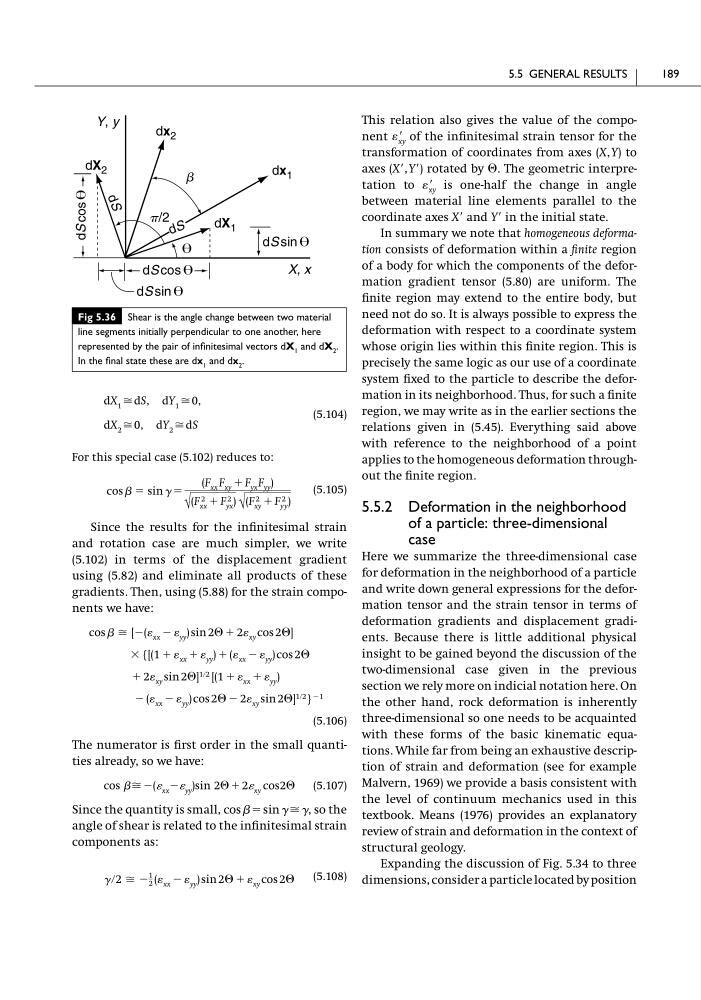
dX 1 Х dS, dY 1 Х 0,
dX 2 Х 0, dY 2 Х dS
(5.104)
For this special case (5.102) reduces to:
(5.105)
Since the results for the infinitesimal strain
and rotation case are much simpler, we write
(5.102) in terms of the displacement gradient
using (5.82) and eliminate all products of these
gradients. Then, using (5.88) for the strain components we have:
(5.106)
The numerator is first order in the small quantities already, so we have:
cos Х Ϫ( xx Ϫ yy )sin 2⌰ϩ2 xy cos2⌰ (5.107)
Since the quantity is small, cos  ϭ sin ␥ Х ␥, so the
angle of shear is related to the infinitesimal strain
components as:
(5.108)
␥ ր2 Х Ϫ
1
2 ( xx Ϫ yy ) sin 2⌰ ϩ xy cos 2⌰
Ϫ 2 xy sin 2⌰] 1ր2 } Ϫ1
Ϫ ( xx Ϫ yy ) cos 2⌰
ϩ 2 xy sin 2⌰] 1ր2 [(1 ϩ xx ϩ yy )
ϫ {[(1 ϩ xx ϩ yy ) ϩ ( xx Ϫ yy ) cos 2⌰
cos  Х [Ϫ( xx Ϫ yy ) sin 2⌰ ϩ 2 xy cos 2⌰]
cos  ϭ sin ␥ ϭ
(F xx F xy ϩ F yx F yy )
√ (F 2
xx ϩ F 2
yx ) √ (F 2
xy ϩ F 2
yy )
This relation also gives the value of the component
of the infinitesimal strain tensor for the
transformation of coordinates from axes (X, Y) to
axes (XЈ, YЈ) rotated by ⌰. The geometric interpretation to
is one-half the change in angle
between material line elements parallel to the
coordinate axes XЈ and YЈ in the initial state.
In summary we note that homogeneous deformation consists of deformation within a finite region
of a body for which the components of the deformation gradient tensor (5.80) are uniform. The
finite region may extend to the entire body, but
need not do so. It is always possible to express the
deformation with respect to a coordinate system
whose origin lies within this finite region. This is
precisely the same logic as our use of a coordinate
system fixed to the particle to describe the deformation in its neighborhood. Thus, for such a finite
region, we may write as in the earlier sections the
relations given in (5.45). Everything said above
with reference to the neighborhood of a point
applies to the homogeneous deformation throughout the finite region.
5.5.2 Deformation in the neighborhood
of a particle: three-dimensional
case
Here we summarize the three-dimensional case
for deformation in the neighborhood of a particle
and write down general expressions for the deformation tensor and the strain tensor in terms of
deformation gradients and displacement gradients. Because there is little additional physical
insight to be gained beyond the discussion of the
two-dimensional case given in the previous
section we rely more on indicial notation here. On
the other hand, rock deformation is inherently
three-dimensional so one needs to be acquainted
with these forms of the basic kinematic equations. While far from being an exhaustive description of strain and deformation (see for example
Malvern, 1969) we provide a basis consistent with
the level of continuum mechanics used in this
textbook. Means (1976) provides an explanatory
review of strain and deformation in the context of
structural geology.
Expanding the discussion of Fig. 5.34 to three
dimensions, consider a particle located by position
Ј xy
Ј xy
5.5 GENERAL RESULTS
189
Fig 5.36 Shear is the angle change between two material
line segments initially perpendicular to one another, here
represented by the pair of infinitesimal vectors dX 1 and dX 2 .
In the final state these are dx 1 and dx 2 .
b
dx 1
dx 2
dX 1
⍜
p/2
dS cos ⍜
d
S
Y, y
dX 2
dS sin ⍜
dS cos ⍜
X, x
dS sin ⍜
d S
dX 2 Х 0, dY 2 Х dS
(5.104)
For this special case (5.102) reduces to:
(5.105)
Since the results for the infinitesimal strain
and rotation case are much simpler, we write
(5.102) in terms of the displacement gradient
using (5.82) and eliminate all products of these
gradients. Then, using (5.88) for the strain components we have:
(5.106)
The numerator is first order in the small quantities already, so we have:
cos Х Ϫ( xx Ϫ yy )sin 2⌰ϩ2 xy cos2⌰ (5.107)
Since the quantity is small, cos  ϭ sin ␥ Х ␥, so the
angle of shear is related to the infinitesimal strain
components as:
(5.108)
␥ ր2 Х Ϫ
1
2 ( xx Ϫ yy ) sin 2⌰ ϩ xy cos 2⌰
Ϫ 2 xy sin 2⌰] 1ր2 } Ϫ1
Ϫ ( xx Ϫ yy ) cos 2⌰
ϩ 2 xy sin 2⌰] 1ր2 [(1 ϩ xx ϩ yy )
ϫ {[(1 ϩ xx ϩ yy ) ϩ ( xx Ϫ yy ) cos 2⌰
cos  Х [Ϫ( xx Ϫ yy ) sin 2⌰ ϩ 2 xy cos 2⌰]
cos  ϭ sin ␥ ϭ
(F xx F xy ϩ F yx F yy )
√ (F 2
xx ϩ F 2
yx ) √ (F 2
xy ϩ F 2
yy )
This relation also gives the value of the component
of the infinitesimal strain tensor for the
transformation of coordinates from axes (X, Y) to
axes (XЈ, YЈ) rotated by ⌰. The geometric interpretation to
is one-half the change in angle
between material line elements parallel to the
coordinate axes XЈ and YЈ in the initial state.
In summary we note that homogeneous deformation consists of deformation within a finite region
of a body for which the components of the deformation gradient tensor (5.80) are uniform. The
finite region may extend to the entire body, but
need not do so. It is always possible to express the
deformation with respect to a coordinate system
whose origin lies within this finite region. This is
precisely the same logic as our use of a coordinate
system fixed to the particle to describe the deformation in its neighborhood. Thus, for such a finite
region, we may write as in the earlier sections the
relations given in (5.45). Everything said above
with reference to the neighborhood of a point
applies to the homogeneous deformation throughout the finite region.
5.5.2 Deformation in the neighborhood
of a particle: three-dimensional
case
Here we summarize the three-dimensional case
for deformation in the neighborhood of a particle
and write down general expressions for the deformation tensor and the strain tensor in terms of
deformation gradients and displacement gradients. Because there is little additional physical
insight to be gained beyond the discussion of the
two-dimensional case given in the previous
section we rely more on indicial notation here. On
the other hand, rock deformation is inherently
three-dimensional so one needs to be acquainted
with these forms of the basic kinematic equations. While far from being an exhaustive description of strain and deformation (see for example
Malvern, 1969) we provide a basis consistent with
the level of continuum mechanics used in this
textbook. Means (1976) provides an explanatory
review of strain and deformation in the context of
structural geology.
Expanding the discussion of Fig. 5.34 to three
dimensions, consider a particle located by position
Ј xy
Ј xy
5.5 GENERAL RESULTS
189
Fig 5.36 Shear is the angle change between two material
line segments initially perpendicular to one another, here
represented by the pair of infinitesimal vectors dX 1 and dX 2 .
In the final state these are dx 1 and dx 2 .
b
dx 1
dx 2
dX 1
⍜
p/2
dS cos ⍜
d
S
Y, y
dX 2
dS sin ⍜
dS cos ⍜
X, x
dS sin ⍜
d S