

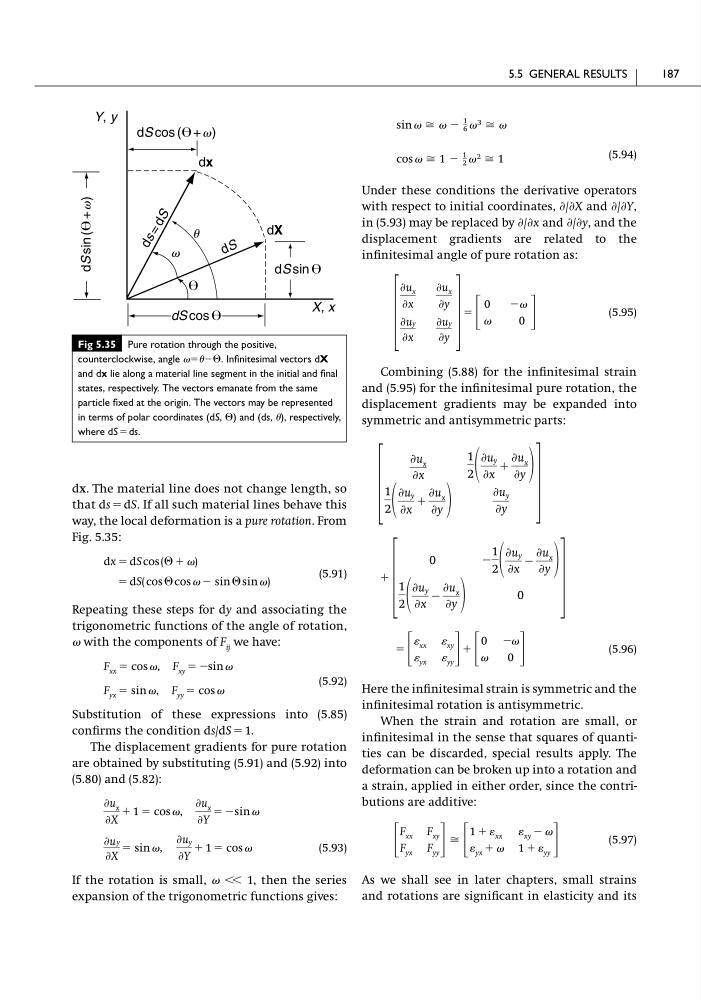
dx. The material line does not change length, so
that ds � dS. If all such material lines behave this
way, the local deformation is a pure rotation. From
Fig. 5.35:
(5.91)
Repeating these steps for dy and associating the
trigonometric functions of the angle of rotation,
� with the components of F ij we have:
(5.92)
Substitution of these expressions into (5.85)
confirms the condition ds/dS � 1.
The displacement gradients for pure rotation
are obtained by substituting (5.91) and (5.92) into
(5.80) and (5.82):
(5.93)
If the rotation is small, � �� 1, then the series
expansion of the trigonometric functions gives:
�uy
�X
� sin �,
�u y
�Y
� 1 � cos �
�u x
�X
� 1 � cos �,
�u x
�Y
� � sin �
F yx � sin �, F yy � cos �
F xx � cos �, F xy � � sin �
� dS( cos � cos � � sin � sin �)
dx � dS cos (� � �)
(5.94)
Under these conditions the derivative operators
with respect to initial coordinates, �/�X and �/�Y,
in (5.93) may be replaced by �/�x and �/�y, and the
displacement gradients are related to the
infinitesimal angle of pure rotation as:
(5.95)
Combining (5.88) for the infinitesimal strain
and (5.95) for the infinitesimal pure rotation, the
displacement gradients may be expanded into
symmetric and antisymmetric parts:
(5.96)
Here the infinitesimal strain is symmetric and the
infinitesimal rotation is antisymmetric.
When the strain and rotation are small, or
infinitesimal in the sense that squares of quantities can be discarded, special results apply. The
deformation can be broken up into a rotation and
a strain, applied in either order, since the contributions are additive:
(5.97)
As we shall see in later chapters, small strains
and rotations are significant in elasticity and its
΄
F xx F xy
F yx F yy ΅ Х ΄
1 � � xx
� yx � �
� xy � �
1 � � yy ΅
� ΄
� xx � xy
� yx � yy ΅ � ΄
0 ��
�
0 ΅
�
΄
0
�
1
2
�u y
�x
�
�u x
�y
1
2
�u y
�x
�
�u x
�y
0
΅
΄
�u x
�x
1
2
�u y
�x
�
�u x
�y
1
2
�u y
�x
�
�u x
�y
�u y
�y
΅
΄
�u x
�x
�u x
�y
�uy
�x
�uy
�y
΅
� ΄
0
��
�
0 ΅
cos � Х 1 �
1
2 � 2 Х 1
sin � Х � �
1
6 � 3 Х �
5.5 GENERAL RESULTS
187
Fig 5.35 Pure rotation through the positive,
counterclockwise, angle �����. Infinitesimal vectors dX
and dx lie along a material line segment in the initial and final
states, respectively. The vectors emanate from the same
particle fixed at the origin. The vectors may be represented
in terms of polar coordinates (dS, �) and (ds, �), respectively,
where dS� ds.
u
dS cos (� + v)
d s = d S
dx
v
dX
d S
X, x
�
Y, y
dS sin (� + v)
dS cos �
dS sin �
that ds � dS. If all such material lines behave this
way, the local deformation is a pure rotation. From
Fig. 5.35:
(5.91)
Repeating these steps for dy and associating the
trigonometric functions of the angle of rotation,
� with the components of F ij we have:
(5.92)
Substitution of these expressions into (5.85)
confirms the condition ds/dS � 1.
The displacement gradients for pure rotation
are obtained by substituting (5.91) and (5.92) into
(5.80) and (5.82):
(5.93)
If the rotation is small, � �� 1, then the series
expansion of the trigonometric functions gives:
�uy
�X
� sin �,
�u y
�Y
� 1 � cos �
�u x
�X
� 1 � cos �,
�u x
�Y
� � sin �
F yx � sin �, F yy � cos �
F xx � cos �, F xy � � sin �
� dS( cos � cos � � sin � sin �)
dx � dS cos (� � �)
(5.94)
Under these conditions the derivative operators
with respect to initial coordinates, �/�X and �/�Y,
in (5.93) may be replaced by �/�x and �/�y, and the
displacement gradients are related to the
infinitesimal angle of pure rotation as:
(5.95)
Combining (5.88) for the infinitesimal strain
and (5.95) for the infinitesimal pure rotation, the
displacement gradients may be expanded into
symmetric and antisymmetric parts:
(5.96)
Here the infinitesimal strain is symmetric and the
infinitesimal rotation is antisymmetric.
When the strain and rotation are small, or
infinitesimal in the sense that squares of quantities can be discarded, special results apply. The
deformation can be broken up into a rotation and
a strain, applied in either order, since the contributions are additive:
(5.97)
As we shall see in later chapters, small strains
and rotations are significant in elasticity and its
΄
F xx F xy
F yx F yy ΅ Х ΄
1 � � xx
� yx � �
� xy � �
1 � � yy ΅
� ΄
� xx � xy
� yx � yy ΅ � ΄
0 ��
�
0 ΅
�
΄
0
�
1
2
�u y
�x
�
�u x
�y
1
2
�u y
�x
�
�u x
�y
0
΅
΄
�u x
�x
1
2
�u y
�x
�
�u x
�y
1
2
�u y
�x
�
�u x
�y
�u y
�y
΅
΄
�u x
�x
�u x
�y
�uy
�x
�uy
�y
΅
� ΄
0
��
�
0 ΅
cos � Х 1 �
1
2 � 2 Х 1
sin � Х � �
1
6 � 3 Х �
5.5 GENERAL RESULTS
187
Fig 5.35 Pure rotation through the positive,
counterclockwise, angle �����. Infinitesimal vectors dX
and dx lie along a material line segment in the initial and final
states, respectively. The vectors emanate from the same
particle fixed at the origin. The vectors may be represented
in terms of polar coordinates (dS, �) and (ds, �), respectively,
where dS� ds.
u
dS cos (� + v)
d s = d S
dx
v
dX
d S
X, x
�
Y, y
dS sin (� + v)
dS cos �
dS sin �