

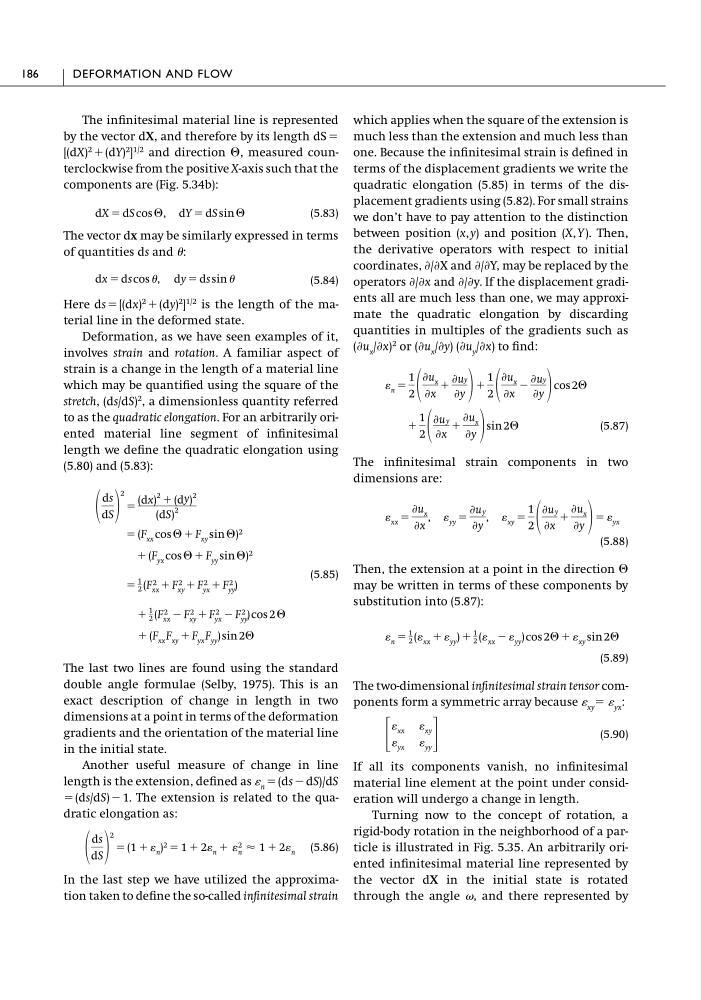
The infinitesimal material line is represented
by the vector dX, and therefore by its length dSϭ
[(dX)
2 ϩ (dY)
2 ]
1/2 and direction ⌰, measured counterclockwise from the positive X-axis such that the
components are (Fig. 5.34b):
(5.83)
The vector dx may be similarly expressed in terms
of quantities ds and :
(5.84)
Here ds ϭ [(dx)
2 ϩ (dy)
2 ]
1/2 is the length of the material line in the deformed state.
Deformation, as we have seen examples of it,
involves strain and rotation. A familiar aspect of
strain is a change in the length of a material line
which may be quantified using the square of the
stretch, (ds/dS)
2 , a dimensionless quantity referred
to as the quadratic elongation. For an arbitrarily oriented material line segment of infinitesimal
length we define the quadratic elongation using
(5.80) and (5.83):
(5.85)
The last two lines are found using the standard
double angle formulae (Selby, 1975). This is an
exact description of change in length in two
dimensions at a point in terms of the deformation
gradients and the orientation of the material line
in the initial state.
Another useful measure of change in line
length is the extension, defined as n ϭ (ds Ϫ dS)/dS
ϭ (ds/dS) Ϫ 1. The extension is related to the quadratic elongation as:
(5.86)
In the last step we have utilized the approximation taken to define the so-called infinitesimal strain
ds
dS
2
ϭ (1 ϩ n ) 2 ϭ 1 ϩ 2 n ϩ 2
n Ϸ 1 ϩ 2 n
ϩ (F xx F xy ϩ F yx F yy ) sin 2⌰
ϩ
1
2 (F 2
xx Ϫ F 2
xy ϩ F 2
yx Ϫ F 2
yy ) cos 2 ⌰
ϭ
1
2 (F 2
xx ϩ F 2
xy ϩ F 2
yx ϩ F 2
yy )
ϩ (F yx cos ⌰ ϩ F yy sin ⌰) 2
ϭ (F xx cos ⌰ ϩ F xy sin ⌰) 2
ds
dS
2
ϭ
(dx)
2 ϩ (dy)
2
(dS)
2
dx ϭ ds cos , dy ϭ ds sin
dX ϭ dS cos ⌰, dY ϭ dS sin ⌰
which applies when the square of the extension is
much less than the extension and much less than
one. Because the infinitesimal strain is defined in
terms of the displacement gradients we write the
quadratic elongation (5.85) in terms of the displacement gradients using (5.82). For small strains
we don’t have to pay attention to the distinction
between position (x, y) and position (X, Y). Then,
the derivative operators with respect to initial
coordinates, Ѩ/ѨX and Ѩ/ѨY, may be replaced by the
operators Ѩ/Ѩx and Ѩ/Ѩy. If the displacement gradients all are much less than one, we may approximate the quadratic elongation by discarding
quantities in multiples of the gradients such as
(Ѩu x /Ѩx)
2 or (Ѩu x /Ѩy) (Ѩu y /Ѩx) to find:
(5.87)
The infinitesimal strain components in two
dimensions are:
(5.88)
Then, the extension at a point in the direction ⌰
may be written in terms of these components by
substitution into (5.87):
(5.89)
The two-dimensional infinitesimal strain tensor components form a symmetric array because xy ϭ yx :
(5.90)
If all its components vanish, no infinitesimal
material line element at the point under consideration will undergo a change in length.
Turning now to the concept of rotation, a
rigid-body rotation in the neighborhood of a particle is illustrated in Fig. 5.35. An arbitrarily oriented infinitesimal material line represented by
the vector dX in the initial state is rotated
through the angle , and there represented by
΄
xx xy
yx yy
΅
n ϭ
1
2 ( xx ϩ yy ) ϩ
1
2 ( xx Ϫ yy ) cos 2⌰ ϩ xy sin 2⌰
xx ϭ
Ѩu x
Ѩx
, yy ϭ
Ѩuy
Ѩy
, xy ϭ
1
2
Ѩuy
Ѩx
ϩ
Ѩu x
Ѩy ϭ yx
ϩ
1
2
Ѩuy
Ѩx
ϩ
Ѩu x
Ѩy
sin 2⌰
n ϭ
1
2
Ѩu x
Ѩx
ϩ
Ѩuy
Ѩy ϩ
1
2
Ѩu x
Ѩx
Ϫ
Ѩuy
Ѩy cos 2⌰
186
DEFORMATION AND FLOW
by the vector dX, and therefore by its length dSϭ
[(dX)
2 ϩ (dY)
2 ]
1/2 and direction ⌰, measured counterclockwise from the positive X-axis such that the
components are (Fig. 5.34b):
(5.83)
The vector dx may be similarly expressed in terms
of quantities ds and :
(5.84)
Here ds ϭ [(dx)
2 ϩ (dy)
2 ]
1/2 is the length of the material line in the deformed state.
Deformation, as we have seen examples of it,
involves strain and rotation. A familiar aspect of
strain is a change in the length of a material line
which may be quantified using the square of the
stretch, (ds/dS)
2 , a dimensionless quantity referred
to as the quadratic elongation. For an arbitrarily oriented material line segment of infinitesimal
length we define the quadratic elongation using
(5.80) and (5.83):
(5.85)
The last two lines are found using the standard
double angle formulae (Selby, 1975). This is an
exact description of change in length in two
dimensions at a point in terms of the deformation
gradients and the orientation of the material line
in the initial state.
Another useful measure of change in line
length is the extension, defined as n ϭ (ds Ϫ dS)/dS
ϭ (ds/dS) Ϫ 1. The extension is related to the quadratic elongation as:
(5.86)
In the last step we have utilized the approximation taken to define the so-called infinitesimal strain
ds
dS
2
ϭ (1 ϩ n ) 2 ϭ 1 ϩ 2 n ϩ 2
n Ϸ 1 ϩ 2 n
ϩ (F xx F xy ϩ F yx F yy ) sin 2⌰
ϩ
1
2 (F 2
xx Ϫ F 2
xy ϩ F 2
yx Ϫ F 2
yy ) cos 2 ⌰
ϭ
1
2 (F 2
xx ϩ F 2
xy ϩ F 2
yx ϩ F 2
yy )
ϩ (F yx cos ⌰ ϩ F yy sin ⌰) 2
ϭ (F xx cos ⌰ ϩ F xy sin ⌰) 2
ds
dS
2
ϭ
(dx)
2 ϩ (dy)
2
(dS)
2
dx ϭ ds cos , dy ϭ ds sin
dX ϭ dS cos ⌰, dY ϭ dS sin ⌰
which applies when the square of the extension is
much less than the extension and much less than
one. Because the infinitesimal strain is defined in
terms of the displacement gradients we write the
quadratic elongation (5.85) in terms of the displacement gradients using (5.82). For small strains
we don’t have to pay attention to the distinction
between position (x, y) and position (X, Y). Then,
the derivative operators with respect to initial
coordinates, Ѩ/ѨX and Ѩ/ѨY, may be replaced by the
operators Ѩ/Ѩx and Ѩ/Ѩy. If the displacement gradients all are much less than one, we may approximate the quadratic elongation by discarding
quantities in multiples of the gradients such as
(Ѩu x /Ѩx)
2 or (Ѩu x /Ѩy) (Ѩu y /Ѩx) to find:
(5.87)
The infinitesimal strain components in two
dimensions are:
(5.88)
Then, the extension at a point in the direction ⌰
may be written in terms of these components by
substitution into (5.87):
(5.89)
The two-dimensional infinitesimal strain tensor components form a symmetric array because xy ϭ yx :
(5.90)
If all its components vanish, no infinitesimal
material line element at the point under consideration will undergo a change in length.
Turning now to the concept of rotation, a
rigid-body rotation in the neighborhood of a particle is illustrated in Fig. 5.35. An arbitrarily oriented infinitesimal material line represented by
the vector dX in the initial state is rotated
through the angle , and there represented by
΄
xx xy
yx yy
΅
n ϭ
1
2 ( xx ϩ yy ) ϩ
1
2 ( xx Ϫ yy ) cos 2⌰ ϩ xy sin 2⌰
xx ϭ
Ѩu x
Ѩx
, yy ϭ
Ѩuy
Ѩy
, xy ϭ
1
2
Ѩuy
Ѩx
ϩ
Ѩu x
Ѩy ϭ yx
ϩ
1
2
Ѩuy
Ѩx
ϩ
Ѩu x
Ѩy
sin 2⌰
n ϭ
1
2
Ѩu x
Ѩx
ϩ
Ѩuy
Ѩy ϩ
1
2
Ѩu x
Ѩx
Ϫ
Ѩuy
Ѩy cos 2⌰
186
DEFORMATION AND FLOW