

attributes of the elements vary smoothly within
the body, and they are informative of the style
and magnitude of deformation, but they do not
provide a complete description. In the idealized
continuous medium of this model, we may
define the quantities describing deformation at a
mathematical point in terms of tensors based
upon gradients in deformation and displacement.
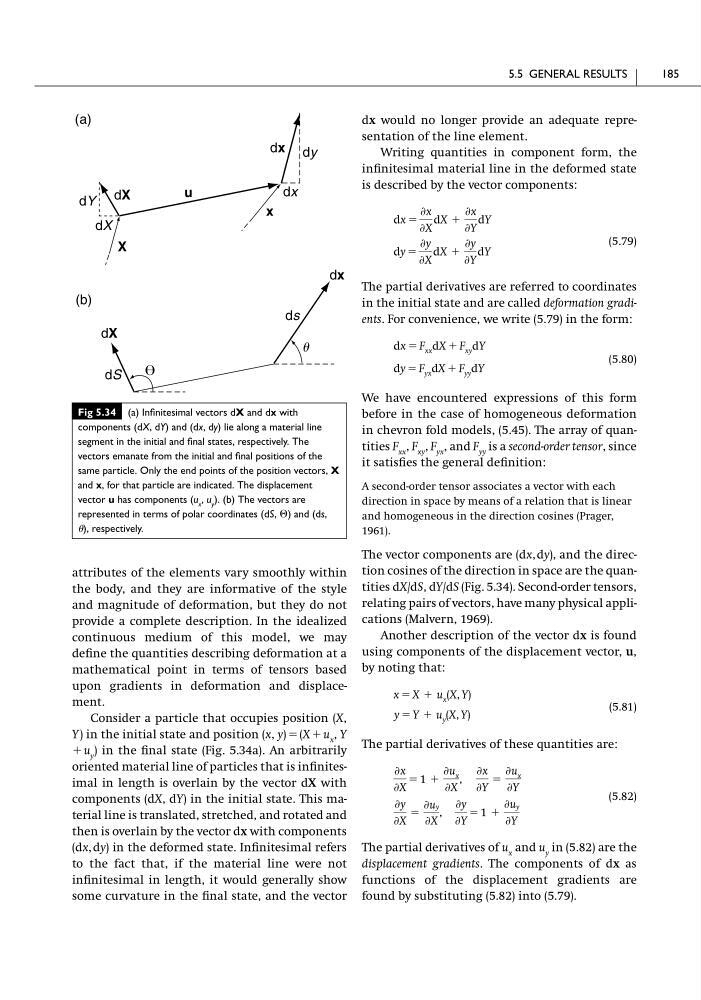
Consider a particle that occupies position (X,
Y) in the initial state and position (x, y) ϭ (X ϩ u x , Y
ϩ u y ) in the final state (Fig. 5.34a). An arbitrarily
oriented material line of particles that is infinitesimal in length is overlain by the vector dX with
components (dX, dY) in the initial state. This material line is translated, stretched, and rotated and
then is overlain by the vector dx with components
(dx,dy) in the deformed state. Infinitesimal refers
to the fact that, if the material line were not
infinitesimal in length, it would generally show
some curvature in the final state, and the vector
dx would no longer provide an adequate representation of the line element.
Writing quantities in component form, the
infinitesimal material line in the deformed state
is described by the vector components:
(5.79)
The partial derivatives are referred to coordinates
in the initial state and are called deformation gradients. For convenience, we write (5.79) in the form:
(5.80)
We have encountered expressions of this form
before in the case of homogeneous deformation
in chevron fold models, (5.45). The array of quantities F xx , F xy , F yx , and F yy is a second-order tensor, since
it satisfies the general definition:
A second-order tensor associates a vector with each
direction in space by means of a relation that is linear
and homogeneous in the direction cosines (Prager,
1961).
The vector components are (dx,dy), and the direction cosines of the direction in space are the quantities dX/dS, dY/dS (Fig. 5.34). Second-order tensors,
relating pairs of vectors, have many physical applications (Malvern, 1969).
Another description of the vector dx is found
using components of the displacement vector, u,
by noting that:
(5.81)
The partial derivatives of these quantities are:
(5.82)
The partial derivatives of u x and u y in (5.82) are the
displacement gradients. The components of dx as
functions of the displacement gradients are
found by substituting (5.82) into (5.79).
Ѩy
ѨX
ϭ
Ѩuy
ѨX
,
Ѩy
ѨY
ϭ 1 ϩ
Ѩu y
ѨY
Ѩx
ѨX
ϭ 1 ϩ
Ѩu x
ѨX
,
Ѩx
ѨY
ϭ
Ѩu x
ѨY
y ϭ Y ϩ u y (X, Y)
x ϭ X ϩ u x (X, Y)
dy ϭ F yx dX ϩ F yy dY
dx ϭ F xx dX ϩ F xy dY
dy ϭ
Ѩy
ѨX
dX ϩ
Ѩy
ѨY
dY
dx ϭ
Ѩx
ѨX
dX ϩ
Ѩx
ѨY
dY
5.5 GENERAL RESULTS
185
Fig 5.34 (a) Infinitesimal vectors dX and dx with
components (dX, dY) and (dx, dy) lie along a material line
segment in the initial and final states, respectively. The
vectors emanate from the initial and final positions of the
same particle. Only the end points of the position vectors, X
and x, for that particle are indicated. The displacement
vector u has components (u x , u y ). (b) The vectors are
represented in terms of polar coordinates (dS, ⌰) and (ds,
), respectively.
⍜
dx dy
dx
x
dx
ds
u
(a)
(b)
dX
dS
dX
dY
dX
X
u
the body, and they are informative of the style
and magnitude of deformation, but they do not
provide a complete description. In the idealized
continuous medium of this model, we may
define the quantities describing deformation at a
mathematical point in terms of tensors based
upon gradients in deformation and displacement.
Consider a particle that occupies position (X,
Y) in the initial state and position (x, y) ϭ (X ϩ u x , Y
ϩ u y ) in the final state (Fig. 5.34a). An arbitrarily
oriented material line of particles that is infinitesimal in length is overlain by the vector dX with
components (dX, dY) in the initial state. This material line is translated, stretched, and rotated and
then is overlain by the vector dx with components
(dx,dy) in the deformed state. Infinitesimal refers
to the fact that, if the material line were not
infinitesimal in length, it would generally show
some curvature in the final state, and the vector
dx would no longer provide an adequate representation of the line element.
Writing quantities in component form, the
infinitesimal material line in the deformed state
is described by the vector components:
(5.79)
The partial derivatives are referred to coordinates
in the initial state and are called deformation gradients. For convenience, we write (5.79) in the form:
(5.80)
We have encountered expressions of this form
before in the case of homogeneous deformation
in chevron fold models, (5.45). The array of quantities F xx , F xy , F yx , and F yy is a second-order tensor, since
it satisfies the general definition:
A second-order tensor associates a vector with each
direction in space by means of a relation that is linear
and homogeneous in the direction cosines (Prager,
1961).
The vector components are (dx,dy), and the direction cosines of the direction in space are the quantities dX/dS, dY/dS (Fig. 5.34). Second-order tensors,
relating pairs of vectors, have many physical applications (Malvern, 1969).
Another description of the vector dx is found
using components of the displacement vector, u,
by noting that:
(5.81)
The partial derivatives of these quantities are:
(5.82)
The partial derivatives of u x and u y in (5.82) are the
displacement gradients. The components of dx as
functions of the displacement gradients are
found by substituting (5.82) into (5.79).
Ѩy
ѨX
ϭ
Ѩuy
ѨX
,
Ѩy
ѨY
ϭ 1 ϩ
Ѩu y
ѨY
Ѩx
ѨX
ϭ 1 ϩ
Ѩu x
ѨX
,
Ѩx
ѨY
ϭ
Ѩu x
ѨY
y ϭ Y ϩ u y (X, Y)
x ϭ X ϩ u x (X, Y)
dy ϭ F yx dX ϩ F yy dY
dx ϭ F xx dX ϩ F xy dY
dy ϭ
Ѩy
ѨX
dX ϩ
Ѩy
ѨY
dY
dx ϭ
Ѩx
ѨX
dX ϩ
Ѩx
ѨY
dY
5.5 GENERAL RESULTS
185
Fig 5.34 (a) Infinitesimal vectors dX and dx with
components (dX, dY) and (dx, dy) lie along a material line
segment in the initial and final states, respectively. The
vectors emanate from the initial and final positions of the
same particle. Only the end points of the position vectors, X
and x, for that particle are indicated. The displacement
vector u has components (u x , u y ). (b) The vectors are
represented in terms of polar coordinates (dS, ⌰) and (ds,
), respectively.
⍜
dx dy
dx
x
dx
ds
u
(a)
(b)
dX
dS
dX
dY
dX
X
u