

(5.35)
But, from Fig. 5.22:
(5.36)
The expression for y is similarly derived. To carry
out the second step, we substitute for the initial
coordinates X and Y in (5.34) the intermediate
coordinates x
(1) and y
(1) of (5.33) for the rotation ⍀
ϭϪ␦, yielding:
(5.37)
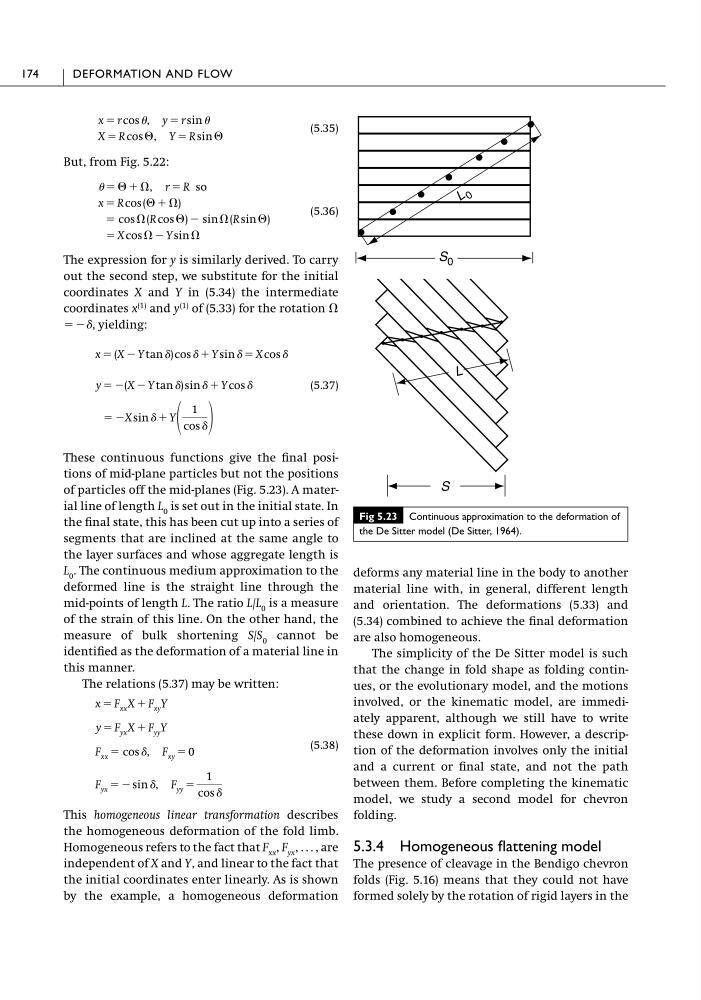
These continuous functions give the final positions of mid-plane particles but not the positions
of particles off the mid-planes (Fig. 5.23). A material line of length L 0 is set out in the initial state. In
the final state, this has been cut up into a series of
segments that are inclined at the same angle to
the layer surfaces and whose aggregate length is
L 0 . The continuous medium approximation to the
deformed line is the straight line through the
mid-points of length L. The ratio L/L 0 is a measure
of the strain of this line. On the other hand, the
measure of bulk shortening S/S 0 cannot be
identified as the deformation of a material line in
this manner.
The relations (5.37) may be written:
(5.38)
This homogeneous linear transformation describes
the homogeneous deformation of the fold limb.
Homogeneous refers to the fact that F xx , F yx , . . . , are
independent of X and Y, and linear to the fact that
the initial coordinates enter linearly. As is shown
by the example, a homogeneous deformation
F yx ϭ Ϫ sin ␦, F yy ϭ
1
cos ␦
F xx ϭ cos ␦, F xy ϭ 0
y ϭ F yx X ϩ F yy Y
x ϭ F xx X ϩ F xy Y
ϭ ϪX sin ␦ ϩ Y
1
cos ␦
y ϭ Ϫ(X Ϫ Y tan ␦) sin ␦ ϩ Y cos ␦
x ϭ (X Ϫ Y tan ␦) cos ␦ ϩ Y sin ␦ ϭ X cos ␦
ϭ X cos ⍀ Ϫ Y sin ⍀
ϭ cos ⍀ (R cos ⌰) Ϫ sin ⍀ (R sin ⌰)
x ϭ R cos (⌰ ϩ ⍀)
ϭ ⌰ ϩ ⍀, r ϭ R so
X ϭ R cos ⌰, Y ϭ R sin ⌰
x ϭ r cos , y ϭ r sin
deforms any material line in the body to another
material line with, in general, different length
and orientation. The deformations (5.33) and
(5.34) combined to achieve the final deformation
are also homogeneous.
The simplicity of the De Sitter model is such
that the change in fold shape as folding continues, or the evolutionary model, and the motions
involved, or the kinematic model, are immediately apparent, although we still have to write
these down in explicit form. However, a description of the deformation involves only the initial
and a current or final state, and not the path
between them. Before completing the kinematic
model, we study a second model for chevron
folding.
5.3.4 Homogeneous flattening model
The presence of cleavage in the Bendigo chevron
folds (Fig. 5.16) means that they could not have
formed solely by the rotation of rigid layers in the
174
DEFORMATION AND FLOW
Fig 5.23 Continuous approximation to the deformation of
the De Sitter model (De Sitter, 1964).
S
L 0
S 0
L
But, from Fig. 5.22:
(5.36)
The expression for y is similarly derived. To carry
out the second step, we substitute for the initial
coordinates X and Y in (5.34) the intermediate
coordinates x
(1) and y
(1) of (5.33) for the rotation ⍀
ϭϪ␦, yielding:
(5.37)
These continuous functions give the final positions of mid-plane particles but not the positions
of particles off the mid-planes (Fig. 5.23). A material line of length L 0 is set out in the initial state. In
the final state, this has been cut up into a series of
segments that are inclined at the same angle to
the layer surfaces and whose aggregate length is
L 0 . The continuous medium approximation to the
deformed line is the straight line through the
mid-points of length L. The ratio L/L 0 is a measure
of the strain of this line. On the other hand, the
measure of bulk shortening S/S 0 cannot be
identified as the deformation of a material line in
this manner.
The relations (5.37) may be written:
(5.38)
This homogeneous linear transformation describes
the homogeneous deformation of the fold limb.
Homogeneous refers to the fact that F xx , F yx , . . . , are
independent of X and Y, and linear to the fact that
the initial coordinates enter linearly. As is shown
by the example, a homogeneous deformation
F yx ϭ Ϫ sin ␦, F yy ϭ
1
cos ␦
F xx ϭ cos ␦, F xy ϭ 0
y ϭ F yx X ϩ F yy Y
x ϭ F xx X ϩ F xy Y
ϭ ϪX sin ␦ ϩ Y
1
cos ␦
y ϭ Ϫ(X Ϫ Y tan ␦) sin ␦ ϩ Y cos ␦
x ϭ (X Ϫ Y tan ␦) cos ␦ ϩ Y sin ␦ ϭ X cos ␦
ϭ X cos ⍀ Ϫ Y sin ⍀
ϭ cos ⍀ (R cos ⌰) Ϫ sin ⍀ (R sin ⌰)
x ϭ R cos (⌰ ϩ ⍀)
ϭ ⌰ ϩ ⍀, r ϭ R so
X ϭ R cos ⌰, Y ϭ R sin ⌰
x ϭ r cos , y ϭ r sin
deforms any material line in the body to another
material line with, in general, different length
and orientation. The deformations (5.33) and
(5.34) combined to achieve the final deformation
are also homogeneous.
The simplicity of the De Sitter model is such
that the change in fold shape as folding continues, or the evolutionary model, and the motions
involved, or the kinematic model, are immediately apparent, although we still have to write
these down in explicit form. However, a description of the deformation involves only the initial
and a current or final state, and not the path
between them. Before completing the kinematic
model, we study a second model for chevron
folding.
5.3.4 Homogeneous flattening model
The presence of cleavage in the Bendigo chevron
folds (Fig. 5.16) means that they could not have
formed solely by the rotation of rigid layers in the
174
DEFORMATION AND FLOW
Fig 5.23 Continuous approximation to the deformation of
the De Sitter model (De Sitter, 1964).
S
L 0
S 0
L