

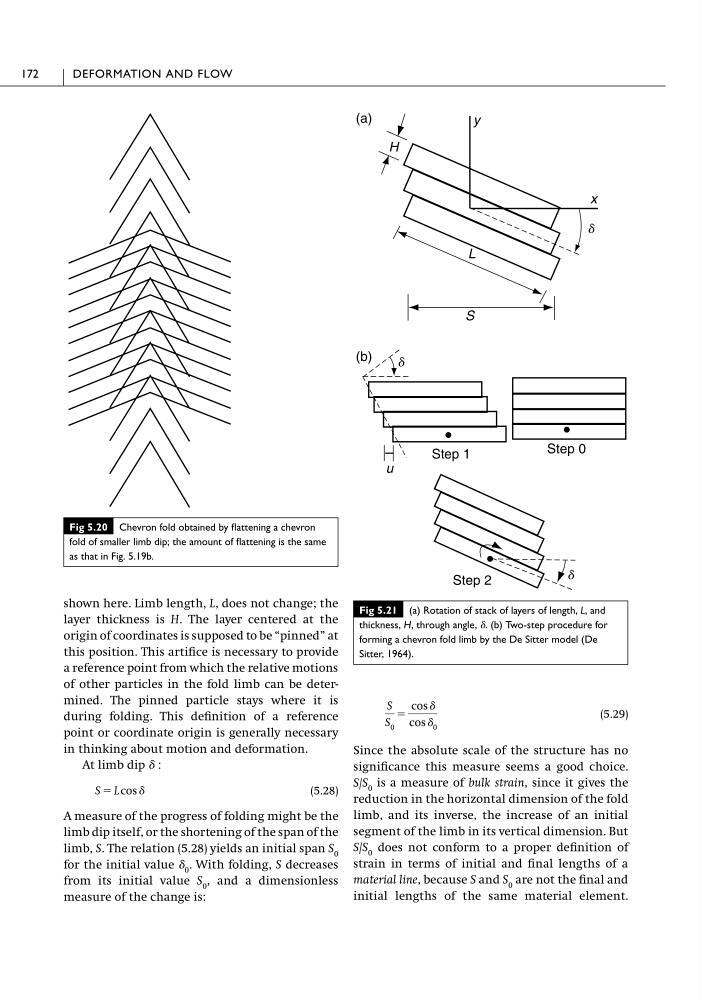
shown here. Limb length, L, does not change; the
layer thickness is H. The layer centered at the
origin of coordinates is supposed to be “pinned” at
this position. This artifice is necessary to provide
a reference point from which the relative motions
of other particles in the fold limb can be determined. The pinned particle stays where it is
during folding. This definition of a reference
point or coordinate origin is generally necessary
in thinking about motion and deformation.
At limb dip ␦ :
(5.28)
A measure of the progress of folding might be the
limb dip itself, or the shortening of the span of the
limb, S. The relation (5.28) yields an initial span S 0
for the initial value ␦ 0 . With folding, S decreases
from its initial value S 0 , and a dimensionless
measure of the change is:
S ϭ L cos ␦
(5.29)
Since the absolute scale of the structure has no
significance this measure seems a good choice.
S/S 0 is a measure of bulk strain, since it gives the
reduction in the horizontal dimension of the fold
limb, and its inverse, the increase of an initial
segment of the limb in its vertical dimension. But
S/S 0 does not conform to a proper definition of
strain in terms of initial and final lengths of a
material line, because S and S 0 are not the final and
initial lengths of the same material element.
S
S 0
ϭ
cos ␦
cos ␦ 0
172
DEFORMATION AND FLOW
Fig 5.20 Chevron fold obtained by flattening a chevron
fold of smaller limb dip; the amount of flattening is the same
as that in Fig. 5.19b.
Fig 5.21 (a) Rotation of stack of layers of length, L, and
thickness, H, through angle, ␦. (b) Two-step procedure for
forming a chevron fold limb by the De Sitter model (De
Sitter, 1964).
y
x
L
S
H
d
u
d
d
(a)
(b)
Step 0
Step 1
Step 2
layer thickness is H. The layer centered at the
origin of coordinates is supposed to be “pinned” at
this position. This artifice is necessary to provide
a reference point from which the relative motions
of other particles in the fold limb can be determined. The pinned particle stays where it is
during folding. This definition of a reference
point or coordinate origin is generally necessary
in thinking about motion and deformation.
At limb dip ␦ :
(5.28)
A measure of the progress of folding might be the
limb dip itself, or the shortening of the span of the
limb, S. The relation (5.28) yields an initial span S 0
for the initial value ␦ 0 . With folding, S decreases
from its initial value S 0 , and a dimensionless
measure of the change is:
S ϭ L cos ␦
(5.29)
Since the absolute scale of the structure has no
significance this measure seems a good choice.
S/S 0 is a measure of bulk strain, since it gives the
reduction in the horizontal dimension of the fold
limb, and its inverse, the increase of an initial
segment of the limb in its vertical dimension. But
S/S 0 does not conform to a proper definition of
strain in terms of initial and final lengths of a
material line, because S and S 0 are not the final and
initial lengths of the same material element.
S
S 0
ϭ
cos ␦
cos ␦ 0
172
DEFORMATION AND FLOW
Fig 5.20 Chevron fold obtained by flattening a chevron
fold of smaller limb dip; the amount of flattening is the same
as that in Fig. 5.19b.
Fig 5.21 (a) Rotation of stack of layers of length, L, and
thickness, H, through angle, ␦. (b) Two-step procedure for
forming a chevron fold limb by the De Sitter model (De
Sitter, 1964).
y
x
L
S
H
d
u
d
d
(a)
(b)
Step 0
Step 1
Step 2