

Because a structural geologist can observe the
final structure, and can infer the initial form of
the rock mass involved, kinematic models are
popular. A suite of structures may be available
from which stages in the development of the
structure may be inferred. A kinematic model is
formulated in three steps.
1. The geometry of the component elements of
the structure, here the individual layers
between slip surfaces, is idealized, providing a
geometric model.
2. From the geometric model, a procedure for
approximating the form of the structure
throughout its evolution is devised: an evolutionary model.
3. Finally, consistent with the evolutionary
model, a set of particle motions is devised to
provide the motion and deformation of all individual rock elements within the structure. This
is the kinematic model proper.
5.3.2 Models for chevron folds
Most characteristic of chevron folds are long
straight limbs in relation to narrow, tight hinges.
An explanation for both features is required,
though one might expect that the explanation for
one might provide that for the other complementary feature. What we mean by explanation in this
case is detailed answers to questions such as:
“How do these features come about? What conditions and circumstances are involved? What must
be the mechanical behavior of the rock layers and
their interfaces?”
While natural chevron folds have variable
layer thickness and form of individual limbs and
hinges, those of Fig. 5.16 and 5.17 show regularity
in layer thickness. Those in Fig. 5.16 also show a
remarkable persistence in form in the vertical
direction. In the geometric models for chevron
folds that we consider, these two regularities are
idealized: (i) fold limbs continue vertically
without change in horizontal span or limb dip;
and (ii) all layers making up a fold limb have the
same thickness. A third idealization is that the
fold limbs are straight and the hinge regions are
narrow. In the evolutionary models for chevron
folding considered here, this idealization, present
in the folds observed in nature, is carried back to
all earlier, lower limb dip stages. This reflects a
lack of any better understanding of how such a
form might arise. The requirement of original
“seed folds” present in the layered material is
physically unrealistic, but in the evolutionary
model, they are taken to be present.
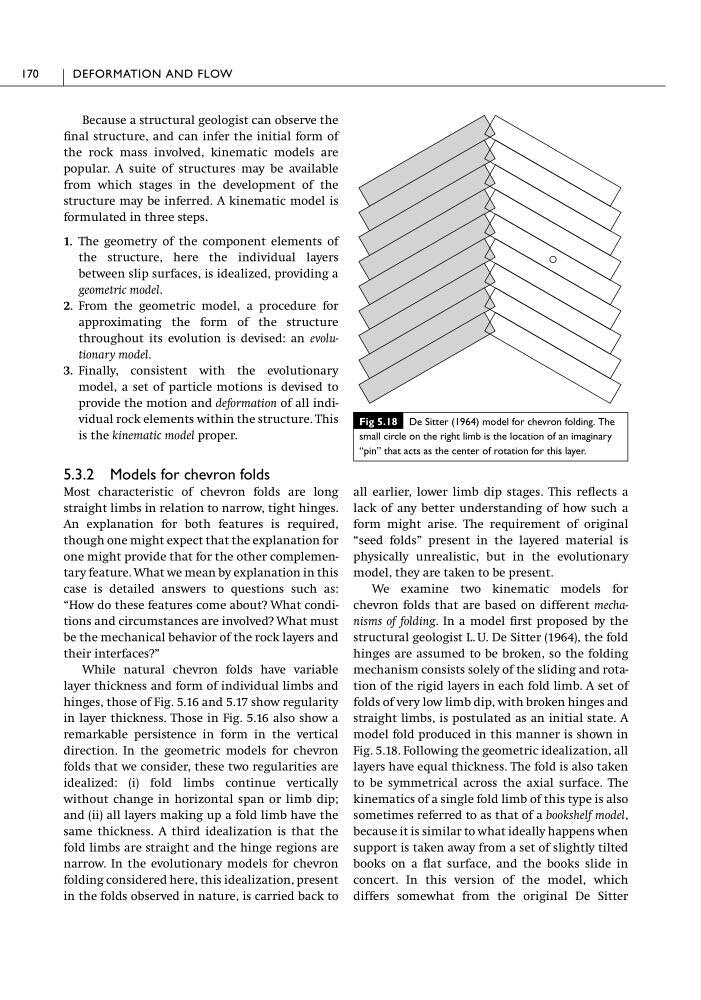
We examine two kinematic models for
chevron folds that are based on different mechanisms of folding. In a model first proposed by the
structural geologist L. U. De Sitter (1964), the fold
hinges are assumed to be broken, so the folding
mechanism consists solely of the sliding and rotation of the rigid layers in each fold limb. A set of
folds of very low limb dip, with broken hinges and
straight limbs, is postulated as an initial state. A
model fold produced in this manner is shown in
Fig. 5.18. Following the geometric idealization, all
layers have equal thickness. The fold is also taken
to be symmetrical across the axial surface. The
kinematics of a single fold limb of this type is also
sometimes referred to as that of a bookshelf model,
because it is similar to what ideally happens when
support is taken away from a set of slightly tilted
books on a flat surface, and the books slide in
concert. In this version of the model, which
differs somewhat from the original De Sitter
170
DEFORMATION AND FLOW
Fig 5.18 De Sitter (1964) model for chevron folding. The
small circle on the right limb is the location of an imaginary
“pin” that acts as the center of rotation for this layer.
final structure, and can infer the initial form of
the rock mass involved, kinematic models are
popular. A suite of structures may be available
from which stages in the development of the
structure may be inferred. A kinematic model is
formulated in three steps.
1. The geometry of the component elements of
the structure, here the individual layers
between slip surfaces, is idealized, providing a
geometric model.
2. From the geometric model, a procedure for
approximating the form of the structure
throughout its evolution is devised: an evolutionary model.
3. Finally, consistent with the evolutionary
model, a set of particle motions is devised to
provide the motion and deformation of all individual rock elements within the structure. This
is the kinematic model proper.
5.3.2 Models for chevron folds
Most characteristic of chevron folds are long
straight limbs in relation to narrow, tight hinges.
An explanation for both features is required,
though one might expect that the explanation for
one might provide that for the other complementary feature. What we mean by explanation in this
case is detailed answers to questions such as:
“How do these features come about? What conditions and circumstances are involved? What must
be the mechanical behavior of the rock layers and
their interfaces?”
While natural chevron folds have variable
layer thickness and form of individual limbs and
hinges, those of Fig. 5.16 and 5.17 show regularity
in layer thickness. Those in Fig. 5.16 also show a
remarkable persistence in form in the vertical
direction. In the geometric models for chevron
folds that we consider, these two regularities are
idealized: (i) fold limbs continue vertically
without change in horizontal span or limb dip;
and (ii) all layers making up a fold limb have the
same thickness. A third idealization is that the
fold limbs are straight and the hinge regions are
narrow. In the evolutionary models for chevron
folding considered here, this idealization, present
in the folds observed in nature, is carried back to
all earlier, lower limb dip stages. This reflects a
lack of any better understanding of how such a
form might arise. The requirement of original
“seed folds” present in the layered material is
physically unrealistic, but in the evolutionary
model, they are taken to be present.
We examine two kinematic models for
chevron folds that are based on different mechanisms of folding. In a model first proposed by the
structural geologist L. U. De Sitter (1964), the fold
hinges are assumed to be broken, so the folding
mechanism consists solely of the sliding and rotation of the rigid layers in each fold limb. A set of
folds of very low limb dip, with broken hinges and
straight limbs, is postulated as an initial state. A
model fold produced in this manner is shown in
Fig. 5.18. Following the geometric idealization, all
layers have equal thickness. The fold is also taken
to be symmetrical across the axial surface. The
kinematics of a single fold limb of this type is also
sometimes referred to as that of a bookshelf model,
because it is similar to what ideally happens when
support is taken away from a set of slightly tilted
books on a flat surface, and the books slide in
concert. In this version of the model, which
differs somewhat from the original De Sitter
170
DEFORMATION AND FLOW
Fig 5.18 De Sitter (1964) model for chevron folding. The
small circle on the right limb is the location of an imaginary
“pin” that acts as the center of rotation for this layer.