

A second feature observed in the Bendigo fold
is cleavage (Ryan and Smith, 1998). Cleavage is
present in both the stiff graywacke sandstone
layers and the interbedded softer metamorphosed
pelitic rocks. Briefly, cleavage is a fine-scaled,
structure – often called a fabric – that is pervasive,
with features such as: (i) a strong planar alignment of platy mineral grains, such as micas; (ii)
small-scale “crinkles,” which may themselves
have the aspect of chevron folds, formed in rocks
possessing a prior strong orientation of the sort
just mentioned, which may first form in the compaction of a clay-rich sediment (shale); or (iii)
planar alignment of grains whose flattened shape
is due to the deformation of the rock itself; or (iv)
discrete, sub-parallel surfaces of dissolution,
often indicated by build up of insoluble residue
such as clay in limestone, referred to as solution
seams.
The presence of these and other features
results in a tendency for the rock to split more
easily along surfaces parallel to the cleavage –
hence, the name. Cleavage is inferred to lie
normal to the direction of maximum shortening
in the rock mass. In many cases, this inference is
supported by direct evidence in the form of bodies
of known initial shape now flattened in the plane
of cleavage; an example is (iii).
Chevron folds are common in sequences of
strata made up of thick “stiff” or “strong” sandstone layers separated by thin “soft” or “weak”
shale layers, or their metamorphosed equivalents.
In our discussion of postulated or actual rock
properties, pairs of terms like stiff and soft, or
strong and weak, are relative, and, often, as here,
do not refer to an explicit type of material behavior, such as elasticity or viscous flow. Later, we do
introduce this specificity and quantitative precision. Also, with regard to dimensions of rock
bodies, we will often use the terms “large and
small” or “thin and thick” in the same relative
sense. That is, a dimension of the object under discussion, such as layer thickness, has two or more
values, among which relations such as layer A is
thick (thin, sub-equal) relative to layer B may be
stated. They are also seen in folding at a much
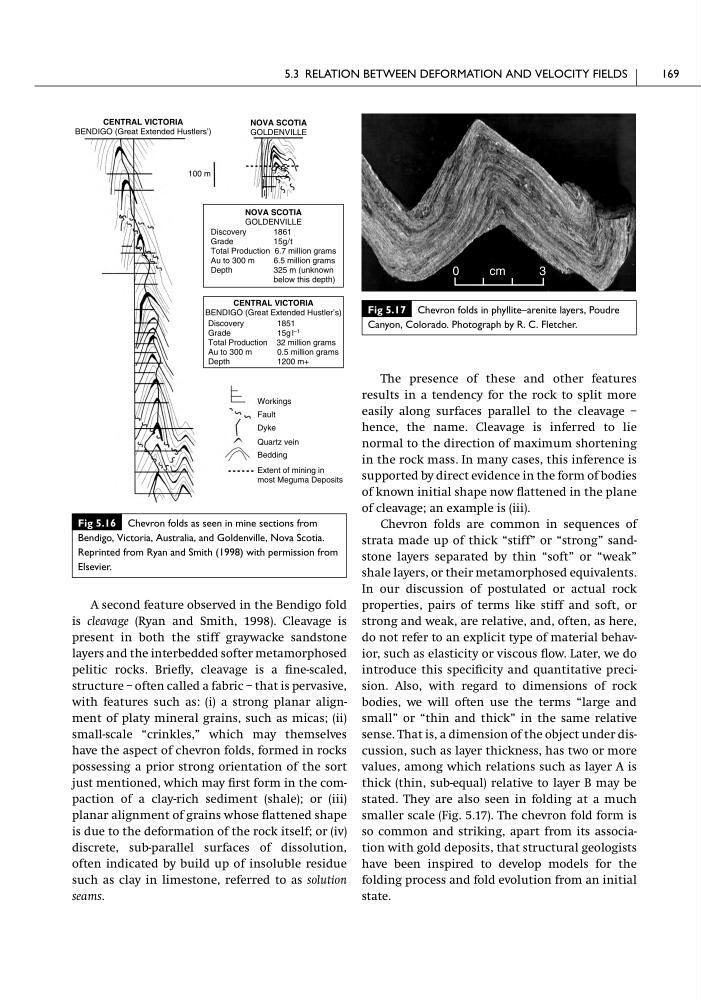
smaller scale (Fig. 5.17). The chevron fold form is
so common and striking, apart from its association with gold deposits, that structural geologists
have been inspired to develop models for the
folding process and fold evolution from an initial
state.
5.3 RELATION BETWEEN DEFORMATION AND VELOCITY FIELDS
169
Fig 5.16 Chevron folds as seen in mine sections from
Bendigo, Victoria, Australia, and Goldenville, Nova Scotia.
Reprinted from Ryan and Smith (1998) with permission from
Elsevier.
CENTRAL VICTORIA
BENDIGO (Great Extended Hustlers’)
NOVA SCOTIA
GOLDENVILLE
100 m
Workings
Fault
Dyke
Quartz vein
Bedding
Extent of mining in
most Meguma Deposits
NOVA SCOTIA
GOLDENVILLE
Discovery
1861
Grade
15g/t
Total Production 6.7 million grams
Au to 300 m
6.5 million grams
Depth
325 m (unknown
below this depth)
Discovery
1851
Grade
15g l
–1
Total Production 32 million grams
Au to 300 m
0.5 million grams
Depth
1200 m+
CENTRAL VICTORIA
BENDIGO (Great Extended Hustler’s)
Fig 5.17 Chevron folds in phyllite–arenite layers, Poudre
Canyon, Colorado. Photograph by R. C. Fletcher.
0
cm
3
is cleavage (Ryan and Smith, 1998). Cleavage is
present in both the stiff graywacke sandstone
layers and the interbedded softer metamorphosed
pelitic rocks. Briefly, cleavage is a fine-scaled,
structure – often called a fabric – that is pervasive,
with features such as: (i) a strong planar alignment of platy mineral grains, such as micas; (ii)
small-scale “crinkles,” which may themselves
have the aspect of chevron folds, formed in rocks
possessing a prior strong orientation of the sort
just mentioned, which may first form in the compaction of a clay-rich sediment (shale); or (iii)
planar alignment of grains whose flattened shape
is due to the deformation of the rock itself; or (iv)
discrete, sub-parallel surfaces of dissolution,
often indicated by build up of insoluble residue
such as clay in limestone, referred to as solution
seams.
The presence of these and other features
results in a tendency for the rock to split more
easily along surfaces parallel to the cleavage –
hence, the name. Cleavage is inferred to lie
normal to the direction of maximum shortening
in the rock mass. In many cases, this inference is
supported by direct evidence in the form of bodies
of known initial shape now flattened in the plane
of cleavage; an example is (iii).
Chevron folds are common in sequences of
strata made up of thick “stiff” or “strong” sandstone layers separated by thin “soft” or “weak”
shale layers, or their metamorphosed equivalents.
In our discussion of postulated or actual rock
properties, pairs of terms like stiff and soft, or
strong and weak, are relative, and, often, as here,
do not refer to an explicit type of material behavior, such as elasticity or viscous flow. Later, we do
introduce this specificity and quantitative precision. Also, with regard to dimensions of rock
bodies, we will often use the terms “large and
small” or “thin and thick” in the same relative
sense. That is, a dimension of the object under discussion, such as layer thickness, has two or more
values, among which relations such as layer A is
thick (thin, sub-equal) relative to layer B may be
stated. They are also seen in folding at a much
smaller scale (Fig. 5.17). The chevron fold form is
so common and striking, apart from its association with gold deposits, that structural geologists
have been inspired to develop models for the
folding process and fold evolution from an initial
state.
5.3 RELATION BETWEEN DEFORMATION AND VELOCITY FIELDS
169
Fig 5.16 Chevron folds as seen in mine sections from
Bendigo, Victoria, Australia, and Goldenville, Nova Scotia.
Reprinted from Ryan and Smith (1998) with permission from
Elsevier.
CENTRAL VICTORIA
BENDIGO (Great Extended Hustlers’)
NOVA SCOTIA
GOLDENVILLE
100 m
Workings
Fault
Dyke
Quartz vein
Bedding
Extent of mining in
most Meguma Deposits
NOVA SCOTIA
GOLDENVILLE
Discovery
1861
Grade
15g/t
Total Production 6.7 million grams
Au to 300 m
6.5 million grams
Depth
325 m (unknown
below this depth)
Discovery
1851
Grade
15g l
–1
Total Production 32 million grams
Au to 300 m
0.5 million grams
Depth
1200 m+
CENTRAL VICTORIA
BENDIGO (Great Extended Hustler’s)
Fig 5.17 Chevron folds in phyllite–arenite layers, Poudre
Canyon, Colorado. Photograph by R. C. Fletcher.
0
cm
3