

gravity, g, indicates. As we shall see, the velocity
field, although expressed by (5.19), is not easy to
conceive of in an ad hoc manner.
The remarkable solution of Stokes for a rigid
sphere rising or sinking in a viscous fluid was
modified by others to treat the rise of a viscous
sphere (Lamb, 1945). A sphere of viscous fluid with
density 1 , intrusion viscosity 1 , and radius R will
rise in a viscous medium with density and viscosity if the density difference, Ϫ 1 , is positive. Experiment and theory show that the sphere
maintains its shape if the rate of rise is slow
enough (Fig. 5.12). We use the results to illustrate
the motion within the sphere, but specifically to
determine the deformation within it and internal
structures that might form between initial and
final states, separated by an interval of rise.
The steady, or time-independent, rate of rise of
the sphere is:
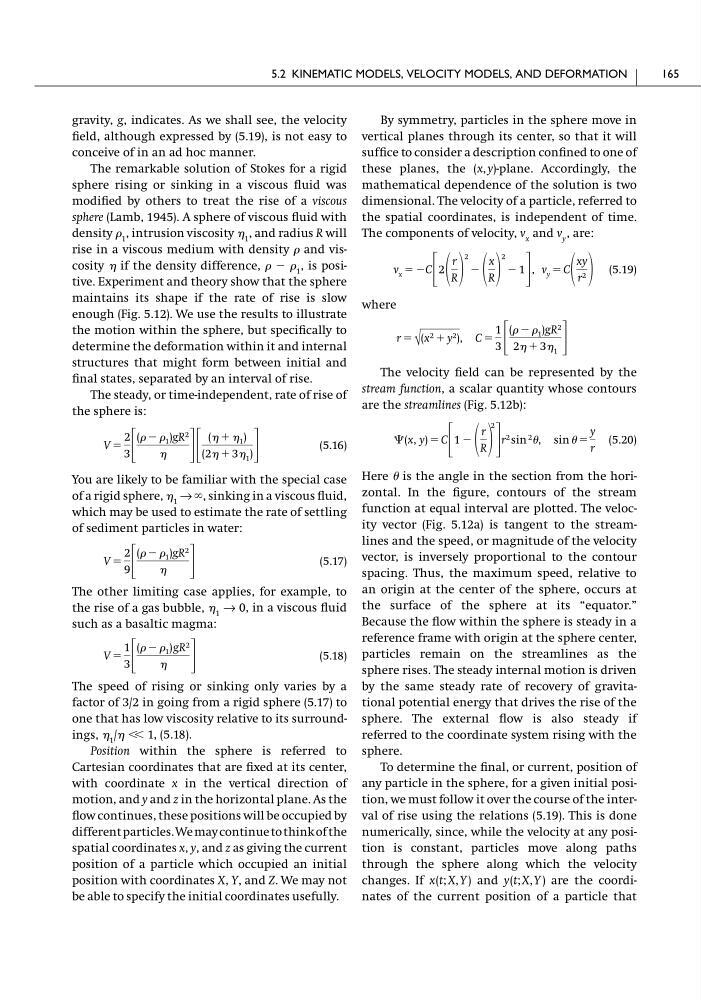
(5.16)
You are likely to be familiar with the special case
of a rigid sphere, 1 → ϱ, sinking in a viscous fluid,
which may be used to estimate the rate of settling
of sediment particles in water:
(5.17)
The other limiting case applies, for example, to
the rise of a gas bubble, 1 → 0, in a viscous fluid
such as a basaltic magma:
(5.18)
The speed of rising or sinking only varies by a
factor of 3/2 in going from a rigid sphere (5.17) to
one that has low viscosity relative to its surroundings, 1 / Ͻ Ͻ 1, (5.18).
Position within the sphere is referred to
Cartesian coordinates that are fixed at its center,
with coordinate x in the vertical direction of
motion, and y and z in the horizontal plane. As the
flow continues, these positions will be occupied by
different particles. We may continue to think of the
spatial coordinates x, y, and z as giving the current
position of a particle which occupied an initial
position with coordinates X, Y, and Z. We may not
be able to specify the initial coordinates usefully.
V ϭ
1
3 ΄
( Ϫ 1 )gR 2
΅
V ϭ
2
9 ΄
( Ϫ 1 )gR 2
΅
V ϭ
2
3 ΄
( Ϫ 1 )gR 2
΅΄
( ϩ 1 )
(2 ϩ 3 1 ) ΅
By symmetry, particles in the sphere move in
vertical planes through its center, so that it will
suffice to consider a description confined to one of
these planes, the (x, y)-plane. Accordingly, the
mathematical dependence of the solution is two
dimensional. The velocity of a particle, referred to
the spatial coordinates, is independent of time.
The components of velocity, v x and v y , are:
(5.19)
where
The velocity field can be represented by the
stream function, a scalar quantity whose contours
are the streamlines (Fig. 5.12b):
(5.20)
Here is the angle in the section from the horizontal. In the figure, contours of the stream
function at equal interval are plotted. The velocity vector (Fig. 5.12a) is tangent to the streamlines and the speed, or magnitude of the velocity
vector, is inversely proportional to the contour
spacing. Thus, the maximum speed, relative to
an origin at the center of the sphere, occurs at
the surface of the sphere at its “equator.”
Because the flow within the sphere is steady in a
reference frame with origin at the sphere center,
particles remain on the streamlines as the
sphere rises. The steady internal motion is driven
by the same steady rate of recovery of gravitational potential energy that drives the rise of the
sphere. The external flow is also steady if
referred to the coordinate system rising with the
sphere.
To determine the final, or current, position of
any particle in the sphere, for a given initial position, we must follow it over the course of the interval of rise using the relations (5.19). This is done
numerically, since, while the velocity at any position is constant, particles move along paths
through the sphere along which the velocity
changes. If x(t; X, Y ) and y(t; X, Y ) are the coordinates of the current position of a particle that
⌿(x, y) ϭ C
΄
1 Ϫ
r
R
2
΅
r 2 sin 2 , sin ϭ
y
r
r ϭ √ (x 2 ϩ y 2 ), C ϭ
1
3 ΄
( Ϫ 1 )gR 2
2 ϩ 3 1
΅
v x ϭ ϪC
΄
2
r
R
2
Ϫ
x
R
2
Ϫ 1
΅
, v y ϭ C
xy
r 2
5.2 KINEMATIC MODELS, VELOCITY MODELS, AND DEFORMATION
165
field, although expressed by (5.19), is not easy to
conceive of in an ad hoc manner.
The remarkable solution of Stokes for a rigid
sphere rising or sinking in a viscous fluid was
modified by others to treat the rise of a viscous
sphere (Lamb, 1945). A sphere of viscous fluid with
density 1 , intrusion viscosity 1 , and radius R will
rise in a viscous medium with density and viscosity if the density difference, Ϫ 1 , is positive. Experiment and theory show that the sphere
maintains its shape if the rate of rise is slow
enough (Fig. 5.12). We use the results to illustrate
the motion within the sphere, but specifically to
determine the deformation within it and internal
structures that might form between initial and
final states, separated by an interval of rise.
The steady, or time-independent, rate of rise of
the sphere is:
(5.16)
You are likely to be familiar with the special case
of a rigid sphere, 1 → ϱ, sinking in a viscous fluid,
which may be used to estimate the rate of settling
of sediment particles in water:
(5.17)
The other limiting case applies, for example, to
the rise of a gas bubble, 1 → 0, in a viscous fluid
such as a basaltic magma:
(5.18)
The speed of rising or sinking only varies by a
factor of 3/2 in going from a rigid sphere (5.17) to
one that has low viscosity relative to its surroundings, 1 / Ͻ Ͻ 1, (5.18).
Position within the sphere is referred to
Cartesian coordinates that are fixed at its center,
with coordinate x in the vertical direction of
motion, and y and z in the horizontal plane. As the
flow continues, these positions will be occupied by
different particles. We may continue to think of the
spatial coordinates x, y, and z as giving the current
position of a particle which occupied an initial
position with coordinates X, Y, and Z. We may not
be able to specify the initial coordinates usefully.
V ϭ
1
3 ΄
( Ϫ 1 )gR 2
΅
V ϭ
2
9 ΄
( Ϫ 1 )gR 2
΅
V ϭ
2
3 ΄
( Ϫ 1 )gR 2
΅΄
( ϩ 1 )
(2 ϩ 3 1 ) ΅
By symmetry, particles in the sphere move in
vertical planes through its center, so that it will
suffice to consider a description confined to one of
these planes, the (x, y)-plane. Accordingly, the
mathematical dependence of the solution is two
dimensional. The velocity of a particle, referred to
the spatial coordinates, is independent of time.
The components of velocity, v x and v y , are:
(5.19)
where
The velocity field can be represented by the
stream function, a scalar quantity whose contours
are the streamlines (Fig. 5.12b):
(5.20)
Here is the angle in the section from the horizontal. In the figure, contours of the stream
function at equal interval are plotted. The velocity vector (Fig. 5.12a) is tangent to the streamlines and the speed, or magnitude of the velocity
vector, is inversely proportional to the contour
spacing. Thus, the maximum speed, relative to
an origin at the center of the sphere, occurs at
the surface of the sphere at its “equator.”
Because the flow within the sphere is steady in a
reference frame with origin at the sphere center,
particles remain on the streamlines as the
sphere rises. The steady internal motion is driven
by the same steady rate of recovery of gravitational potential energy that drives the rise of the
sphere. The external flow is also steady if
referred to the coordinate system rising with the
sphere.
To determine the final, or current, position of
any particle in the sphere, for a given initial position, we must follow it over the course of the interval of rise using the relations (5.19). This is done
numerically, since, while the velocity at any position is constant, particles move along paths
through the sphere along which the velocity
changes. If x(t; X, Y ) and y(t; X, Y ) are the coordinates of the current position of a particle that
⌿(x, y) ϭ C
΄
1 Ϫ
r
R
2
΅
r 2 sin 2 , sin ϭ
y
r
r ϭ √ (x 2 ϩ y 2 ), C ϭ
1
3 ΄
( Ϫ 1 )gR 2
2 ϩ 3 1
΅
v x ϭ ϪC
΄
2
r
R
2
Ϫ
x
R
2
Ϫ 1
΅
, v y ϭ C
xy
r 2
5.2 KINEMATIC MODELS, VELOCITY MODELS, AND DEFORMATION
165