

presently interested in the causal mechanism. By
symmetry, the inflation, although of a threedimensional object, is mathematically one dimensional, depending only on radius. The object is the
volume contained between two concentric spherical surfaces. We may readily grasp the nature of the
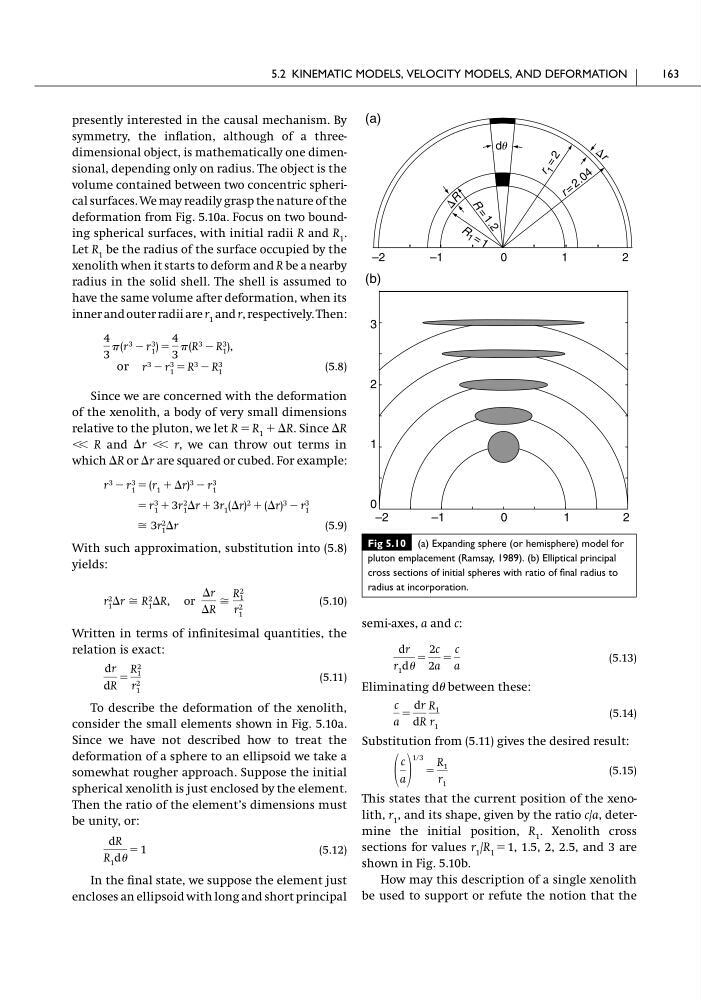
deformation from Fig. 5.10a. Focus on two bounding spherical surfaces, with initial radii R and R 1 .
Let R 1 be the radius of the surface occupied by the
xenolith when it starts to deform and R be a nearby
radius in the solid shell. The shell is assumed to
have the same volume after deformation, when its
inner and outer radii are r 1 and r, respectively. Then:
or
(5.8)
Since we are concerned with the deformation
of the xenolith, a body of very small dimensions
relative to the pluton, we let
. Since
Ͻ Ͻ R and
Ͻ Ͻ r, we can throw out terms in
which
or are squared or cubed. For example:
(5.9)
With such approximation, substitution into (5.8)
yields:
(5.10)
Written in terms of infinitesimal quantities, the
relation is exact:
(5.11)
To describe the deformation of the xenolith,
consider the small elements shown in Fig. 5.10a.
Since we have not described how to treat the
deformation of a sphere to an ellipsoid we take a
somewhat rougher approach. Suppose the initial
spherical xenolith is just enclosed by the element.
Then the ratio of the element’s dimensions must
be unity, or:
(5.12)
In the final state, we suppose the element just
encloses an ellipsoid with long and short principal
dR
R 1 d
ϭ 1
dr
dR
ϭ
R 2
1
r 2
1
r 2
1 ⌬r Х R 2
1 ⌬R, or
⌬r
⌬R
Х
R 2
1
r 2
1
Х 3r 2
1 ⌬r
ϭ r 3
1 ϩ 3r 2
1 ⌬r ϩ 3r 1 (⌬r) 2 ϩ (⌬r) 3 Ϫ r 3
1
r 3 Ϫ r 3
1 ϭ (r 1 ϩ ⌬r) 3 Ϫ r 3
1
⌬r
⌬R
⌬r
⌬R
R ϭ R 1 ϩ ⌬R
r 3 Ϫ r 3
1 ϭ R 3 Ϫ R 3
1
4
3
(r 3 Ϫ r 3
1 ) ϭ
4
3
(R 3 Ϫ R 3
1 ),
semi-axes, a and c:
(5.13)
Eliminating d between these:
(5.14)
Substitution from (5.11) gives the desired result:
(5.15)
This states that the current position of the xenolith, r 1 , and its shape, given by the ratio c/a, determine the initial position, R 1 . Xenolith cross
sections for values r 1 /R 1 ϭ 1, 1.5, 2, 2.5, and 3 are
shown in Fig. 5.10b.
How may this description of a single xenolith
be used to support or refute the notion that the
c
a
1ր 3
ϭ
R 1
r 1
c
a
ϭ
dr
dR
R 1
r 1
dr
r 1 d
ϭ
2c
2a
ϭ
c
a
5.2 KINEMATIC MODELS, VELOCITY MODELS, AND DEFORMATION
163
Fig 5.10 (a) Expanding sphere (or hemisphere) model for
pluton emplacement (Ramsay, 1989). (b) Elliptical principal
cross sections of initial spheres with ratio of final radius to
radius at incorporation.
3
2
1
0
–2
–1
0
1
2
⌬
r
R
= 1 . 2
⌬
R
du
r 1
= 2
r = 2 . 0 4
R
1 = 1
(a)
–2
–1
0
1
2
(b)
symmetry, the inflation, although of a threedimensional object, is mathematically one dimensional, depending only on radius. The object is the
volume contained between two concentric spherical surfaces. We may readily grasp the nature of the
deformation from Fig. 5.10a. Focus on two bounding spherical surfaces, with initial radii R and R 1 .
Let R 1 be the radius of the surface occupied by the
xenolith when it starts to deform and R be a nearby
radius in the solid shell. The shell is assumed to
have the same volume after deformation, when its
inner and outer radii are r 1 and r, respectively. Then:
or
(5.8)
Since we are concerned with the deformation
of the xenolith, a body of very small dimensions
relative to the pluton, we let
. Since
Ͻ Ͻ R and
Ͻ Ͻ r, we can throw out terms in
which
or are squared or cubed. For example:
(5.9)
With such approximation, substitution into (5.8)
yields:
(5.10)
Written in terms of infinitesimal quantities, the
relation is exact:
(5.11)
To describe the deformation of the xenolith,
consider the small elements shown in Fig. 5.10a.
Since we have not described how to treat the
deformation of a sphere to an ellipsoid we take a
somewhat rougher approach. Suppose the initial
spherical xenolith is just enclosed by the element.
Then the ratio of the element’s dimensions must
be unity, or:
(5.12)
In the final state, we suppose the element just
encloses an ellipsoid with long and short principal
dR
R 1 d
ϭ 1
dr
dR
ϭ
R 2
1
r 2
1
r 2
1 ⌬r Х R 2
1 ⌬R, or
⌬r
⌬R
Х
R 2
1
r 2
1
Х 3r 2
1 ⌬r
ϭ r 3
1 ϩ 3r 2
1 ⌬r ϩ 3r 1 (⌬r) 2 ϩ (⌬r) 3 Ϫ r 3
1
r 3 Ϫ r 3
1 ϭ (r 1 ϩ ⌬r) 3 Ϫ r 3
1
⌬r
⌬R
⌬r
⌬R
R ϭ R 1 ϩ ⌬R
r 3 Ϫ r 3
1 ϭ R 3 Ϫ R 3
1
4
3
(r 3 Ϫ r 3
1 ) ϭ
4
3
(R 3 Ϫ R 3
1 ),
semi-axes, a and c:
(5.13)
Eliminating d between these:
(5.14)
Substitution from (5.11) gives the desired result:
(5.15)
This states that the current position of the xenolith, r 1 , and its shape, given by the ratio c/a, determine the initial position, R 1 . Xenolith cross
sections for values r 1 /R 1 ϭ 1, 1.5, 2, 2.5, and 3 are
shown in Fig. 5.10b.
How may this description of a single xenolith
be used to support or refute the notion that the
c
a
1ր 3
ϭ
R 1
r 1
c
a
ϭ
dr
dR
R 1
r 1
dr
r 1 d
ϭ
2c
2a
ϭ
c
a
5.2 KINEMATIC MODELS, VELOCITY MODELS, AND DEFORMATION
163
Fig 5.10 (a) Expanding sphere (or hemisphere) model for
pluton emplacement (Ramsay, 1989). (b) Elliptical principal
cross sections of initial spheres with ratio of final radius to
radius at incorporation.
3
2
1
0
–2
–1
0
1
2
⌬
r
R
= 1 . 2
⌬
R
du
r 1
= 2
r = 2 . 0 4
R
1 = 1
(a)
–2
–1
0
1
2
(b)