

showing the short and long axis are demonstrated
for each population. All xenolith axial lengths are
changed from their initial values.
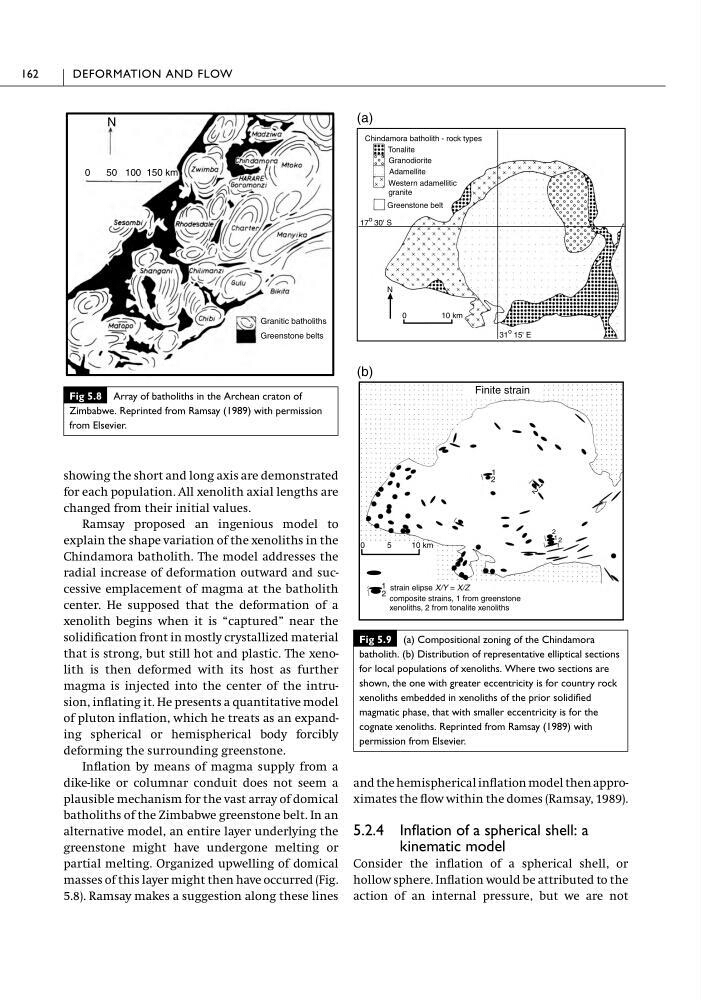
Ramsay proposed an ingenious model to
explain the shape variation of the xenoliths in the
Chindamora batholith. The model addresses the
radial increase of deformation outward and successive emplacement of magma at the batholith
center. He supposed that the deformation of a
xenolith begins when it is “captured” near the
solidification front in mostly crystallized material
that is strong, but still hot and plastic. The xenolith is then deformed with its host as further
magma is injected into the center of the intrusion, inflating it. He presents a quantitative model
of pluton inflation, which he treats as an expanding spherical or hemispherical body forcibly
deforming the surrounding greenstone.
Inflation by means of magma supply from a
dike-like or columnar conduit does not seem a
plausible mechanism for the vast array of domical
batholiths of the Zimbabwe greenstone belt. In an
alternative model, an entire layer underlying the
greenstone might have undergone melting or
partial melting. Organized upwelling of domical
masses of this layer might then have occurred (Fig.
5.8). Ramsay makes a suggestion along these lines
and the hemispherical inflation model then approximates the flow within the domes (Ramsay, 1989).
5.2.4 Inflation of a spherical shell: a
kinematic model
Consider the inflation of a spherical shell, or
hollow sphere. Inflation would be attributed to the
action of an internal pressure, but we are not
162
DEFORMATION AND FLOW
Fig 5.8 Array of batholiths in the Archean craton of
Zimbabwe. Reprinted from Ramsay (1989) with permission
from Elsevier.
N
0
50 100 150 km
Granitic batholiths
Greenstone belts
Fig 5.9 (a) Compositional zoning of the Chindamora
batholith. (b) Distribution of representative elliptical sections
for local populations of xenoliths. Where two sections are
shown, the one with greater eccentricity is for country rock
xenoliths embedded in xenoliths of the prior solidified
magmatic phase, that with smaller eccentricity is for the
cognate xenoliths. Reprinted from Ramsay (1989) with
permission from Elsevier.
0
5
10 km
strain elipse X/Y = X/Z
composite strains, 1 from greenstone
xenoliths, 2 from tonalite xenoliths
1
2
1
2
1
2
2
1 2
1
Finite strain
(a)
Tonalite
Granodiorite
Adamellite
Western adamellitic
granite
Greenstone belt
N
0
10 km
Chindamora batholith - rock types
17
o 30' S
31
o 15' E
(b)
for each population. All xenolith axial lengths are
changed from their initial values.
Ramsay proposed an ingenious model to
explain the shape variation of the xenoliths in the
Chindamora batholith. The model addresses the
radial increase of deformation outward and successive emplacement of magma at the batholith
center. He supposed that the deformation of a
xenolith begins when it is “captured” near the
solidification front in mostly crystallized material
that is strong, but still hot and plastic. The xenolith is then deformed with its host as further
magma is injected into the center of the intrusion, inflating it. He presents a quantitative model
of pluton inflation, which he treats as an expanding spherical or hemispherical body forcibly
deforming the surrounding greenstone.
Inflation by means of magma supply from a
dike-like or columnar conduit does not seem a
plausible mechanism for the vast array of domical
batholiths of the Zimbabwe greenstone belt. In an
alternative model, an entire layer underlying the
greenstone might have undergone melting or
partial melting. Organized upwelling of domical
masses of this layer might then have occurred (Fig.
5.8). Ramsay makes a suggestion along these lines
and the hemispherical inflation model then approximates the flow within the domes (Ramsay, 1989).
5.2.4 Inflation of a spherical shell: a
kinematic model
Consider the inflation of a spherical shell, or
hollow sphere. Inflation would be attributed to the
action of an internal pressure, but we are not
162
DEFORMATION AND FLOW
Fig 5.8 Array of batholiths in the Archean craton of
Zimbabwe. Reprinted from Ramsay (1989) with permission
from Elsevier.
N
0
50 100 150 km
Granitic batholiths
Greenstone belts
Fig 5.9 (a) Compositional zoning of the Chindamora
batholith. (b) Distribution of representative elliptical sections
for local populations of xenoliths. Where two sections are
shown, the one with greater eccentricity is for country rock
xenoliths embedded in xenoliths of the prior solidified
magmatic phase, that with smaller eccentricity is for the
cognate xenoliths. Reprinted from Ramsay (1989) with
permission from Elsevier.
0
5
10 km
strain elipse X/Y = X/Z
composite strains, 1 from greenstone
xenoliths, 2 from tonalite xenoliths
1
2
1
2
1
2
2
1 2
1
Finite strain
(a)
Tonalite
Granodiorite
Adamellite
Western adamellitic
granite
Greenstone belt
N
0
10 km
Chindamora batholith - rock types
17
o 30' S
31
o 15' E
(b)