

(Ramsay, 1989). The batholith is zoned (Fig. 5.9a) in
the order of intrusion, with the earliest intruded
unit at its periphery. Ramsay determined the
mean shapes of populations of xenoliths (Greek:
foreign stones), consisting of fragments of the
country rock, or of previously solidified intrusive
units (cognate xenoliths). The distribution of xenolith shapes within the batholith is shown in Fig.
5.9b. More strongly flattened xenoliths are found
in the earlier emplaced rocks and nearer the
periphery. The exception, in both inward order of
intrusion and presence of strongly flattened xenoliths, is the last-intruded western granite.
The initial forms of the xenoliths would have
been irregular, but roughly equant, so we take the
mean form as a sphere. The final form for a given
local population of xenoliths averages out to a
pancake-shaped ellipsoid with one short axis and
two sub-equal long axes. Elliptical sections
5.2 KINEMATIC MODELS, VELOCITY MODELS, AND DEFORMATION
161
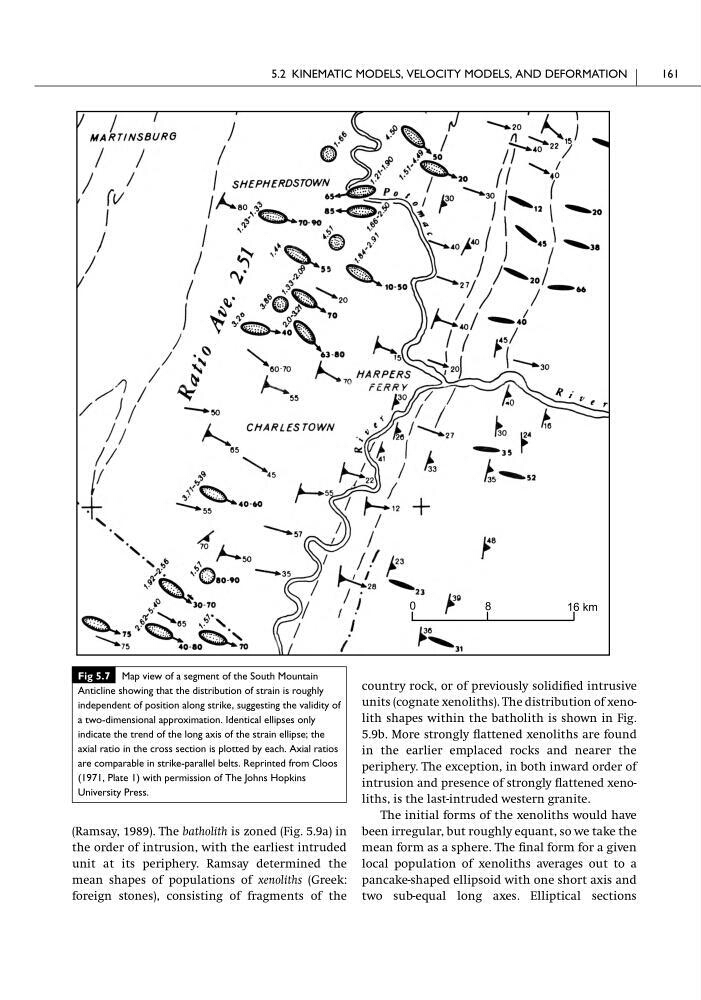
Fig 5.7 Map view of a segment of the South Mountain
Anticline showing that the distribution of strain is roughly
independent of position along strike, suggesting the validity of
a two-dimensional approximation. Identical ellipses only
indicate the trend of the long axis of the strain ellipse; the
axial ratio in the cross section is plotted by each. Axial ratios
are comparable in strike-parallel belts. Reprinted from Cloos
(1971, Plate 1) with permission of The Johns Hopkins
University Press.
16 km
0
8
the order of intrusion, with the earliest intruded
unit at its periphery. Ramsay determined the
mean shapes of populations of xenoliths (Greek:
foreign stones), consisting of fragments of the
country rock, or of previously solidified intrusive
units (cognate xenoliths). The distribution of xenolith shapes within the batholith is shown in Fig.
5.9b. More strongly flattened xenoliths are found
in the earlier emplaced rocks and nearer the
periphery. The exception, in both inward order of
intrusion and presence of strongly flattened xenoliths, is the last-intruded western granite.
The initial forms of the xenoliths would have
been irregular, but roughly equant, so we take the
mean form as a sphere. The final form for a given
local population of xenoliths averages out to a
pancake-shaped ellipsoid with one short axis and
two sub-equal long axes. Elliptical sections
5.2 KINEMATIC MODELS, VELOCITY MODELS, AND DEFORMATION
161
Fig 5.7 Map view of a segment of the South Mountain
Anticline showing that the distribution of strain is roughly
independent of position along strike, suggesting the validity of
a two-dimensional approximation. Identical ellipses only
indicate the trend of the long axis of the strain ellipse; the
axial ratio in the cross section is plotted by each. Axial ratios
are comparable in strike-parallel belts. Reprinted from Cloos
(1971, Plate 1) with permission of The Johns Hopkins
University Press.
16 km
0
8