

constrain and determine, both of which, unlike
control, have distinct and separate meanings.
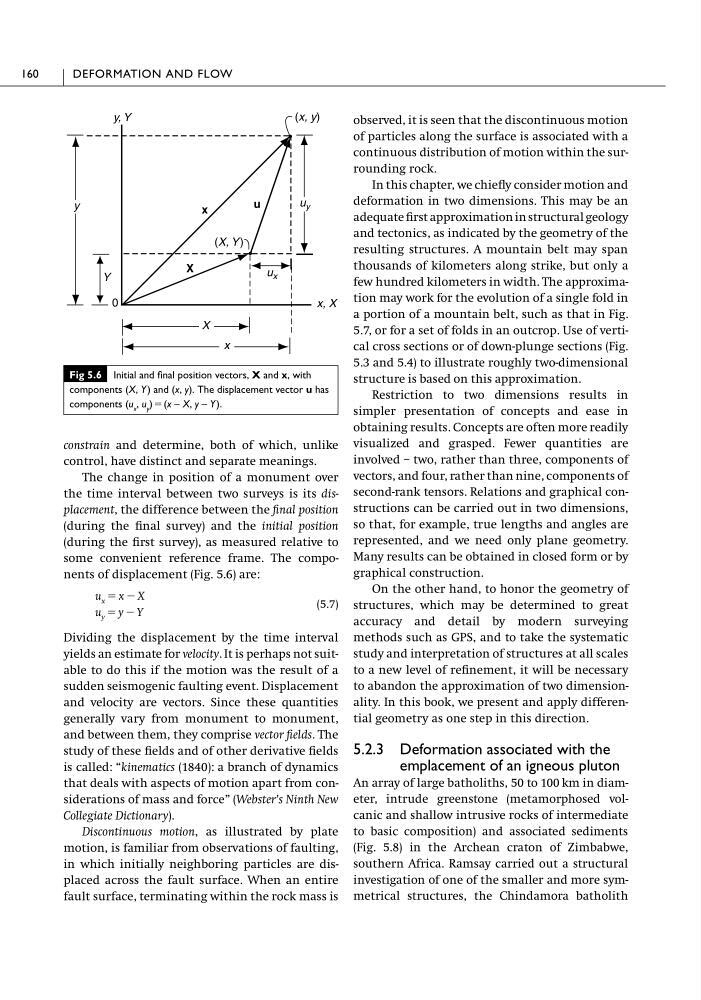
The change in position of a monument over
the time interval between two surveys is its displacement, the difference between the final position
(during the final survey) and the initial position
(during the first survey), as measured relative to
some convenient reference frame. The components of displacement (Fig. 5.6) are:
(5.7)
Dividing the displacement by the time interval
yields an estimate for velocity. It is perhaps not suitable to do this if the motion was the result of a
sudden seismogenic faulting event. Displacement
and velocity are vectors. Since these quantities
generally vary from monument to monument,
and between them, they comprise vector fields. The
study of these fields and of other derivative fields
is called: “kinematics (1840): a branch of dynamics
that deals with aspects of motion apart from considerations of mass and force” (Webster’s Ninth New
Collegiate Dictionary).
Discontinuous motion, as illustrated by plate
motion, is familiar from observations of faulting,
in which initially neighboring particles are displaced across the fault surface. When an entire
fault surface, terminating within the rock mass is
u y ϭ y Ϫ Y
u x ϭ x Ϫ X
observed, it is seen that the discontinuous motion
of particles along the surface is associated with a
continuous distribution of motion within the surrounding rock.
In this chapter, we chiefly consider motion and
deformation in two dimensions. This may be an
adequate first approximation in structural geology
and tectonics, as indicated by the geometry of the
resulting structures. A mountain belt may span
thousands of kilometers along strike, but only a
few hundred kilometers in width. The approximation may work for the evolution of a single fold in
a portion of a mountain belt, such as that in Fig.
5.7, or for a set of folds in an outcrop. Use of vertical cross sections or of down-plunge sections (Fig.
5.3 and 5.4) to illustrate roughly two-dimensional
structure is based on this approximation.
Restriction to two dimensions results in
simpler presentation of concepts and ease in
obtaining results. Concepts are often more readily
visualized and grasped. Fewer quantities are
involved – two, rather than three, components of
vectors, and four, rather than nine, components of
second-rank tensors. Relations and graphical constructions can be carried out in two dimensions,
so that, for example, true lengths and angles are
represented, and we need only plane geometry.
Many results can be obtained in closed form or by
graphical construction.
On the other hand, to honor the geometry of
structures, which may be determined to great
accuracy and detail by modern surveying
methods such as GPS, and to take the systematic
study and interpretation of structures at all scales
to a new level of refinement, it will be necessary
to abandon the approximation of two dimensionality. In this book, we present and apply differential geometry as one step in this direction.
5.2.3 Deformation associated with the
emplacement of an igneous pluton
An array of large batholiths, 50 to 100 km in diameter, intrude greenstone (metamorphosed volcanic and shallow intrusive rocks of intermediate
to basic composition) and associated sediments
(Fig. 5.8) in the Archean craton of Zimbabwe,
southern Africa. Ramsay carried out a structural
investigation of one of the smaller and more symmetrical structures, the Chindamora batholith
160
DEFORMATION AND FLOW
Fig 5.6 Initial and final position vectors, X and x, with
components (X, Y ) and (x, y). The displacement vector u has
components (u x , u y )ϭ (x – X, y – Y ).
y, Y
(x, y)
u
x
u x
X
(X, Y)
0
x, X
u y
x
X
y
Y
control, have distinct and separate meanings.
The change in position of a monument over
the time interval between two surveys is its displacement, the difference between the final position
(during the final survey) and the initial position
(during the first survey), as measured relative to
some convenient reference frame. The components of displacement (Fig. 5.6) are:
(5.7)
Dividing the displacement by the time interval
yields an estimate for velocity. It is perhaps not suitable to do this if the motion was the result of a
sudden seismogenic faulting event. Displacement
and velocity are vectors. Since these quantities
generally vary from monument to monument,
and between them, they comprise vector fields. The
study of these fields and of other derivative fields
is called: “kinematics (1840): a branch of dynamics
that deals with aspects of motion apart from considerations of mass and force” (Webster’s Ninth New
Collegiate Dictionary).
Discontinuous motion, as illustrated by plate
motion, is familiar from observations of faulting,
in which initially neighboring particles are displaced across the fault surface. When an entire
fault surface, terminating within the rock mass is
u y ϭ y Ϫ Y
u x ϭ x Ϫ X
observed, it is seen that the discontinuous motion
of particles along the surface is associated with a
continuous distribution of motion within the surrounding rock.
In this chapter, we chiefly consider motion and
deformation in two dimensions. This may be an
adequate first approximation in structural geology
and tectonics, as indicated by the geometry of the
resulting structures. A mountain belt may span
thousands of kilometers along strike, but only a
few hundred kilometers in width. The approximation may work for the evolution of a single fold in
a portion of a mountain belt, such as that in Fig.
5.7, or for a set of folds in an outcrop. Use of vertical cross sections or of down-plunge sections (Fig.
5.3 and 5.4) to illustrate roughly two-dimensional
structure is based on this approximation.
Restriction to two dimensions results in
simpler presentation of concepts and ease in
obtaining results. Concepts are often more readily
visualized and grasped. Fewer quantities are
involved – two, rather than three, components of
vectors, and four, rather than nine, components of
second-rank tensors. Relations and graphical constructions can be carried out in two dimensions,
so that, for example, true lengths and angles are
represented, and we need only plane geometry.
Many results can be obtained in closed form or by
graphical construction.
On the other hand, to honor the geometry of
structures, which may be determined to great
accuracy and detail by modern surveying
methods such as GPS, and to take the systematic
study and interpretation of structures at all scales
to a new level of refinement, it will be necessary
to abandon the approximation of two dimensionality. In this book, we present and apply differential geometry as one step in this direction.
5.2.3 Deformation associated with the
emplacement of an igneous pluton
An array of large batholiths, 50 to 100 km in diameter, intrude greenstone (metamorphosed volcanic and shallow intrusive rocks of intermediate
to basic composition) and associated sediments
(Fig. 5.8) in the Archean craton of Zimbabwe,
southern Africa. Ramsay carried out a structural
investigation of one of the smaller and more symmetrical structures, the Chindamora batholith
160
DEFORMATION AND FLOW
Fig 5.6 Initial and final position vectors, X and x, with
components (X, Y ) and (x, y). The displacement vector u has
components (u x , u y )ϭ (x – X, y – Y ).
y, Y
(x, y)
u
x
u x
X
(X, Y)
0
x, X
u y
x
X
y
Y