

sliding or shearing of these vast rock masses, one
upon the other, is indicated by the very large
strains (large aspect ratio strain ellipses) present at
the base of each nappe. Notice that the strain varies
spatially. In the right-side-up strata at the upper
part of the nappe, the strain is small to moderate,
relative to the much larger strains near its base. The
belemnite of Fig. 5.1 comes from a quarry at
Leytron, Switzerland, just above the axial surface
of the Morcles Nappe, at which the beds switch
from overturned below to right-side-up above.
5.1.2 Other examples: folds and folded
oölites
The quartz vein in Fig. 5.3 may be used to provide
information on the strain in the rock containing
it. The rock may have been deformed before the
quartz vein formed, so the information pertains
only to the subsequent deformation. If it is
assumed the vein buckled into the folded form
without changing its arc length, the final length l
ϭ 260/60" and the initial length l 0 ϭ 370/60" give a
ratio l/l 0 ϭ 0.70. This ratio is less than one, and,
also called a stretch, represents a contraction in
the direction parallel to the line labeled l. If
maximum elongation occurred at right-angles to
the contraction in the plane of the figure, and the
area in the plane was unchanged in the deformation, the corresponding elongation would be the
reciprocal of the above ratio, or 1.42, and this
stretch refers to the material lines perpendicular
to the line labeled l.
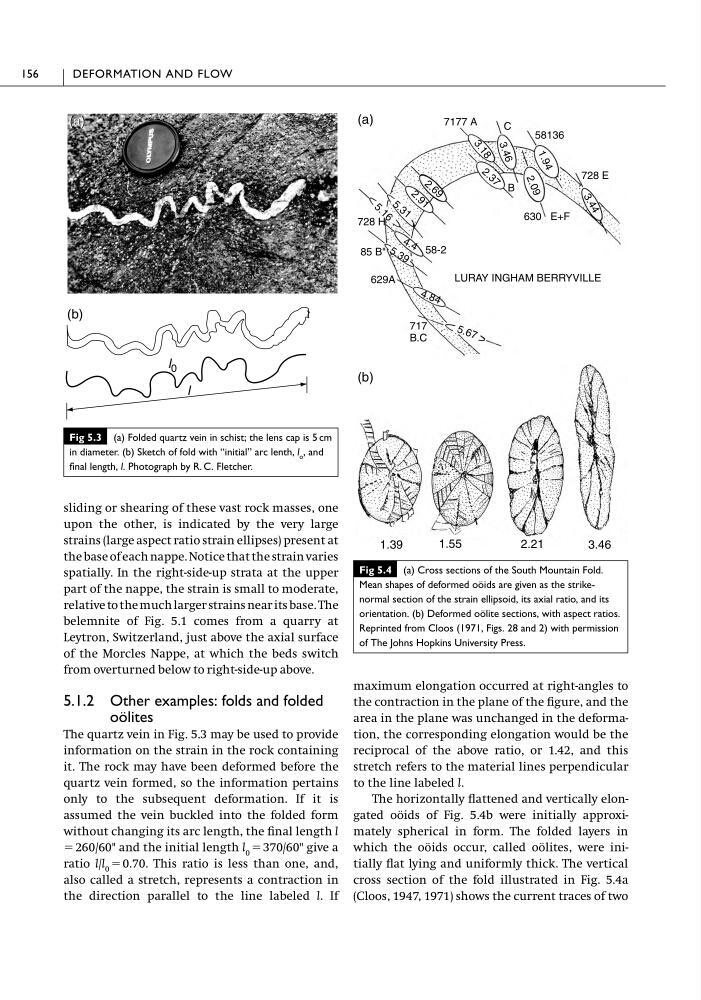
The horizontally flattened and vertically elongated oöids of Fig. 5.4b were initially approximately spherical in form. The folded layers in
which the oöids occur, called oölites, were initially flat lying and uniformly thick. The vertical
cross section of the fold illustrated in Fig. 5.4a
(Cloos, 1947, 1971) shows the current traces of two
156
DEFORMATION AND FLOW
Fig 5.3 (a) Folded quartz vein in schist; the lens cap is 5 cm
in diameter. (b) Sketch of fold with “initial” arc lenth, l o , and
final length, l. Photograph by R. C. Fletcher.
(b)
l
l 0
(a)
(a)
Fig 5.4 (a) Cross sections of the South Mountain Fold.
Mean shapes of deformed oöids are given as the strikenormal section of the strain ellipsoid, its axial ratio, and its
orientation. (b) Deformed oölite sections, with aspect ratios.
Reprinted from Cloos (1971, Figs. 28 and 2) with permission
of The Johns Hopkins University Press.
LURAY INGHAM BERRYVILLE
717
B.C
629A
85 B"
58-2
728 H
2 . 3 7
3 . 1 8
3 .4 6
2 .0 9
1 .9 4
3 . 4 4
728 E
58136
C
B
7177 A
630 E+F
(a)
5 .6 7
4 .8 4
5 . 3 9
4 . 4
5 . 1 6
5 . 3 1
2 . 9 1
2 . 6 9
1.39
1.55
2.21
3.46
(b)
upon the other, is indicated by the very large
strains (large aspect ratio strain ellipses) present at
the base of each nappe. Notice that the strain varies
spatially. In the right-side-up strata at the upper
part of the nappe, the strain is small to moderate,
relative to the much larger strains near its base. The
belemnite of Fig. 5.1 comes from a quarry at
Leytron, Switzerland, just above the axial surface
of the Morcles Nappe, at which the beds switch
from overturned below to right-side-up above.
5.1.2 Other examples: folds and folded
oölites
The quartz vein in Fig. 5.3 may be used to provide
information on the strain in the rock containing
it. The rock may have been deformed before the
quartz vein formed, so the information pertains
only to the subsequent deformation. If it is
assumed the vein buckled into the folded form
without changing its arc length, the final length l
ϭ 260/60" and the initial length l 0 ϭ 370/60" give a
ratio l/l 0 ϭ 0.70. This ratio is less than one, and,
also called a stretch, represents a contraction in
the direction parallel to the line labeled l. If
maximum elongation occurred at right-angles to
the contraction in the plane of the figure, and the
area in the plane was unchanged in the deformation, the corresponding elongation would be the
reciprocal of the above ratio, or 1.42, and this
stretch refers to the material lines perpendicular
to the line labeled l.
The horizontally flattened and vertically elongated oöids of Fig. 5.4b were initially approximately spherical in form. The folded layers in
which the oöids occur, called oölites, were initially flat lying and uniformly thick. The vertical
cross section of the fold illustrated in Fig. 5.4a
(Cloos, 1947, 1971) shows the current traces of two
156
DEFORMATION AND FLOW
Fig 5.3 (a) Folded quartz vein in schist; the lens cap is 5 cm
in diameter. (b) Sketch of fold with “initial” arc lenth, l o , and
final length, l. Photograph by R. C. Fletcher.
(b)
l
l 0
(a)
(a)
Fig 5.4 (a) Cross sections of the South Mountain Fold.
Mean shapes of deformed oöids are given as the strikenormal section of the strain ellipsoid, its axial ratio, and its
orientation. (b) Deformed oölite sections, with aspect ratios.
Reprinted from Cloos (1971, Figs. 28 and 2) with permission
of The Johns Hopkins University Press.
LURAY INGHAM BERRYVILLE
717
B.C
629A
85 B"
58-2
728 H
2 . 3 7
3 . 1 8
3 .4 6
2 .0 9
1 .9 4
3 . 4 4
728 E
58136
C
B
7177 A
630 E+F
(a)
5 .6 7
4 .8 4
5 . 3 9
4 . 4
5 . 1 6
5 . 3 1
2 . 9 1
2 . 6 9
1.39
1.55
2.21
3.46
(b)