

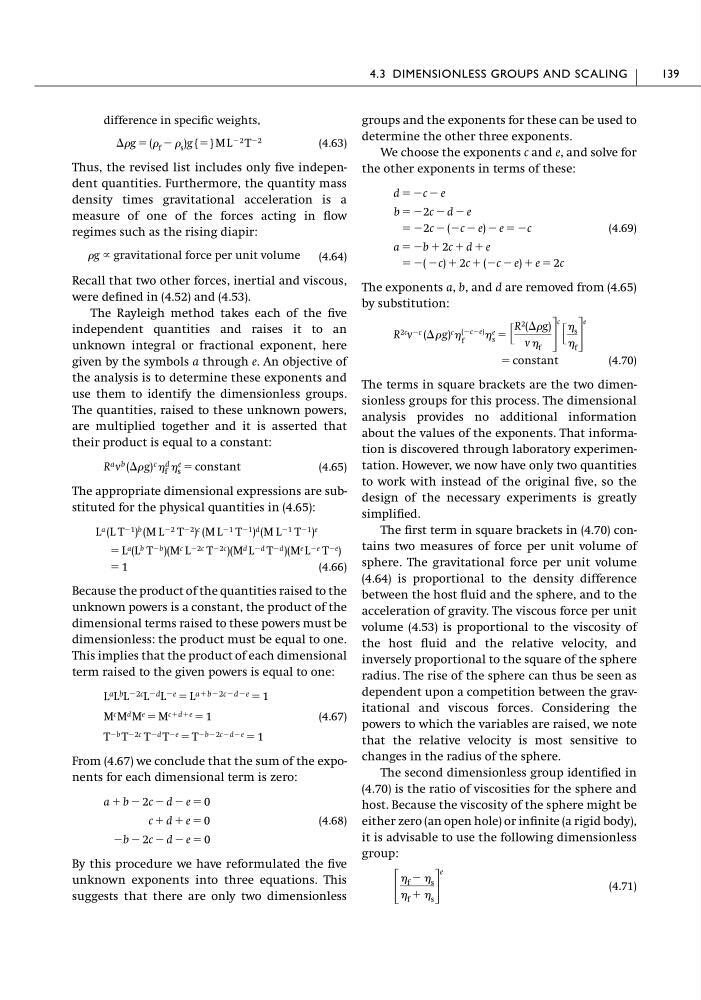
difference in specific weights,
(4.63)
Thus, the revised list includes only five independent quantities. Furthermore, the quantity mass
density times gravitational acceleration is a
measure of one of the forces acting in flow
regimes such as the rising diapir:
(4.64)
Recall that two other forces, inertial and viscous,
were defined in (4.52) and (4.53).
The Rayleigh method takes each of the five
independent quantities and raises it to an
unknown integral or fractional exponent, here
given by the symbols a through e. An objective of
the analysis is to determine these exponents and
use them to identify the dimensionless groups.
The quantities, raised to these unknown powers,
are multiplied together and it is asserted that
their product is equal to a constant:
(4.65)
The appropriate dimensional expressions are substituted for the physical quantities in (4.65):
(4.66)
Because the product of the quantities raised to the
unknown powers is a constant, the product of the
dimensional terms raised to these powers must be
dimensionless: the product must be equal to one.
This implies that the product of each dimensional
term raised to the given powers is equal to one:
(4.67)
From (4.67) we conclude that the sum of the exponents for each dimensional term is zero:
(4.68)
By this procedure we have reformulated the five
unknown exponents into three equations. This
suggests that there are only two dimensionless
Ϫb Ϫ 2c Ϫ d Ϫ e ϭ 0
c ϩ d ϩ e ϭ 0
a ϩ b Ϫ 2c Ϫ d Ϫ e ϭ 0
T Ϫb T Ϫ2c T Ϫd T Ϫe ϭ T ϪbϪ2cϪdϪe ϭ 1
M c M d M e ϭ M cϩdϩe ϭ 1
L a L b L Ϫ2c L Ϫd L Ϫe ϭ L aϩbϪ2cϪdϪe ϭ 1
ϭ 1
ϭ L a (L b T Ϫb )(M c L Ϫ2c T Ϫ2c )(M d L Ϫd T Ϫd )(M e L Ϫe T Ϫe )
L a (L T Ϫ1 ) b (M L Ϫ2 T Ϫ2 ) c (M L Ϫ1 T Ϫ1 ) d (M L Ϫ1 T Ϫ1 ) e
R a v b (⌬g) c d
f e
s ϭ constant
g ϰ gravitational force per unit volume
⌬g ϭ ( f Ϫ s )g{ϭ}M L Ϫ2 T Ϫ2
groups and the exponents for these can be used to
determine the other three exponents.
We choose the exponents c and e, and solve for
the other exponents in terms of these:
(4.69)
The exponents a, b, and d are removed from (4.65)
by substitution:
(4.70)
The terms in square brackets are the two dimensionless groups for this process. The dimensional
analysis provides no additional information
about the values of the exponents. That information is discovered through laboratory experimentation. However, we now have only two quantities
to work with instead of the original five, so the
design of the necessary experiments is greatly
simplified.
The first term in square brackets in (4.70) contains two measures of force per unit volume of
sphere. The gravitational force per unit volume
(4.64) is proportional to the density difference
between the host fluid and the sphere, and to the
acceleration of gravity. The viscous force per unit
volume (4.53) is proportional to the viscosity of
the host fluid and the relative velocity, and
inversely proportional to the square of the sphere
radius. The rise of the sphere can thus be seen as
dependent upon a competition between the gravitational and viscous forces. Considering the
powers to which the variables are raised, we note
that the relative velocity is most sensitive to
changes in the radius of the sphere.
The second dimensionless group identified in
(4.70) is the ratio of viscosities for the sphere and
host. Because the viscosity of the sphere might be
either zero (an open hole) or infinite (a rigid body),
it is advisable to use the following dimensionless
group:
(4.71)
΄
f Ϫ s
f ϩ s ΅
e
ϭ constant
R 2c v Ϫc (⌬g) c
(ϪcϪe)
f
e
s ϭ ΄
R 2 (⌬g)
v f ΅
c ΄
s
f ΅
e
ϭ Ϫ( Ϫc) ϩ 2c ϩ (Ϫc Ϫ e) ϩ e ϭ 2c
a ϭ Ϫb ϩ 2c ϩ d ϩ e
ϭ Ϫ2c Ϫ (Ϫc Ϫ e) Ϫ e ϭ Ϫc
b ϭ Ϫ2c Ϫ d Ϫ e
d ϭ Ϫc Ϫ e
4.3 DIMENSIONLESS GROUPS AND SCALING
139
(4.63)
Thus, the revised list includes only five independent quantities. Furthermore, the quantity mass
density times gravitational acceleration is a
measure of one of the forces acting in flow
regimes such as the rising diapir:
(4.64)
Recall that two other forces, inertial and viscous,
were defined in (4.52) and (4.53).
The Rayleigh method takes each of the five
independent quantities and raises it to an
unknown integral or fractional exponent, here
given by the symbols a through e. An objective of
the analysis is to determine these exponents and
use them to identify the dimensionless groups.
The quantities, raised to these unknown powers,
are multiplied together and it is asserted that
their product is equal to a constant:
(4.65)
The appropriate dimensional expressions are substituted for the physical quantities in (4.65):
(4.66)
Because the product of the quantities raised to the
unknown powers is a constant, the product of the
dimensional terms raised to these powers must be
dimensionless: the product must be equal to one.
This implies that the product of each dimensional
term raised to the given powers is equal to one:
(4.67)
From (4.67) we conclude that the sum of the exponents for each dimensional term is zero:
(4.68)
By this procedure we have reformulated the five
unknown exponents into three equations. This
suggests that there are only two dimensionless
Ϫb Ϫ 2c Ϫ d Ϫ e ϭ 0
c ϩ d ϩ e ϭ 0
a ϩ b Ϫ 2c Ϫ d Ϫ e ϭ 0
T Ϫb T Ϫ2c T Ϫd T Ϫe ϭ T ϪbϪ2cϪdϪe ϭ 1
M c M d M e ϭ M cϩdϩe ϭ 1
L a L b L Ϫ2c L Ϫd L Ϫe ϭ L aϩbϪ2cϪdϪe ϭ 1
ϭ 1
ϭ L a (L b T Ϫb )(M c L Ϫ2c T Ϫ2c )(M d L Ϫd T Ϫd )(M e L Ϫe T Ϫe )
L a (L T Ϫ1 ) b (M L Ϫ2 T Ϫ2 ) c (M L Ϫ1 T Ϫ1 ) d (M L Ϫ1 T Ϫ1 ) e
R a v b (⌬g) c d
f e
s ϭ constant
g ϰ gravitational force per unit volume
⌬g ϭ ( f Ϫ s )g{ϭ}M L Ϫ2 T Ϫ2
groups and the exponents for these can be used to
determine the other three exponents.
We choose the exponents c and e, and solve for
the other exponents in terms of these:
(4.69)
The exponents a, b, and d are removed from (4.65)
by substitution:
(4.70)
The terms in square brackets are the two dimensionless groups for this process. The dimensional
analysis provides no additional information
about the values of the exponents. That information is discovered through laboratory experimentation. However, we now have only two quantities
to work with instead of the original five, so the
design of the necessary experiments is greatly
simplified.
The first term in square brackets in (4.70) contains two measures of force per unit volume of
sphere. The gravitational force per unit volume
(4.64) is proportional to the density difference
between the host fluid and the sphere, and to the
acceleration of gravity. The viscous force per unit
volume (4.53) is proportional to the viscosity of
the host fluid and the relative velocity, and
inversely proportional to the square of the sphere
radius. The rise of the sphere can thus be seen as
dependent upon a competition between the gravitational and viscous forces. Considering the
powers to which the variables are raised, we note
that the relative velocity is most sensitive to
changes in the radius of the sphere.
The second dimensionless group identified in
(4.70) is the ratio of viscosities for the sphere and
host. Because the viscosity of the sphere might be
either zero (an open hole) or infinite (a rigid body),
it is advisable to use the following dimensionless
group:
(4.71)
΄
f Ϫ s
f ϩ s ΅
e
ϭ constant
R 2c v Ϫc (⌬g) c
(ϪcϪe)
f
e
s ϭ ΄
R 2 (⌬g)
v f ΅
c ΄
s
f ΅
e
ϭ Ϫ( Ϫc) ϩ 2c ϩ (Ϫc Ϫ e) ϩ e ϭ 2c
a ϭ Ϫb ϩ 2c ϩ d ϩ e
ϭ Ϫ2c Ϫ (Ϫc Ϫ e) Ϫ e ϭ Ϫc
b ϭ Ϫ2c Ϫ d Ϫ e
d ϭ Ϫc Ϫ e
4.3 DIMENSIONLESS GROUPS AND SCALING
139