

and brittle solid that bent and fractured in
response to the advancing magma. Masses of salt
(or magma) whose rise is largely accommodated
by ductile flow of the surrounding rock are called
diapirs. We illustrate the Rayleigh method of
dimensional analysis in the context of diapirs by
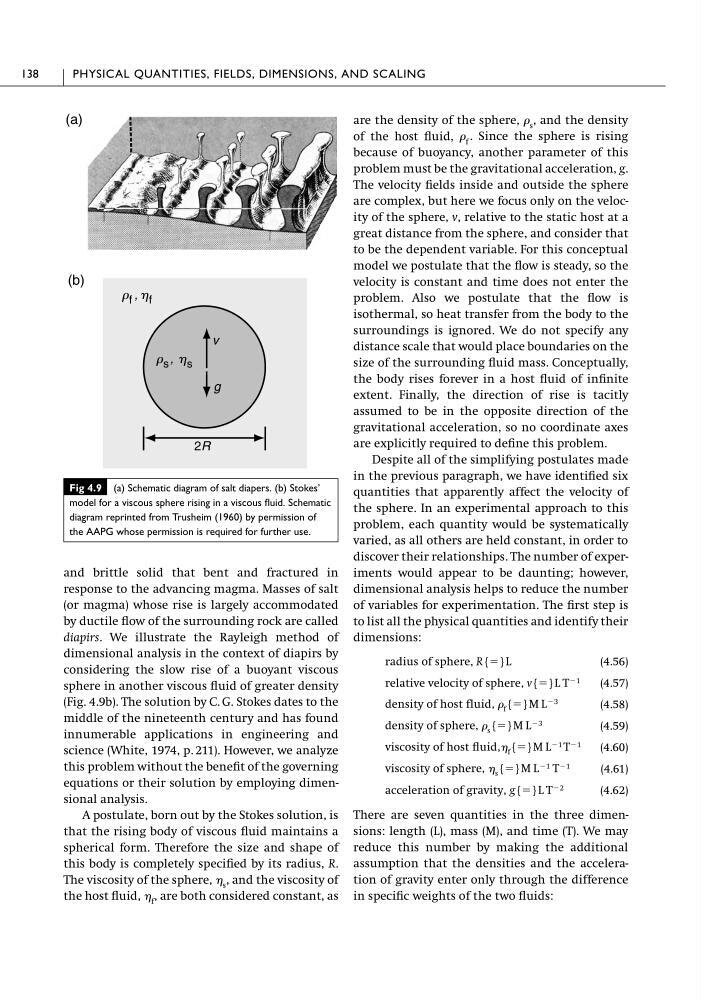
considering the slow rise of a buoyant viscous
sphere in another viscous fluid of greater density
(Fig. 4.9b). The solution by C. G. Stokes dates to the
middle of the nineteenth century and has found
innumerable applications in engineering and
science (White, 1974, p. 211). However, we analyze
this problem without the benefit of the governing
equations or their solution by employing dimensional analysis.
A postulate, born out by the Stokes solution, is
that the rising body of viscous fluid maintains a
spherical form. Therefore the size and shape of
this body is completely specified by its radius, R.
The viscosity of the sphere, s , and the viscosity of
the host fluid, f , are both considered constant, as
are the density of the sphere, s , and the density
of the host fluid, f . Since the sphere is rising
because of buoyancy, another parameter of this
problem must be the gravitational acceleration, g.
The velocity fields inside and outside the sphere
are complex, but here we focus only on the velocity of the sphere, v, relative to the static host at a
great distance from the sphere, and consider that
to be the dependent variable. For this conceptual
model we postulate that the flow is steady, so the
velocity is constant and time does not enter the
problem. Also we postulate that the flow is
isothermal, so heat transfer from the body to the
surroundings is ignored. We do not specify any
distance scale that would place boundaries on the
size of the surrounding fluid mass. Conceptually,
the body rises forever in a host fluid of infinite
extent. Finally, the direction of rise is tacitly
assumed to be in the opposite direction of the
gravitational acceleration, so no coordinate axes
are explicitly required to define this problem.
Despite all of the simplifying postulates made
in the previous paragraph, we have identified six
quantities that apparently affect the velocity of
the sphere. In an experimental approach to this
problem, each quantity would be systematically
varied, as all others are held constant, in order to
discover their relationships. The number of experiments would appear to be daunting; however,
dimensional analysis helps to reduce the number
of variables for experimentation. The first step is
to list all the physical quantities and identify their
dimensions:
(4.56)
(4.57)
(4.58)
(4.59)
(4.60)
(4.61)
(4.62)
There are seven quantities in the three dimensions: length (L), mass (M), and time (T). We may
reduce this number by making the additional
assumption that the densities and the acceleration of gravity enter only through the difference
in specific weights of the two fluids:
acceleration of gravity, g{ϭ}L T Ϫ2
viscosity of sphere, s {ϭ}M L Ϫ1 T Ϫ1
viscosity of host fluid, f {ϭ}M L Ϫ1 T Ϫ1
density of sphere, s {ϭ}M L Ϫ3
density of host fluid, f {ϭ}M L Ϫ3
relative velocity of sphere, v{ϭ}L T Ϫ1
radius of sphere, R{ϭ}L
138
PHYSICAL QUANTITIES, FIELDS, DIMENSIONS, AND SCALING
Fig 4.9 (a) Schematic diagram of salt diapers. (b) Stokes’
model for a viscous sphere rising in a viscous fluid. Schematic
diagram reprinted from Trusheim (1960) by permission of
the AAPG whose permission is required for further use.
v
2R
r s , h s
g
(a)
(b)
r f , h f
response to the advancing magma. Masses of salt
(or magma) whose rise is largely accommodated
by ductile flow of the surrounding rock are called
diapirs. We illustrate the Rayleigh method of
dimensional analysis in the context of diapirs by
considering the slow rise of a buoyant viscous
sphere in another viscous fluid of greater density
(Fig. 4.9b). The solution by C. G. Stokes dates to the
middle of the nineteenth century and has found
innumerable applications in engineering and
science (White, 1974, p. 211). However, we analyze
this problem without the benefit of the governing
equations or their solution by employing dimensional analysis.
A postulate, born out by the Stokes solution, is
that the rising body of viscous fluid maintains a
spherical form. Therefore the size and shape of
this body is completely specified by its radius, R.
The viscosity of the sphere, s , and the viscosity of
the host fluid, f , are both considered constant, as
are the density of the sphere, s , and the density
of the host fluid, f . Since the sphere is rising
because of buoyancy, another parameter of this
problem must be the gravitational acceleration, g.
The velocity fields inside and outside the sphere
are complex, but here we focus only on the velocity of the sphere, v, relative to the static host at a
great distance from the sphere, and consider that
to be the dependent variable. For this conceptual
model we postulate that the flow is steady, so the
velocity is constant and time does not enter the
problem. Also we postulate that the flow is
isothermal, so heat transfer from the body to the
surroundings is ignored. We do not specify any
distance scale that would place boundaries on the
size of the surrounding fluid mass. Conceptually,
the body rises forever in a host fluid of infinite
extent. Finally, the direction of rise is tacitly
assumed to be in the opposite direction of the
gravitational acceleration, so no coordinate axes
are explicitly required to define this problem.
Despite all of the simplifying postulates made
in the previous paragraph, we have identified six
quantities that apparently affect the velocity of
the sphere. In an experimental approach to this
problem, each quantity would be systematically
varied, as all others are held constant, in order to
discover their relationships. The number of experiments would appear to be daunting; however,
dimensional analysis helps to reduce the number
of variables for experimentation. The first step is
to list all the physical quantities and identify their
dimensions:
(4.56)
(4.57)
(4.58)
(4.59)
(4.60)
(4.61)
(4.62)
There are seven quantities in the three dimensions: length (L), mass (M), and time (T). We may
reduce this number by making the additional
assumption that the densities and the acceleration of gravity enter only through the difference
in specific weights of the two fluids:
acceleration of gravity, g{ϭ}L T Ϫ2
viscosity of sphere, s {ϭ}M L Ϫ1 T Ϫ1
viscosity of host fluid, f {ϭ}M L Ϫ1 T Ϫ1
density of sphere, s {ϭ}M L Ϫ3
density of host fluid, f {ϭ}M L Ϫ3
relative velocity of sphere, v{ϭ}L T Ϫ1
radius of sphere, R{ϭ}L
138
PHYSICAL QUANTITIES, FIELDS, DIMENSIONS, AND SCALING
Fig 4.9 (a) Schematic diagram of salt diapers. (b) Stokes’
model for a viscous sphere rising in a viscous fluid. Schematic
diagram reprinted from Trusheim (1960) by permission of
the AAPG whose permission is required for further use.
v
2R
r s , h s
g
(a)
(b)
r f , h f