

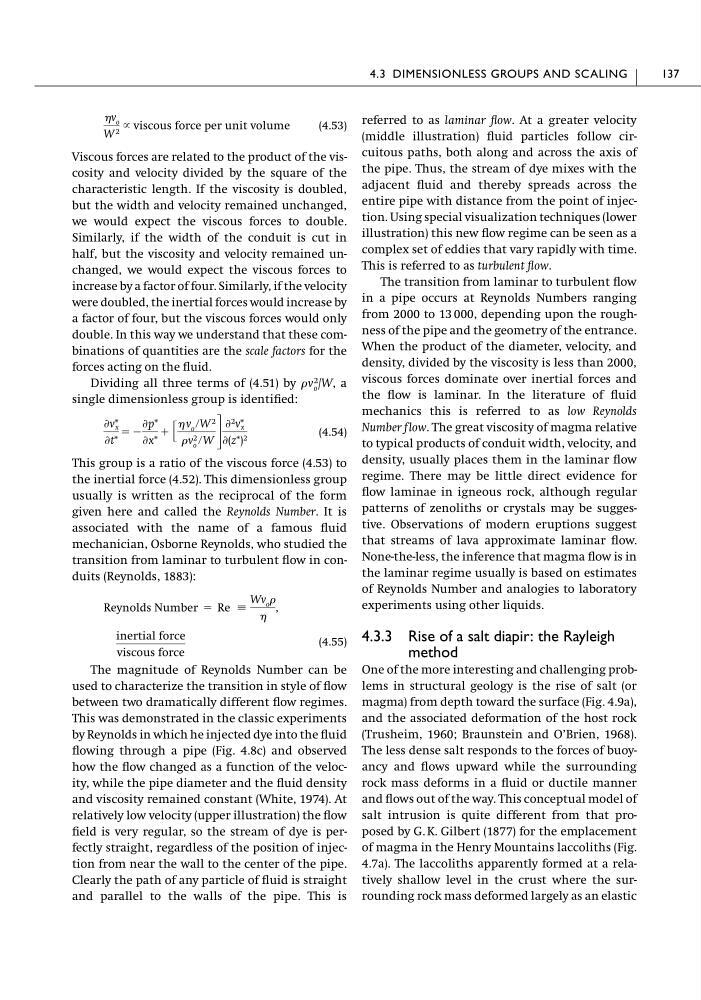
(4.53)
Viscous forces are related to the product of the viscosity and velocity divided by the square of the
characteristic length. If the viscosity is doubled,
but the width and velocity remained unchanged,
we would expect the viscous forces to double.
Similarly, if the width of the conduit is cut in
half, but the viscosity and velocity remained unchanged, we would expect the viscous forces to
increase by a factor of four. Similarly, if the velocity
were doubled, the inertial forces would increase by
a factor of four, but the viscous forces would only
double. In this way we understand that these combinations of quantities are the scale factors for the
forces acting on the fluid.
Dividing all three terms of (4.51) by
/W, a
single dimensionless group is identified:
(4.54)
This group is a ratio of the viscous force (4.53) to
the inertial force (4.52). This dimensionless group
usually is written as the reciprocal of the form
given here and called the Reynolds Number. It is
associated with the name of a famous fluid
mechanician, Osborne Reynolds, who studied the
transition from laminar to turbulent flow in conduits (Reynolds, 1883):
(4.55)
The magnitude of Reynolds Number can be
used to characterize the transition in style of flow
between two dramatically different flow regimes.
This was demonstrated in the classic experiments
by Reynolds in which he injected dye into the fluid
flowing through a pipe (Fig. 4.8c) and observed
how the flow changed as a function of the velocity, while the pipe diameter and the fluid density
and viscosity remained constant (White, 1974). At
relatively low velocity (upper illustration) the flow
field is very regular, so the stream of dye is perfectly straight, regardless of the position of injection from near the wall to the center of the pipe.
Clearly the path of any particle of fluid is straight
and parallel to the walls of the pipe. This is
inertial force
viscous force
Reynolds Number ϭ Re ϵ
Wv o
,
Ѩv* x
Ѩt*
ϭ Ϫ
Ѩp*
Ѩx*
ϩ ΄
v o րW 2
v 2
o ր W ΅
Ѩ 2 v* x
Ѩ(z*) 2
v 2
o
v o
W 2 ϰ viscous force per unit volume
referred to as laminar flow. At a greater velocity
(middle illustration) fluid particles follow circuitous paths, both along and across the axis of
the pipe. Thus, the stream of dye mixes with the
adjacent fluid and thereby spreads across the
entire pipe with distance from the point of injection. Using special visualization techniques (lower
illustration) this new flow regime can be seen as a
complex set of eddies that vary rapidly with time.
This is referred to as turbulent flow.
The transition from laminar to turbulent flow
in a pipe occurs at Reynolds Numbers ranging
from 2000 to 13 000, depending upon the roughness of the pipe and the geometry of the entrance.
When the product of the diameter, velocity, and
density, divided by the viscosity is less than 2000,
viscous forces dominate over inertial forces and
the flow is laminar. In the literature of fluid
mechanics this is referred to as low Reynolds
Number flow. The great viscosity of magma relative
to typical products of conduit width, velocity, and
density, usually places them in the laminar flow
regime. There may be little direct evidence for
flow laminae in igneous rock, although regular
patterns of zenoliths or crystals may be suggestive. Observations of modern eruptions suggest
that streams of lava approximate laminar flow.
None-the-less, the inference that magma flow is in
the laminar regime usually is based on estimates
of Reynolds Number and analogies to laboratory
experiments using other liquids.
4.3.3 Rise of a salt diapir: the Rayleigh
method
One of the more interesting and challenging problems in structural geology is the rise of salt (or
magma) from depth toward the surface (Fig. 4.9a),
and the associated deformation of the host rock
(Trusheim, 1960; Braunstein and O’Brien, 1968).
The less dense salt responds to the forces of buoyancy and flows upward while the surrounding
rock mass deforms in a fluid or ductile manner
and flows out of the way. This conceptual model of
salt intrusion is quite different from that proposed by G. K. Gilbert (1877) for the emplacement
of magma in the Henry Mountains laccoliths (Fig.
4.7a). The laccoliths apparently formed at a relatively shallow level in the crust where the surrounding rock mass deformed largely as an elastic
4.3 DIMENSIONLESS GROUPS AND SCALING
137
Viscous forces are related to the product of the viscosity and velocity divided by the square of the
characteristic length. If the viscosity is doubled,
but the width and velocity remained unchanged,
we would expect the viscous forces to double.
Similarly, if the width of the conduit is cut in
half, but the viscosity and velocity remained unchanged, we would expect the viscous forces to
increase by a factor of four. Similarly, if the velocity
were doubled, the inertial forces would increase by
a factor of four, but the viscous forces would only
double. In this way we understand that these combinations of quantities are the scale factors for the
forces acting on the fluid.
Dividing all three terms of (4.51) by
/W, a
single dimensionless group is identified:
(4.54)
This group is a ratio of the viscous force (4.53) to
the inertial force (4.52). This dimensionless group
usually is written as the reciprocal of the form
given here and called the Reynolds Number. It is
associated with the name of a famous fluid
mechanician, Osborne Reynolds, who studied the
transition from laminar to turbulent flow in conduits (Reynolds, 1883):
(4.55)
The magnitude of Reynolds Number can be
used to characterize the transition in style of flow
between two dramatically different flow regimes.
This was demonstrated in the classic experiments
by Reynolds in which he injected dye into the fluid
flowing through a pipe (Fig. 4.8c) and observed
how the flow changed as a function of the velocity, while the pipe diameter and the fluid density
and viscosity remained constant (White, 1974). At
relatively low velocity (upper illustration) the flow
field is very regular, so the stream of dye is perfectly straight, regardless of the position of injection from near the wall to the center of the pipe.
Clearly the path of any particle of fluid is straight
and parallel to the walls of the pipe. This is
inertial force
viscous force
Reynolds Number ϭ Re ϵ
Wv o
,
Ѩv* x
Ѩt*
ϭ Ϫ
Ѩp*
Ѩx*
ϩ ΄
v o րW 2
v 2
o ր W ΅
Ѩ 2 v* x
Ѩ(z*) 2
v 2
o
v o
W 2 ϰ viscous force per unit volume
referred to as laminar flow. At a greater velocity
(middle illustration) fluid particles follow circuitous paths, both along and across the axis of
the pipe. Thus, the stream of dye mixes with the
adjacent fluid and thereby spreads across the
entire pipe with distance from the point of injection. Using special visualization techniques (lower
illustration) this new flow regime can be seen as a
complex set of eddies that vary rapidly with time.
This is referred to as turbulent flow.
The transition from laminar to turbulent flow
in a pipe occurs at Reynolds Numbers ranging
from 2000 to 13 000, depending upon the roughness of the pipe and the geometry of the entrance.
When the product of the diameter, velocity, and
density, divided by the viscosity is less than 2000,
viscous forces dominate over inertial forces and
the flow is laminar. In the literature of fluid
mechanics this is referred to as low Reynolds
Number flow. The great viscosity of magma relative
to typical products of conduit width, velocity, and
density, usually places them in the laminar flow
regime. There may be little direct evidence for
flow laminae in igneous rock, although regular
patterns of zenoliths or crystals may be suggestive. Observations of modern eruptions suggest
that streams of lava approximate laminar flow.
None-the-less, the inference that magma flow is in
the laminar regime usually is based on estimates
of Reynolds Number and analogies to laboratory
experiments using other liquids.
4.3.3 Rise of a salt diapir: the Rayleigh
method
One of the more interesting and challenging problems in structural geology is the rise of salt (or
magma) from depth toward the surface (Fig. 4.9a),
and the associated deformation of the host rock
(Trusheim, 1960; Braunstein and O’Brien, 1968).
The less dense salt responds to the forces of buoyancy and flows upward while the surrounding
rock mass deforms in a fluid or ductile manner
and flows out of the way. This conceptual model of
salt intrusion is quite different from that proposed by G. K. Gilbert (1877) for the emplacement
of magma in the Henry Mountains laccoliths (Fig.
4.7a). The laccoliths apparently formed at a relatively shallow level in the crust where the surrounding rock mass deformed largely as an elastic
4.3 DIMENSIONLESS GROUPS AND SCALING
137