

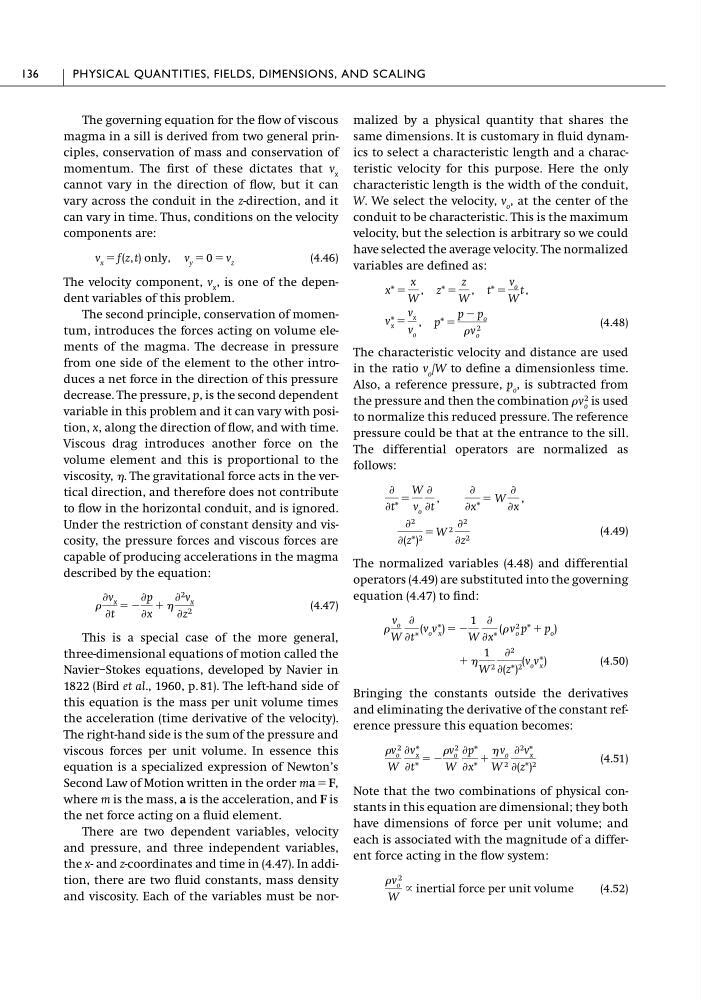
The governing equation for the flow of viscous
magma in a sill is derived from two general principles, conservation of mass and conservation of
momentum. The first of these dictates that v x
cannot vary in the direction of flow, but it can
vary across the conduit in the z-direction, and it
can vary in time. Thus, conditions on the velocity
components are:
(4.46)
The velocity component, v x , is one of the dependent variables of this problem.
The second principle, conservation of momentum, introduces the forces acting on volume elements of the magma. The decrease in pressure
from one side of the element to the other introduces a net force in the direction of this pressure
decrease. The pressure, p, is the second dependent
variable in this problem and it can vary with position, x, along the direction of flow, and with time.
Viscous drag introduces another force on the
volume element and this is proportional to the
viscosity, �. The gravitational force acts in the vertical direction, and therefore does not contribute
to flow in the horizontal conduit, and is ignored.
Under the restriction of constant density and viscosity, the pressure forces and viscous forces are
capable of producing accelerations in the magma
described by the equation:
(4.47)
This is a special case of the more general,
three-dimensional equations of motion called the
Navier–Stokes equations, developed by Navier in
1822 (Bird et al., 1960, p. 81). The left-hand side of
this equation is the mass per unit volume times
the acceleration (time derivative of the velocity).
The right-hand side is the sum of the pressure and
viscous forces per unit volume. In essence this
equation is a specialized expression of Newton’s
Second Law of Motion written in the order ma � F,
where m is the mass, a is the acceleration, and F is
the net force acting on a fluid element.
There are two dependent variables, velocity
and pressure, and three independent variables,
the x- and z-coordinates and time in (4.47). In addition, there are two fluid constants, mass density
and viscosity. Each of the variables must be nor�
�v x
�t
� �
�p
�x
� �
� 2 v x
�z 2
v x � f (z, t) only, v y � 0 � v z
malized by a physical quantity that shares the
same dimensions. It is customary in fluid dynamics to select a characteristic length and a characteristic velocity for this purpose. Here the only
characteristic length is the width of the conduit,
W. We select the velocity, v o , at the center of the
conduit to be characteristic. This is the maximum
velocity, but the selection is arbitrary so we could
have selected the average velocity. The normalized
variables are defined as:
(4.48)
The characteristic velocity and distance are used
in the ratio v o /W to define a dimensionless time.
Also, a reference pressure, p o , is subtracted from
the pressure and then the combination
is used
to normalize this reduced pressure. The reference
pressure could be that at the entrance to the sill.
The differential operators are normalized as
follows:
(4.49)
The normalized variables (4.48) and differential
operators (4.49) are substituted into the governing
equation (4.47) to find:
(4.50)
Bringing the constants outside the derivatives
and eliminating the derivative of the constant reference pressure this equation becomes:
(4.51)
Note that the two combinations of physical constants in this equation are dimensional; they both
have dimensions of force per unit volume; and
each is associated with the magnitude of a different force acting in the flow system:
(4.52)
�v 2
o
W
� inertial force per unit volume
�v 2
o
W
�v* x
�t*
� �
�v 2
o
W
�p*
�x*
�
� v o
W 2
� 2 v* x
�(z*) 2
� �
1
W 2
� 2
�(z*) 2 (v o v* x )
�
v o
W
�
�t*
(v o v* x ) � �
1
W
�
�x*
(� v 2
o p* � p o )
� 2
�(z*) 2 � W 2 � 2
�z 2
�
�t*
�
W
v o
�
�t
,
�
�x*
� W
�
�x
,
�v 2
o
v* x �
v x
v o
, p* �
p � p o
�v 2
o
x* �
x
W
, z* �
z
W
, t* �
v o
W
t ,
136
PHYSICAL QUANTITIES, FIELDS, DIMENSIONS, AND SCALING
magma in a sill is derived from two general principles, conservation of mass and conservation of
momentum. The first of these dictates that v x
cannot vary in the direction of flow, but it can
vary across the conduit in the z-direction, and it
can vary in time. Thus, conditions on the velocity
components are:
(4.46)
The velocity component, v x , is one of the dependent variables of this problem.
The second principle, conservation of momentum, introduces the forces acting on volume elements of the magma. The decrease in pressure
from one side of the element to the other introduces a net force in the direction of this pressure
decrease. The pressure, p, is the second dependent
variable in this problem and it can vary with position, x, along the direction of flow, and with time.
Viscous drag introduces another force on the
volume element and this is proportional to the
viscosity, �. The gravitational force acts in the vertical direction, and therefore does not contribute
to flow in the horizontal conduit, and is ignored.
Under the restriction of constant density and viscosity, the pressure forces and viscous forces are
capable of producing accelerations in the magma
described by the equation:
(4.47)
This is a special case of the more general,
three-dimensional equations of motion called the
Navier–Stokes equations, developed by Navier in
1822 (Bird et al., 1960, p. 81). The left-hand side of
this equation is the mass per unit volume times
the acceleration (time derivative of the velocity).
The right-hand side is the sum of the pressure and
viscous forces per unit volume. In essence this
equation is a specialized expression of Newton’s
Second Law of Motion written in the order ma � F,
where m is the mass, a is the acceleration, and F is
the net force acting on a fluid element.
There are two dependent variables, velocity
and pressure, and three independent variables,
the x- and z-coordinates and time in (4.47). In addition, there are two fluid constants, mass density
and viscosity. Each of the variables must be nor�
�v x
�t
� �
�p
�x
� �
� 2 v x
�z 2
v x � f (z, t) only, v y � 0 � v z
malized by a physical quantity that shares the
same dimensions. It is customary in fluid dynamics to select a characteristic length and a characteristic velocity for this purpose. Here the only
characteristic length is the width of the conduit,
W. We select the velocity, v o , at the center of the
conduit to be characteristic. This is the maximum
velocity, but the selection is arbitrary so we could
have selected the average velocity. The normalized
variables are defined as:
(4.48)
The characteristic velocity and distance are used
in the ratio v o /W to define a dimensionless time.
Also, a reference pressure, p o , is subtracted from
the pressure and then the combination
is used
to normalize this reduced pressure. The reference
pressure could be that at the entrance to the sill.
The differential operators are normalized as
follows:
(4.49)
The normalized variables (4.48) and differential
operators (4.49) are substituted into the governing
equation (4.47) to find:
(4.50)
Bringing the constants outside the derivatives
and eliminating the derivative of the constant reference pressure this equation becomes:
(4.51)
Note that the two combinations of physical constants in this equation are dimensional; they both
have dimensions of force per unit volume; and
each is associated with the magnitude of a different force acting in the flow system:
(4.52)
�v 2
o
W
� inertial force per unit volume
�v 2
o
W
�v* x
�t*
� �
�v 2
o
W
�p*
�x*
�
� v o
W 2
� 2 v* x
�(z*) 2
� �
1
W 2
� 2
�(z*) 2 (v o v* x )
�
v o
W
�
�t*
(v o v* x ) � �
1
W
�
�x*
(� v 2
o p* � p o )
� 2
�(z*) 2 � W 2 � 2
�z 2
�
�t*
�
W
v o
�
�t
,
�
�x*
� W
�
�x
,
�v 2
o
v* x �
v x
v o
, p* �
p � p o
�v 2
o
x* �
x
W
, z* �
z
W
, t* �
v o
W
t ,
136
PHYSICAL QUANTITIES, FIELDS, DIMENSIONS, AND SCALING