

field and laboratory investigations that focuses on
measurement of the most sensitive parameters.
For example, errors in the field measurement of
length or height of the layer over the laccolith are
of greater consequence than comparable errors in
the laboratory measurement of rock stiffness. Of
course, such assessments depend upon the
correct selection of the governing equation.
Recent analyses based on somewhat different governing equations, geometry, and boundary conditions for the deformation of strata over laccoliths
have provided additional insights (Kerr and
Pollard, 1998; Zenzri and Keer, 2001).
4.3.2 Magma flow in a conduit: the direct
method
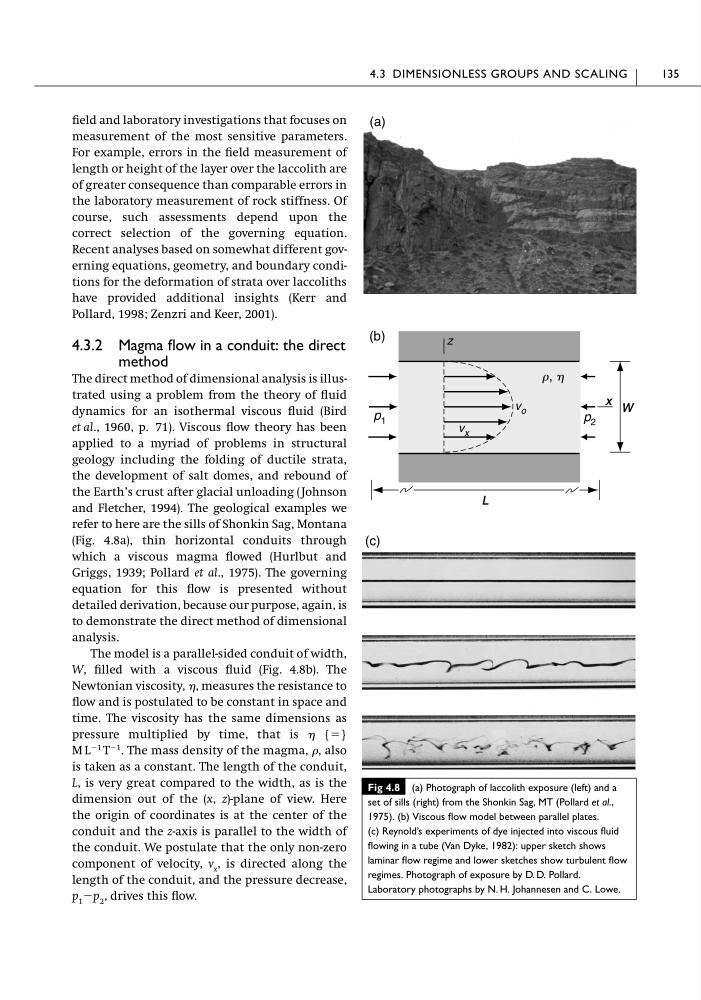
The direct method of dimensional analysis is illustrated using a problem from the theory of fluid
dynamics for an isothermal viscous fluid (Bird
et al., 1960, p. 71). Viscous flow theory has been
applied to a myriad of problems in structural
geology including the folding of ductile strata,
the development of salt domes, and rebound of
the Earth’s crust after glacial unloading (Johnson
and Fletcher, 1994). The geological examples we
refer to here are the sills of Shonkin Sag, Montana
(Fig. 4.8a), thin horizontal conduits through
which a viscous magma flowed (Hurlbut and
Griggs, 1939; Pollard et al., 1975). The governing
equation for this flow is presented without
detailed derivation, because our purpose, again, is
to demonstrate the direct method of dimensional
analysis.
The model is a parallel-sided conduit of width,
W, filled with a viscous fluid (Fig. 4.8b). The
Newtonian viscosity, , measures the resistance to
flow and is postulated to be constant in space and
time. The viscosity has the same dimensions as
pressure multiplied by time, that is {ϭ}
M L
Ϫ1 T
Ϫ1 . The mass density of the magma, , also
is taken as a constant. The length of the conduit,
L, is very great compared to the width, as is the
dimension out of the (x, z)-plane of view. Here
the origin of coordinates is at the center of the
conduit and the z-axis is parallel to the width of
the conduit. We postulate that the only non-zero
component of velocity, v x , is directed along the
length of the conduit, and the pressure decrease,
p 1 Ϫp 2 , drives this flow.
4.3 DIMENSIONLESS GROUPS AND SCALING
135
Fig 4.8 (a) Photograph of laccolith exposure (left) and a
set of sills (right) from the Shonkin Sag, MT (Pollard et al.,
1975). (b) Viscous flow model between parallel plates.
(c) Reynold’s experiments of dye injected into viscous fluid
flowing in a tube (Van Dyke, 1982): upper sketch shows
laminar flow regime and lower sketches show turbulent flow
regimes. Photograph of exposure by D. D. Pollard.
Laboratory photographs by N. H. Johannesen and C. Lowe.
(c)
(a)
v o
W
x
z
v x
(b)
L
p 1
p 2
r, h
measurement of the most sensitive parameters.
For example, errors in the field measurement of
length or height of the layer over the laccolith are
of greater consequence than comparable errors in
the laboratory measurement of rock stiffness. Of
course, such assessments depend upon the
correct selection of the governing equation.
Recent analyses based on somewhat different governing equations, geometry, and boundary conditions for the deformation of strata over laccoliths
have provided additional insights (Kerr and
Pollard, 1998; Zenzri and Keer, 2001).
4.3.2 Magma flow in a conduit: the direct
method
The direct method of dimensional analysis is illustrated using a problem from the theory of fluid
dynamics for an isothermal viscous fluid (Bird
et al., 1960, p. 71). Viscous flow theory has been
applied to a myriad of problems in structural
geology including the folding of ductile strata,
the development of salt domes, and rebound of
the Earth’s crust after glacial unloading (Johnson
and Fletcher, 1994). The geological examples we
refer to here are the sills of Shonkin Sag, Montana
(Fig. 4.8a), thin horizontal conduits through
which a viscous magma flowed (Hurlbut and
Griggs, 1939; Pollard et al., 1975). The governing
equation for this flow is presented without
detailed derivation, because our purpose, again, is
to demonstrate the direct method of dimensional
analysis.
The model is a parallel-sided conduit of width,
W, filled with a viscous fluid (Fig. 4.8b). The
Newtonian viscosity, , measures the resistance to
flow and is postulated to be constant in space and
time. The viscosity has the same dimensions as
pressure multiplied by time, that is {ϭ}
M L
Ϫ1 T
Ϫ1 . The mass density of the magma, , also
is taken as a constant. The length of the conduit,
L, is very great compared to the width, as is the
dimension out of the (x, z)-plane of view. Here
the origin of coordinates is at the center of the
conduit and the z-axis is parallel to the width of
the conduit. We postulate that the only non-zero
component of velocity, v x , is directed along the
length of the conduit, and the pressure decrease,
p 1 Ϫp 2 , drives this flow.
4.3 DIMENSIONLESS GROUPS AND SCALING
135
Fig 4.8 (a) Photograph of laccolith exposure (left) and a
set of sills (right) from the Shonkin Sag, MT (Pollard et al.,
1975). (b) Viscous flow model between parallel plates.
(c) Reynold’s experiments of dye injected into viscous fluid
flowing in a tube (Van Dyke, 1982): upper sketch shows
laminar flow regime and lower sketches show turbulent flow
regimes. Photograph of exposure by D. D. Pollard.
Laboratory photographs by N. H. Johannesen and C. Lowe.
(c)
(a)
v o
W
x
z
v x
(b)
L
p 1
p 2
r, h