

Johnson, 1973; Koch et al., 1981), but these effects
are ignored in order to introduce dimensional
analysis using a simple model. These effects, in
part, may account for the flatter top of the
Trachyte Mesa laccolith (Fig. 4.7a) as compared to
the laboratory model laccolith with a single layer
(Fig. 4.7c).
The governing differential equation for the
bending plate model is presented without derivation (Johnson, 1970), because our purpose is to
demonstrate the direct method of dimensional
analysis. This equation is based upon simplifying
postulates about the kinematics of bending that
are valid if the layer is thin compared to its length
(Timoshenko and Woinowsky-Krieger, 1959). The
differential equation for the vertical deflection,
u z , of the middle surface of the layer is:
(4.41)
The first step in the analysis is to identify the variables, and to understand their roles in the physical process. Here, the spatial coordinate, x, is the
only independent variable, and the vertical
deflection, u z , is the only dependent variable. A
solution to (4.41) is u z ϭf (x), a function that
describes the distribution of deflection with position along the layer.
The next step is to make the variables dimensionless (to normalize them) by dividing each by a
characteristic value of a quantity with the same
dimensions. The natural choice for normalizing x
is L, the length of the layer in the x-direction. For
a characteristic vertical deflection, we choose the
value at the center of the plate, u o ϭ u z (x ϭ 0). These
choices are arbitrary, but are motivated by the
geometry and the symmetry of the problem. The
normalized variables are written with a superscript *:
(4.42)
The differential operator in (4.41) also must be
normalized. In this case d
4 /dx
4
L
Ϫ4 , and this
operator is normalized using the length of the
layer:
(4.43)
d 4
d(x*) 4 ϭ L 4 d 4
dx 4
{ϭ}
x* ϭ
x
L
, u* z ϭ
u z
u o
d 4 u z
dx 4 ϭ
12p
BH 3
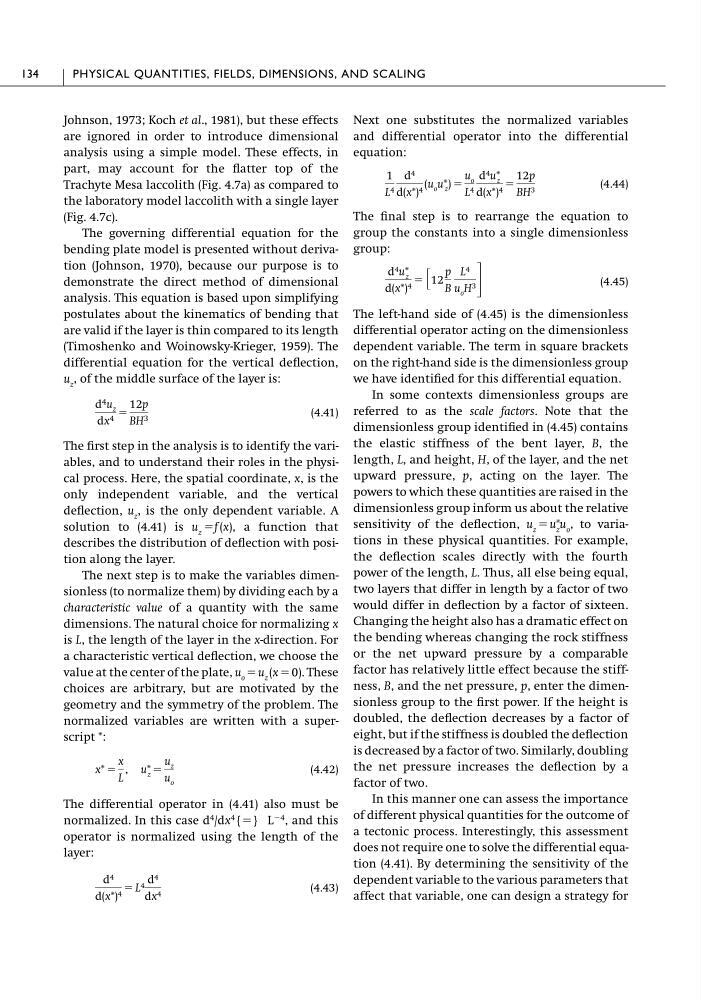
Next one substitutes the normalized variables
and differential operator into the differential
equation:
(4.44)
The final step is to rearrange the equation to
group the constants into a single dimensionless
group:
(4.45)
The left-hand side of (4.45) is the dimensionless
differential operator acting on the dimensionless
dependent variable. The term in square brackets
on the right-hand side is the dimensionless group
we have identified for this differential equation.
In some contexts dimensionless groups are
referred to as the scale factors. Note that the
dimensionless group identified in (4.45) contains
the elastic stiffness of the bent layer, B, the
length, L, and height, H, of the layer, and the net
upward pressure, p, acting on the layer. The
powers to which these quantities are raised in the
dimensionless group inform us about the relative
sensitivity of the deflection, u z ϭ u z
*u o , to variations in these physical quantities. For example,
the deflection scales directly with the fourth
power of the length, L. Thus, all else being equal,
two layers that differ in length by a factor of two
would differ in deflection by a factor of sixteen.
Changing the height also has a dramatic effect on
the bending whereas changing the rock stiffness
or the net upward pressure by a comparable
factor has relatively little effect because the stiffness, B, and the net pressure, p, enter the dimensionless group to the first power. If the height is
doubled, the deflection decreases by a factor of
eight, but if the stiffness is doubled the deflection
is decreased by a factor of two. Similarly, doubling
the net pressure increases the deflection by a
factor of two.
In this manner one can assess the importance
of different physical quantities for the outcome of
a tectonic process. Interestingly, this assessment
does not require one to solve the differential equation (4.41). By determining the sensitivity of the
dependent variable to the various parameters that
affect that variable, one can design a strategy for
d 4 u* z
d(x*) 4 ϭ ΄12
p
B
L 4
u o H 3΅
1
L 4
d 4
d(x*) 4 (u o u* z ) ϭ
u o
L 4
d 4 u* z
d(x*) 4 ϭ
12p
BH 3
134
PHYSICAL QUANTITIES, FIELDS, DIMENSIONS, AND SCALING
are ignored in order to introduce dimensional
analysis using a simple model. These effects, in
part, may account for the flatter top of the
Trachyte Mesa laccolith (Fig. 4.7a) as compared to
the laboratory model laccolith with a single layer
(Fig. 4.7c).
The governing differential equation for the
bending plate model is presented without derivation (Johnson, 1970), because our purpose is to
demonstrate the direct method of dimensional
analysis. This equation is based upon simplifying
postulates about the kinematics of bending that
are valid if the layer is thin compared to its length
(Timoshenko and Woinowsky-Krieger, 1959). The
differential equation for the vertical deflection,
u z , of the middle surface of the layer is:
(4.41)
The first step in the analysis is to identify the variables, and to understand their roles in the physical process. Here, the spatial coordinate, x, is the
only independent variable, and the vertical
deflection, u z , is the only dependent variable. A
solution to (4.41) is u z ϭf (x), a function that
describes the distribution of deflection with position along the layer.
The next step is to make the variables dimensionless (to normalize them) by dividing each by a
characteristic value of a quantity with the same
dimensions. The natural choice for normalizing x
is L, the length of the layer in the x-direction. For
a characteristic vertical deflection, we choose the
value at the center of the plate, u o ϭ u z (x ϭ 0). These
choices are arbitrary, but are motivated by the
geometry and the symmetry of the problem. The
normalized variables are written with a superscript *:
(4.42)
The differential operator in (4.41) also must be
normalized. In this case d
4 /dx
4
L
Ϫ4 , and this
operator is normalized using the length of the
layer:
(4.43)
d 4
d(x*) 4 ϭ L 4 d 4
dx 4
{ϭ}
x* ϭ
x
L
, u* z ϭ
u z
u o
d 4 u z
dx 4 ϭ
12p
BH 3
Next one substitutes the normalized variables
and differential operator into the differential
equation:
(4.44)
The final step is to rearrange the equation to
group the constants into a single dimensionless
group:
(4.45)
The left-hand side of (4.45) is the dimensionless
differential operator acting on the dimensionless
dependent variable. The term in square brackets
on the right-hand side is the dimensionless group
we have identified for this differential equation.
In some contexts dimensionless groups are
referred to as the scale factors. Note that the
dimensionless group identified in (4.45) contains
the elastic stiffness of the bent layer, B, the
length, L, and height, H, of the layer, and the net
upward pressure, p, acting on the layer. The
powers to which these quantities are raised in the
dimensionless group inform us about the relative
sensitivity of the deflection, u z ϭ u z
*u o , to variations in these physical quantities. For example,
the deflection scales directly with the fourth
power of the length, L. Thus, all else being equal,
two layers that differ in length by a factor of two
would differ in deflection by a factor of sixteen.
Changing the height also has a dramatic effect on
the bending whereas changing the rock stiffness
or the net upward pressure by a comparable
factor has relatively little effect because the stiffness, B, and the net pressure, p, enter the dimensionless group to the first power. If the height is
doubled, the deflection decreases by a factor of
eight, but if the stiffness is doubled the deflection
is decreased by a factor of two. Similarly, doubling
the net pressure increases the deflection by a
factor of two.
In this manner one can assess the importance
of different physical quantities for the outcome of
a tectonic process. Interestingly, this assessment
does not require one to solve the differential equation (4.41). By determining the sensitivity of the
dependent variable to the various parameters that
affect that variable, one can design a strategy for
d 4 u* z
d(x*) 4 ϭ ΄12
p
B
L 4
u o H 3΅
1
L 4
d 4
d(x*) 4 (u o u* z ) ϭ
u o
L 4
d 4 u* z
d(x*) 4 ϭ
12p
BH 3
134
PHYSICAL QUANTITIES, FIELDS, DIMENSIONS, AND SCALING