

The choice of a method depends upon one’s
confidence in selecting the governing equations
versus one’s confidence in selecting all the variables (but no more) and properly grouping them.
4.3.1 Bending over a laccolith:
the direct method
The first example is taken from the theory of
bending of thin elastic plates under lateral loads
(Timoshenko and Woinowsky-Krieger, 1959). This
theory has been applied to the study of laccolithic intrusions (Johnson, 1970; Pollard and
Johnson, 1973; Jackson and Pollard, 1990) in the
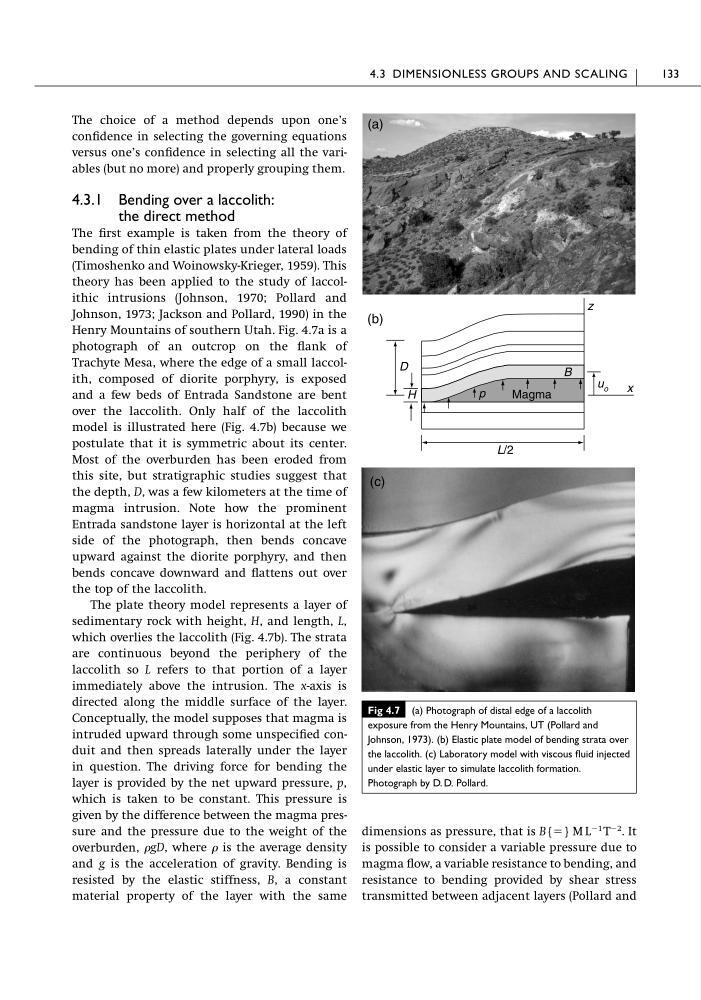
Henry Mountains of southern Utah. Fig. 4.7a is a
photograph of an outcrop on the flank of
Trachyte Mesa, where the edge of a small laccolith, composed of diorite porphyry, is exposed
and a few beds of Entrada Sandstone are bent
over the laccolith. Only half of the laccolith
model is illustrated here (Fig. 4.7b) because we
postulate that it is symmetric about its center.
Most of the overburden has been eroded from
this site, but stratigraphic studies suggest that
the depth, D, was a few kilometers at the time of
magma intrusion. Note how the prominent
Entrada sandstone layer is horizontal at the left
side of the photograph, then bends concave
upward against the diorite porphyry, and then
bends concave downward and flattens out over
the top of the laccolith.
The plate theory model represents a layer of
sedimentary rock with height, H, and length, L,
which overlies the laccolith (Fig. 4.7b). The strata
are continuous beyond the periphery of the
laccolith so L refers to that portion of a layer
immediately above the intrusion. The x-axis is
directed along the middle surface of the layer.
Conceptually, the model supposes that magma is
intruded upward through some unspecified conduit and then spreads laterally under the layer
in question. The driving force for bending the
layer is provided by the net upward pressure, p,
which is taken to be constant. This pressure is
given by the difference between the magma pressure and the pressure due to the weight of the
overburden, gD, where is the average density
and g is the acceleration of gravity. Bending is
resisted by the elastic stiffness, B, a constant
material property of the layer with the same
dimensions as pressure, that is B
M L
Ϫ1 T
Ϫ2 . It
is possible to consider a variable pressure due to
magma flow, a variable resistance to bending, and
resistance to bending provided by shear stress
transmitted between adjacent layers (Pollard and
{ϭ}
4.3 DIMENSIONLESS GROUPS AND SCALING
133
Fig 4.7 (a) Photograph of distal edge of a laccolith
exposure from the Henry Mountains, UT (Pollard and
Johnson, 1973). (b) Elastic plate model of bending strata over
the laccolith. (c) Laboratory model with viscous fluid injected
under elastic layer to simulate laccolith formation.
Photograph by D. D. Pollard.
(b)
H
L/2
u o
p
B
Magma
D
x
z
(a)
(c)
confidence in selecting the governing equations
versus one’s confidence in selecting all the variables (but no more) and properly grouping them.
4.3.1 Bending over a laccolith:
the direct method
The first example is taken from the theory of
bending of thin elastic plates under lateral loads
(Timoshenko and Woinowsky-Krieger, 1959). This
theory has been applied to the study of laccolithic intrusions (Johnson, 1970; Pollard and
Johnson, 1973; Jackson and Pollard, 1990) in the
Henry Mountains of southern Utah. Fig. 4.7a is a
photograph of an outcrop on the flank of
Trachyte Mesa, where the edge of a small laccolith, composed of diorite porphyry, is exposed
and a few beds of Entrada Sandstone are bent
over the laccolith. Only half of the laccolith
model is illustrated here (Fig. 4.7b) because we
postulate that it is symmetric about its center.
Most of the overburden has been eroded from
this site, but stratigraphic studies suggest that
the depth, D, was a few kilometers at the time of
magma intrusion. Note how the prominent
Entrada sandstone layer is horizontal at the left
side of the photograph, then bends concave
upward against the diorite porphyry, and then
bends concave downward and flattens out over
the top of the laccolith.
The plate theory model represents a layer of
sedimentary rock with height, H, and length, L,
which overlies the laccolith (Fig. 4.7b). The strata
are continuous beyond the periphery of the
laccolith so L refers to that portion of a layer
immediately above the intrusion. The x-axis is
directed along the middle surface of the layer.
Conceptually, the model supposes that magma is
intruded upward through some unspecified conduit and then spreads laterally under the layer
in question. The driving force for bending the
layer is provided by the net upward pressure, p,
which is taken to be constant. This pressure is
given by the difference between the magma pressure and the pressure due to the weight of the
overburden, gD, where is the average density
and g is the acceleration of gravity. Bending is
resisted by the elastic stiffness, B, a constant
material property of the layer with the same
dimensions as pressure, that is B
M L
Ϫ1 T
Ϫ2 . It
is possible to consider a variable pressure due to
magma flow, a variable resistance to bending, and
resistance to bending provided by shear stress
transmitted between adjacent layers (Pollard and
{ϭ}
4.3 DIMENSIONLESS GROUPS AND SCALING
133
Fig 4.7 (a) Photograph of distal edge of a laccolith
exposure from the Henry Mountains, UT (Pollard and
Johnson, 1973). (b) Elastic plate model of bending strata over
the laccolith. (c) Laboratory model with viscous fluid injected
under elastic layer to simulate laccolith formation.
Photograph by D. D. Pollard.
(b)
H
L/2
u o
p
B
Magma
D
x
z
(a)
(c)