

The quantity in square brackets ranges from Ϫ1
to ϩ1 as the sphere changes from rigid
to an open hole
. This dimensionless
group is eliminated from consideration if the viscosity of the sphere and the host fluid are the
same.
The so-called Buckingham ⌸ Theorem was published by E. Buckingham in 1915, and often is cited
in discussions of dimensional analysis (Buckingham, 1915; Bird et al., 1960; Brodkey and Hershey,
1988). This theorem is based upon the necessity
for dimensional homogeneity of equations that
describe physical phenomena. That is, every term
in such an equation, when written in terms of the
dimensions of the four fundamental quantities,
must be made up of the same powers of each
quantity. The theorem states:
The number of dimensionless groups for a particular
physical process is equal to the number of variables
less the number of dimensions represented in those
variables.
Since there are five physical quantities in the
rising sphere problem as conceptualized here, and
there are three dimensions, there are only two
independent dimensionless groups according to
the ⌸ theorem. The Rayleigh method determines
two groups and that is consistent with the
theorem.
4.3.4 Dimension analysis applied to the
folding process
A fundamental question in structural geology
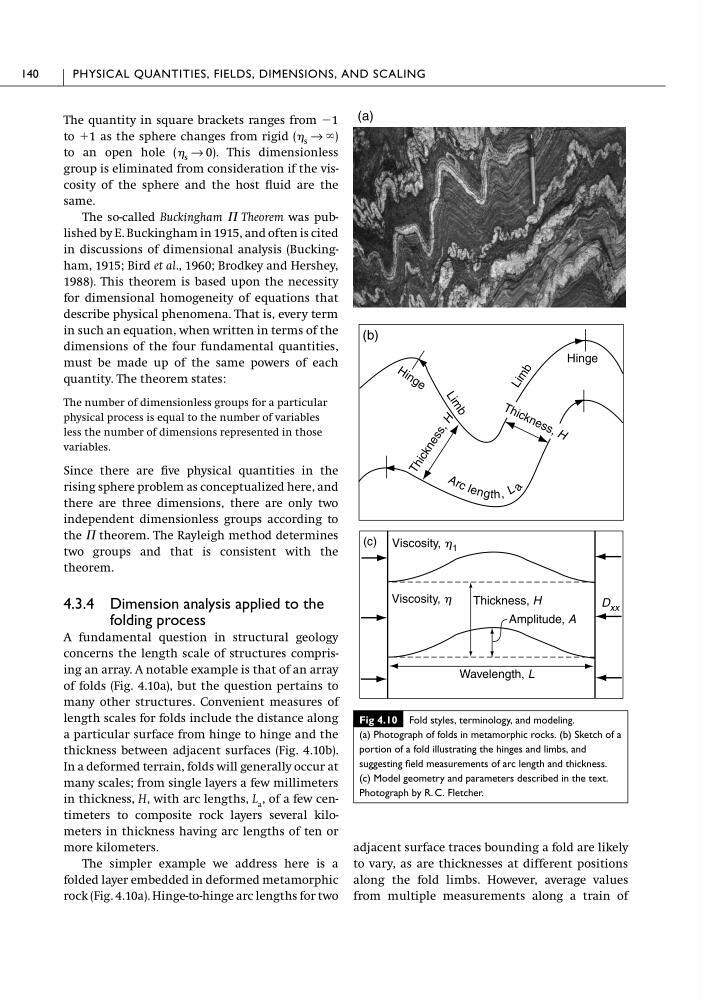
concerns the length scale of structures comprising an array. A notable example is that of an array
of folds (Fig. 4.10a), but the question pertains to
many other structures. Convenient measures of
length scales for folds include the distance along
a particular surface from hinge to hinge and the
thickness between adjacent surfaces (Fig. 4.10b).
In a deformed terrain, folds will generally occur at
many scales; from single layers a few millimeters
in thickness, H, with arc lengths, L a , of a few centimeters to composite rock layers several kilometers in thickness having arc lengths of ten or
more kilometers.
The simpler example we address here is a
folded layer embedded in deformed metamorphic
rock (Fig. 4.10a). Hinge-to-hinge arc lengths for two
( s → 0)
( s → ϱ)
adjacent surface traces bounding a fold are likely
to vary, as are thicknesses at different positions
along the fold limbs. However, average values
from multiple measurements along a train of
140
PHYSICAL QUANTITIES, FIELDS, DIMENSIONS, AND SCALING
Fig 4.10 Fold styles, terminology, and modeling.
(a) Photograph of folds in metamorphic rocks. (b) Sketch of a
portion of a fold illustrating the hinges and limbs, and
suggesting field measurements of arc length and thickness.
(c) Model geometry and parameters described in the text.
Photograph by R. C. Fletcher.
Wavelength, L
Hinge
(a)
(b)
L i m b
L i m b
H i n g e
A r c le n gt h, L
a
(c)
T h ic k n e s s , H
Amplitude, A
T h i c k n e s s , H
D xx
Viscosity, h
Viscosity, h 1
Thickness, H
to ϩ1 as the sphere changes from rigid
to an open hole
. This dimensionless
group is eliminated from consideration if the viscosity of the sphere and the host fluid are the
same.
The so-called Buckingham ⌸ Theorem was published by E. Buckingham in 1915, and often is cited
in discussions of dimensional analysis (Buckingham, 1915; Bird et al., 1960; Brodkey and Hershey,
1988). This theorem is based upon the necessity
for dimensional homogeneity of equations that
describe physical phenomena. That is, every term
in such an equation, when written in terms of the
dimensions of the four fundamental quantities,
must be made up of the same powers of each
quantity. The theorem states:
The number of dimensionless groups for a particular
physical process is equal to the number of variables
less the number of dimensions represented in those
variables.
Since there are five physical quantities in the
rising sphere problem as conceptualized here, and
there are three dimensions, there are only two
independent dimensionless groups according to
the ⌸ theorem. The Rayleigh method determines
two groups and that is consistent with the
theorem.
4.3.4 Dimension analysis applied to the
folding process
A fundamental question in structural geology
concerns the length scale of structures comprising an array. A notable example is that of an array
of folds (Fig. 4.10a), but the question pertains to
many other structures. Convenient measures of
length scales for folds include the distance along
a particular surface from hinge to hinge and the
thickness between adjacent surfaces (Fig. 4.10b).
In a deformed terrain, folds will generally occur at
many scales; from single layers a few millimeters
in thickness, H, with arc lengths, L a , of a few centimeters to composite rock layers several kilometers in thickness having arc lengths of ten or
more kilometers.
The simpler example we address here is a
folded layer embedded in deformed metamorphic
rock (Fig. 4.10a). Hinge-to-hinge arc lengths for two
( s → 0)
( s → ϱ)
adjacent surface traces bounding a fold are likely
to vary, as are thicknesses at different positions
along the fold limbs. However, average values
from multiple measurements along a train of
140
PHYSICAL QUANTITIES, FIELDS, DIMENSIONS, AND SCALING
Fig 4.10 Fold styles, terminology, and modeling.
(a) Photograph of folds in metamorphic rocks. (b) Sketch of a
portion of a fold illustrating the hinges and limbs, and
suggesting field measurements of arc length and thickness.
(c) Model geometry and parameters described in the text.
Photograph by R. C. Fletcher.
Wavelength, L
Hinge
(a)
(b)
L i m b
L i m b
H i n g e
A r c le n gt h, L
a
(c)
T h ic k n e s s , H
Amplitude, A
T h i c k n e s s , H
D xx
Viscosity, h
Viscosity, h 1
Thickness, H