

such a column, but we will evaluate those lateral
constraints in a later chapter. A handy rule of
thumb is: the vertical stress in the Earth’s crust
due to the weight of overlying rock increases with
depth at a rate of about 25 million pascals per
thousand meters.
A few units, not part of the official SI system,
are in such common usage in the geological literature that we refer to them throughout the text.
The annum, a, is used for one year when measuring the age (time before present) of rocks and minerals. The unit degree Celsius, ЊC, is equivalent to
the unit kelvin, but the scales are offset such that
the number of degrees Celsius is less than the
number of kelvin by the constant 273.15. Some
important derived quantities are made up of
ratios of fundamental quantities in which the
units cancel out. For example, one measure of
deformation called stretch, is defined as the final
length of a material line segment divided by its
original length, so the stretch is devoid of units.
Because angles are defined as ratios of circular arc
lengths to radial lengths, they too are devoid of
units. However, it is customary to assign the unit
radian to angles.
4.1.2 SI prefixes and conversion factors
One of the beauties of the SI system is the ease
with which quantities are manipulated in simple
powers of ten by placing different prefixes on the
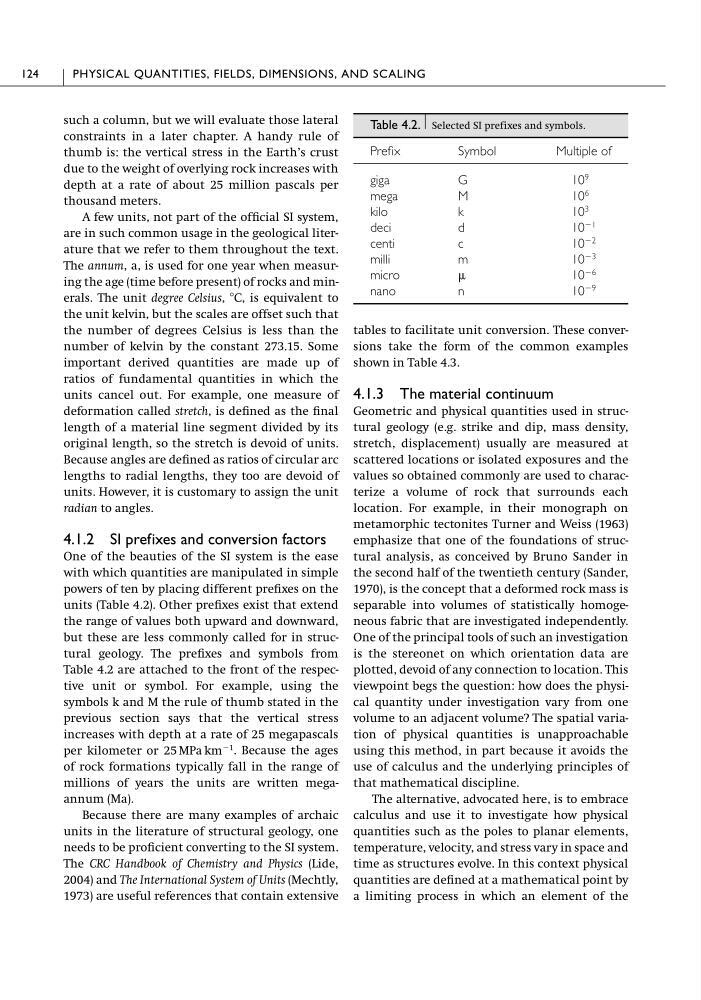
units (Table 4.2). Other prefixes exist that extend
the range of values both upward and downward,
but these are less commonly called for in structural geology. The prefixes and symbols from
Table 4.2 are attached to the front of the respective unit or symbol. For example, using the
symbols k and M the rule of thumb stated in the
previous section says that the vertical stress
increases with depth at a rate of 25 megapascals
per kilometer or 25 MPa km
Ϫ1 . Because the ages
of rock formations typically fall in the range of
millions of years the units are written megaannum (Ma).
Because there are many examples of archaic
units in the literature of structural geology, one
needs to be proficient converting to the SI system.
The CRC Handbook of Chemistry and Physics (Lide,
2004) and The International System of Units (Mechtly,
1973) are useful references that contain extensive
tables to facilitate unit conversion. These conversions take the form of the common examples
shown in Table 4.3.
4.1.3 The material continuum
Geometric and physical quantities used in structural geology (e.g. strike and dip, mass density,
stretch, displacement) usually are measured at
scattered locations or isolated exposures and the
values so obtained commonly are used to characterize a volume of rock that surrounds each
location. For example, in their monograph on
metamorphic tectonites Turner and Weiss (1963)
emphasize that one of the foundations of structural analysis, as conceived by Bruno Sander in
the second half of the twentieth century (Sander,
1970), is the concept that a deformed rock mass is
separable into volumes of statistically homogeneous fabric that are investigated independently.
One of the principal tools of such an investigation
is the stereonet on which orientation data are
plotted, devoid of any connection to location. This
viewpoint begs the question: how does the physical quantity under investigation vary from one
volume to an adjacent volume? The spatial variation of physical quantities is unapproachable
using this method, in part because it avoids the
use of calculus and the underlying principles of
that mathematical discipline.
The alternative, advocated here, is to embrace
calculus and use it to investigate how physical
quantities such as the poles to planar elements,
temperature, velocity, and stress vary in space and
time as structures evolve. In this context physical
quantities are defined at a mathematical point by
a limiting process in which an element of the
124
PHYSICAL QUANTITIES, FIELDS, DIMENSIONS, AND SCALING
Table 4.2. Selected SI prefixes and symbols.
Prefix
Symbol
Multiple of
giga
G
10
9
mega
M
10
6
kilo
k
10
3
deci
d
10
Ϫ1
centi
c
10
Ϫ2
milli
m
10
Ϫ3
micro
10
Ϫ6
nano
n
10
Ϫ9
constraints in a later chapter. A handy rule of
thumb is: the vertical stress in the Earth’s crust
due to the weight of overlying rock increases with
depth at a rate of about 25 million pascals per
thousand meters.
A few units, not part of the official SI system,
are in such common usage in the geological literature that we refer to them throughout the text.
The annum, a, is used for one year when measuring the age (time before present) of rocks and minerals. The unit degree Celsius, ЊC, is equivalent to
the unit kelvin, but the scales are offset such that
the number of degrees Celsius is less than the
number of kelvin by the constant 273.15. Some
important derived quantities are made up of
ratios of fundamental quantities in which the
units cancel out. For example, one measure of
deformation called stretch, is defined as the final
length of a material line segment divided by its
original length, so the stretch is devoid of units.
Because angles are defined as ratios of circular arc
lengths to radial lengths, they too are devoid of
units. However, it is customary to assign the unit
radian to angles.
4.1.2 SI prefixes and conversion factors
One of the beauties of the SI system is the ease
with which quantities are manipulated in simple
powers of ten by placing different prefixes on the
units (Table 4.2). Other prefixes exist that extend
the range of values both upward and downward,
but these are less commonly called for in structural geology. The prefixes and symbols from
Table 4.2 are attached to the front of the respective unit or symbol. For example, using the
symbols k and M the rule of thumb stated in the
previous section says that the vertical stress
increases with depth at a rate of 25 megapascals
per kilometer or 25 MPa km
Ϫ1 . Because the ages
of rock formations typically fall in the range of
millions of years the units are written megaannum (Ma).
Because there are many examples of archaic
units in the literature of structural geology, one
needs to be proficient converting to the SI system.
The CRC Handbook of Chemistry and Physics (Lide,
2004) and The International System of Units (Mechtly,
1973) are useful references that contain extensive
tables to facilitate unit conversion. These conversions take the form of the common examples
shown in Table 4.3.
4.1.3 The material continuum
Geometric and physical quantities used in structural geology (e.g. strike and dip, mass density,
stretch, displacement) usually are measured at
scattered locations or isolated exposures and the
values so obtained commonly are used to characterize a volume of rock that surrounds each
location. For example, in their monograph on
metamorphic tectonites Turner and Weiss (1963)
emphasize that one of the foundations of structural analysis, as conceived by Bruno Sander in
the second half of the twentieth century (Sander,
1970), is the concept that a deformed rock mass is
separable into volumes of statistically homogeneous fabric that are investigated independently.
One of the principal tools of such an investigation
is the stereonet on which orientation data are
plotted, devoid of any connection to location. This
viewpoint begs the question: how does the physical quantity under investigation vary from one
volume to an adjacent volume? The spatial variation of physical quantities is unapproachable
using this method, in part because it avoids the
use of calculus and the underlying principles of
that mathematical discipline.
The alternative, advocated here, is to embrace
calculus and use it to investigate how physical
quantities such as the poles to planar elements,
temperature, velocity, and stress vary in space and
time as structures evolve. In this context physical
quantities are defined at a mathematical point by
a limiting process in which an element of the
124
PHYSICAL QUANTITIES, FIELDS, DIMENSIONS, AND SCALING
Table 4.2. Selected SI prefixes and symbols.
Prefix
Symbol
Multiple of
giga
G
10
9
mega
M
10
6
kilo
k
10
3
deci
d
10
Ϫ1
centi
c
10
Ϫ2
milli
m
10
Ϫ3
micro
10
Ϫ6
nano
n
10
Ϫ9