

Note that proper names for the SI units, such as
newton and kelvin, are not capitalized, but the
corresponding units themselves, N and K, are capitalized. The unit of stress follows from the
concept of a force per unit area:
(4.6)
The SI unit for stress is the pascal, named after the
French mathematician and physicist Blaise Pascal
(1623–62). Equations (4.5) and (4.6) illustrate how
the special units of derived quantities can be converted to products and powers of units of the fundamental quantities.
To put the newton and the pascal into a
geological context consider the weight per unit
volume of granite, one of the most common
crustal rocks. Measurement of 155 different
samples of granite produced a range from 2.516ϫ
10
4 Nm
Ϫ3 to 2.809 ϫ 10
4 N m
Ϫ3 . These unit weights
come from Table 4.1 of Memoir 97 of the
Geological Society of America (Daly et al., 1966).
Clearly not all rocks called granite have the same
unit weight, but we take the reported mean value
of 2.667 ϫ 10
4 Nm
Ϫ3 for this calculation. Thus, one
cubic meter of this granite weighs 2.667 ϫ 10
4 N at
sea level. The sea level weight of one of the authors
of this textbook in archaic units is 140 pounds
force, which is 6.23 ϫ 10
2 N. Thus, the weight of
the granite cube is greater than that of the author
by a factor of 4.28 ϫ 10
1 .
Implicit in the preceding paragraph are two
concepts, scientific notation and significant figures
that are standard practice for a scientist working
with numerical data. For example, the mean unit
weight of granite is given in scientific notation
with four significant figures. In scientific notation
a value is represented by a number, with only one
digit to the left of the decimal place, multiplied by
a power of ten. The power indicates the order of
magnitude of the quantity. The total number of
digits to the left and right of the decimal place is
the number of significant figures. They are called
significant because they recur consistently during
repeated measurements. The weight of the author
has three significant figures.
When multiplying or dividing two quantities
in scientific notation the number of significant
figures of the result is the same as that of the
stress, [ϭ](kg · m · s Ϫ2 ) · m Ϫ2 ϭ N · m Ϫ2 ϭ Pa
quantity with the least significant figures. Thus,
when the weight of the granite cube is divided by
the author’s weight, the quotient is rounded off to
three significant figures. When adding or subtracting a set of numbers, they are arranged by
place (hundreds, tens, ones, tenths, etc.) and the
result is rounded off to the least place that contains significant figures in all the numbers of the
set.
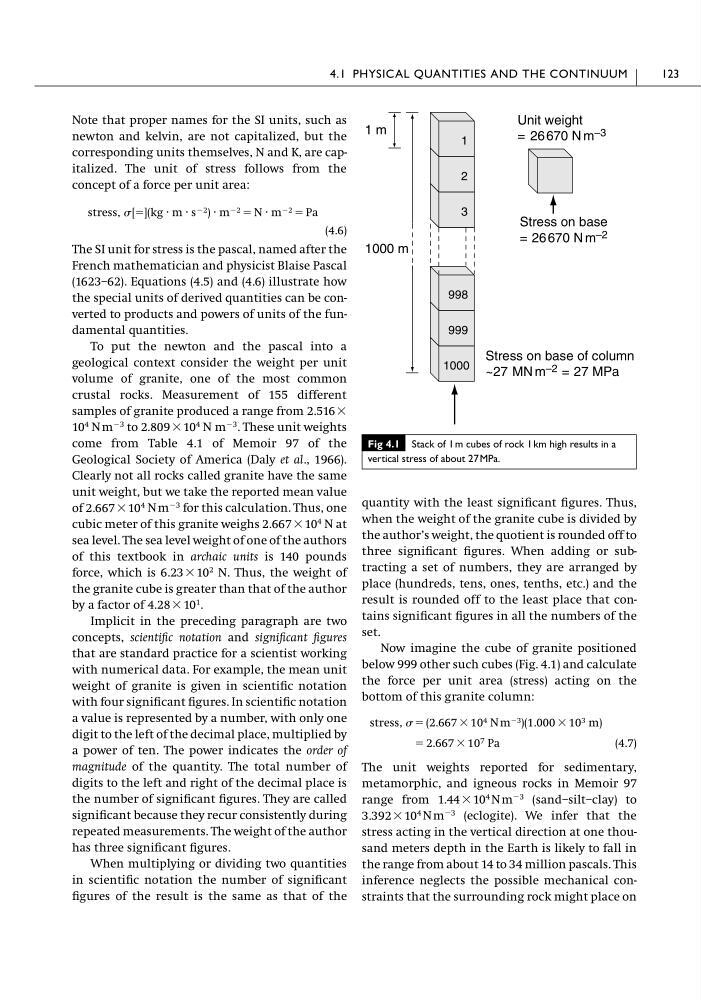
Now imagine the cube of granite positioned
below 999 other such cubes (Fig. 4.1) and calculate
the force per unit area (stress) acting on the
bottom of this granite column:
(4.7)
The unit weights reported for sedimentary,
metamorphic, and igneous rocks in Memoir 97
range from 1.44 ϫ 10
4 Nm
Ϫ3 (sand–silt–clay) to
3.392 ϫ 10
4 Nm
Ϫ3 (eclogite). We infer that the
stress acting in the vertical direction at one thousand meters depth in the Earth is likely to fall in
the range from about 14 to 34 million pascals. This
inference neglects the possible mechanical constraints that the surrounding rock might place on
ϭ 2.667 ϫ 10 7 Pa
stress, ϭ (2.667 ϫ 10 4 N m Ϫ3 )(1.000 ϫ 10 3 m)
4.1 PHYSICAL QUANTITIES AND THE CONTINUUM
123
1
2
3
998
999
1000
1 m
Stress on base of column
~27 MN m –2 = 27 MPa
Stress on base
= 26670 N m –2
Unit weight
= 26670 N m –3
1000 m
Fig 4.1 Stack of 1m cubes of rock 1km high results in a
vertical stress of about 27MPa.
newton and kelvin, are not capitalized, but the
corresponding units themselves, N and K, are capitalized. The unit of stress follows from the
concept of a force per unit area:
(4.6)
The SI unit for stress is the pascal, named after the
French mathematician and physicist Blaise Pascal
(1623–62). Equations (4.5) and (4.6) illustrate how
the special units of derived quantities can be converted to products and powers of units of the fundamental quantities.
To put the newton and the pascal into a
geological context consider the weight per unit
volume of granite, one of the most common
crustal rocks. Measurement of 155 different
samples of granite produced a range from 2.516ϫ
10
4 Nm
Ϫ3 to 2.809 ϫ 10
4 N m
Ϫ3 . These unit weights
come from Table 4.1 of Memoir 97 of the
Geological Society of America (Daly et al., 1966).
Clearly not all rocks called granite have the same
unit weight, but we take the reported mean value
of 2.667 ϫ 10
4 Nm
Ϫ3 for this calculation. Thus, one
cubic meter of this granite weighs 2.667 ϫ 10
4 N at
sea level. The sea level weight of one of the authors
of this textbook in archaic units is 140 pounds
force, which is 6.23 ϫ 10
2 N. Thus, the weight of
the granite cube is greater than that of the author
by a factor of 4.28 ϫ 10
1 .
Implicit in the preceding paragraph are two
concepts, scientific notation and significant figures
that are standard practice for a scientist working
with numerical data. For example, the mean unit
weight of granite is given in scientific notation
with four significant figures. In scientific notation
a value is represented by a number, with only one
digit to the left of the decimal place, multiplied by
a power of ten. The power indicates the order of
magnitude of the quantity. The total number of
digits to the left and right of the decimal place is
the number of significant figures. They are called
significant because they recur consistently during
repeated measurements. The weight of the author
has three significant figures.
When multiplying or dividing two quantities
in scientific notation the number of significant
figures of the result is the same as that of the
stress, [ϭ](kg · m · s Ϫ2 ) · m Ϫ2 ϭ N · m Ϫ2 ϭ Pa
quantity with the least significant figures. Thus,
when the weight of the granite cube is divided by
the author’s weight, the quotient is rounded off to
three significant figures. When adding or subtracting a set of numbers, they are arranged by
place (hundreds, tens, ones, tenths, etc.) and the
result is rounded off to the least place that contains significant figures in all the numbers of the
set.
Now imagine the cube of granite positioned
below 999 other such cubes (Fig. 4.1) and calculate
the force per unit area (stress) acting on the
bottom of this granite column:
(4.7)
The unit weights reported for sedimentary,
metamorphic, and igneous rocks in Memoir 97
range from 1.44 ϫ 10
4 Nm
Ϫ3 (sand–silt–clay) to
3.392 ϫ 10
4 Nm
Ϫ3 (eclogite). We infer that the
stress acting in the vertical direction at one thousand meters depth in the Earth is likely to fall in
the range from about 14 to 34 million pascals. This
inference neglects the possible mechanical constraints that the surrounding rock might place on
ϭ 2.667 ϫ 10 7 Pa
stress, ϭ (2.667 ϫ 10 4 N m Ϫ3 )(1.000 ϫ 10 3 m)
4.1 PHYSICAL QUANTITIES AND THE CONTINUUM
123
1
2
3
998
999
1000
1 m
Stress on base of column
~27 MN m –2 = 27 MPa
Stress on base
= 26670 N m –2
Unit weight
= 26670 N m –3
1000 m
Fig 4.1 Stack of 1m cubes of rock 1km high results in a
vertical stress of about 27MPa.