

with appropriate units of measure. A myriad of units
of measure for the fundamental quantities have
been invented and many are in use today, but we
will use those now recognized as part of the
“Système Internationale d’Unités” or SI system
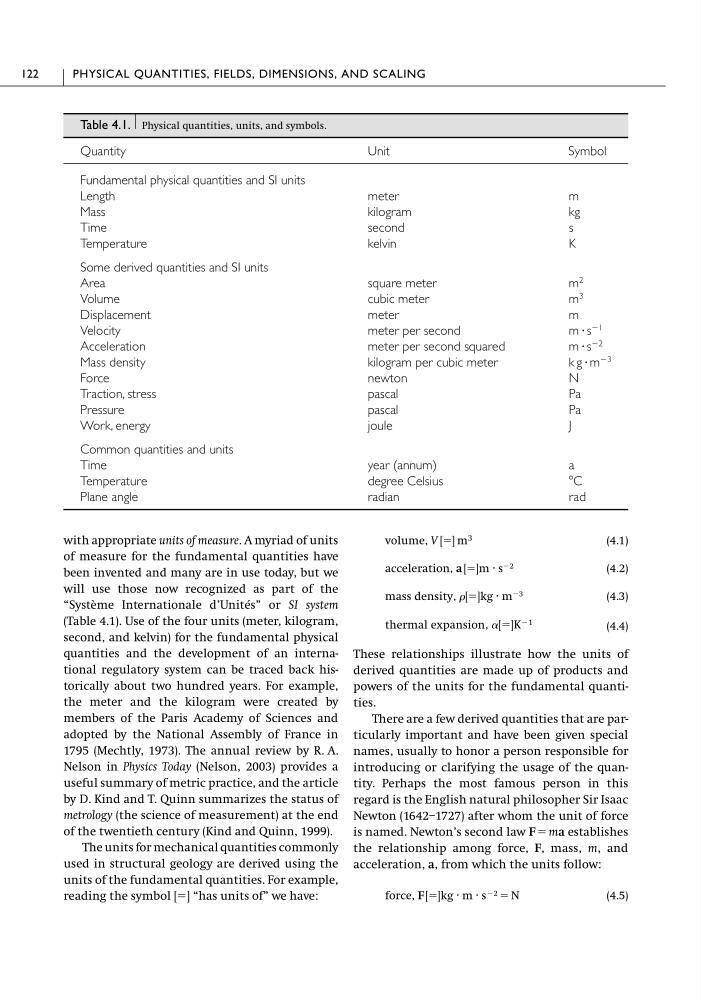
(Table 4.1). Use of the four units (meter, kilogram,
second, and kelvin) for the fundamental physical
quantities and the development of an international regulatory system can be traced back historically about two hundred years. For example,
the meter and the kilogram were created by
members of the Paris Academy of Sciences and
adopted by the National Assembly of France in
1795 (Mechtly, 1973). The annual review by R. A.
Nelson in Physics Today (Nelson, 2003) provides a
useful summary of metric practice, and the article
by D. Kind and T. Quinn summarizes the status of
metrology (the science of measurement) at the end
of the twentieth century (Kind and Quinn, 1999).
The units for mechanical quantities commonly
used in structural geology are derived using the
units of the fundamental quantities. For example,
reading the symbol [ϭ] “has units of” we have:
(4.1)
(4.2)
(4.3)
(4.4)
These relationships illustrate how the units of
derived quantities are made up of products and
powers of the units for the fundamental quantities.
There are a few derived quantities that are particularly important and have been given special
names, usually to honor a person responsible for
introducing or clarifying the usage of the quantity. Perhaps the most famous person in this
regard is the English natural philosopher Sir Isaac
Newton (1642–1727) after whom the unit of force
is named. Newton’s second law F ϭ ma establishes
the relationship among force, F, mass, m, and
acceleration, a, from which the units follow:
(4.5)
force, F [ϭ]kg · m · s Ϫ2 ϭ N
thermal expansion, ␣[ϭ]K Ϫ1
mass density, [ϭ]kg · m Ϫ3
acceleration, a [ϭ]m · s Ϫ2
volume, V [ϭ] m 3
122
PHYSICAL QUANTITIES, FIELDS, DIMENSIONS, AND SCALING
Table 4.1. Physical quantities, units, and symbols.
Quantity
Unit
Symbol
Fundamental physical quantities and SI units
Length
meter
m
Mass
kilogram
kg
Time
second
s
Temperature
kelvin
K
Some derived quantities and SI units
Area
square meter
m
2
Volume
cubic meter
m
3
Displacement
meter
m
Velocity
meter per second
m и s
Ϫ1
Acceleration
meter per second squared
m и s
Ϫ2
Mass density
kilogram per cubic meter
k g иm
Ϫ3
Force
newton
N
Traction, stress
pascal
Pa
Pressure
pascal
Pa
Work, energy
joule
J
Common quantities and units
Time
year (annum)
a
Temperature
degree Celsius
ЊC
Plane angle
radian
rad
of measure for the fundamental quantities have
been invented and many are in use today, but we
will use those now recognized as part of the
“Système Internationale d’Unités” or SI system
(Table 4.1). Use of the four units (meter, kilogram,
second, and kelvin) for the fundamental physical
quantities and the development of an international regulatory system can be traced back historically about two hundred years. For example,
the meter and the kilogram were created by
members of the Paris Academy of Sciences and
adopted by the National Assembly of France in
1795 (Mechtly, 1973). The annual review by R. A.
Nelson in Physics Today (Nelson, 2003) provides a
useful summary of metric practice, and the article
by D. Kind and T. Quinn summarizes the status of
metrology (the science of measurement) at the end
of the twentieth century (Kind and Quinn, 1999).
The units for mechanical quantities commonly
used in structural geology are derived using the
units of the fundamental quantities. For example,
reading the symbol [ϭ] “has units of” we have:
(4.1)
(4.2)
(4.3)
(4.4)
These relationships illustrate how the units of
derived quantities are made up of products and
powers of the units for the fundamental quantities.
There are a few derived quantities that are particularly important and have been given special
names, usually to honor a person responsible for
introducing or clarifying the usage of the quantity. Perhaps the most famous person in this
regard is the English natural philosopher Sir Isaac
Newton (1642–1727) after whom the unit of force
is named. Newton’s second law F ϭ ma establishes
the relationship among force, F, mass, m, and
acceleration, a, from which the units follow:
(4.5)
force, F [ϭ]kg · m · s Ϫ2 ϭ N
thermal expansion, ␣[ϭ]K Ϫ1
mass density, [ϭ]kg · m Ϫ3
acceleration, a [ϭ]m · s Ϫ2
volume, V [ϭ] m 3
122
PHYSICAL QUANTITIES, FIELDS, DIMENSIONS, AND SCALING
Table 4.1. Physical quantities, units, and symbols.
Quantity
Unit
Symbol
Fundamental physical quantities and SI units
Length
meter
m
Mass
kilogram
kg
Time
second
s
Temperature
kelvin
K
Some derived quantities and SI units
Area
square meter
m
2
Volume
cubic meter
m
3
Displacement
meter
m
Velocity
meter per second
m и s
Ϫ1
Acceleration
meter per second squared
m и s
Ϫ2
Mass density
kilogram per cubic meter
k g иm
Ϫ3
Force
newton
N
Traction, stress
pascal
Pa
Pressure
pascal
Pa
Work, energy
joule
J
Common quantities and units
Time
year (annum)
a
Temperature
degree Celsius
ЊC
Plane angle
radian
rad