

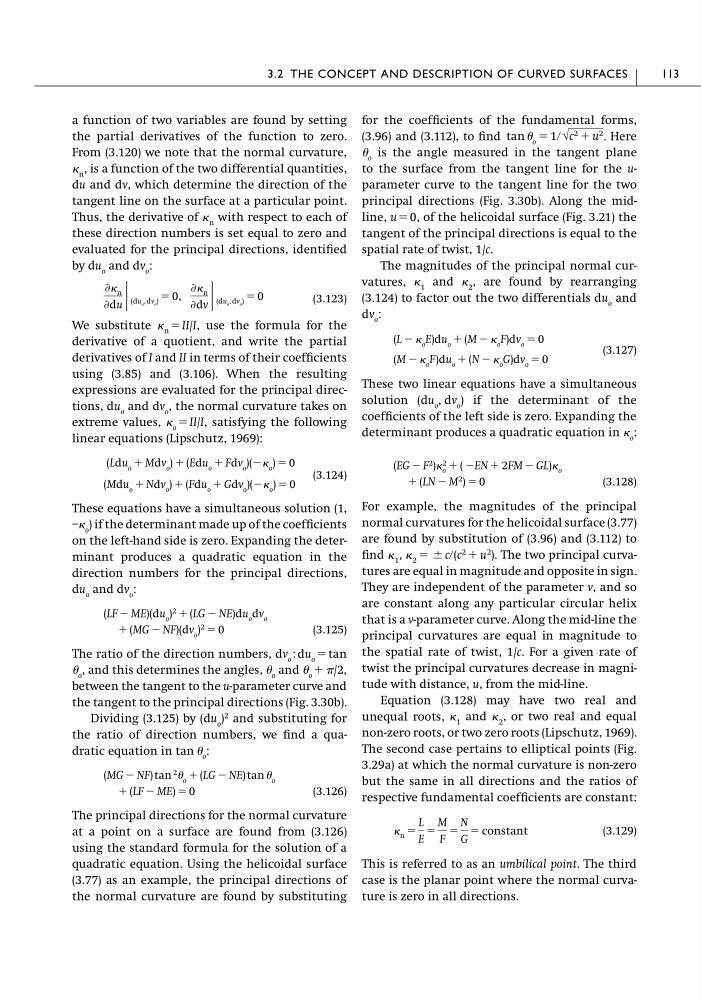
a function of two variables are found by setting
the partial derivatives of the function to zero.
From (3.120) we note that the normal curvature,
n , is a function of the two differential quantities,
du and dv, which determine the direction of the
tangent line on the surface at a particular point.
Thus, the derivative of n with respect to each of
these direction numbers is set equal to zero and
evaluated for the principal directions, identified
by du o and dv o :
(3.123)
We substitute n ϭ II/I, use the formula for the
derivative of a quotient, and write the partial
derivatives of I and II in terms of their coefficients
using (3.85) and (3.106). When the resulting
expressions are evaluated for the principal directions, du o and dv o , the normal curvature takes on
extreme values, o ϭ II/I, satisfying the following
linear equations (Lipschutz, 1969):
(3.124)
These equations have a simultaneous solution (1,
– o ) if the determinant made up of the coefficients
on the left-hand side is zero. Expanding the determinant produces a quadratic equation in the
direction numbers for the principal directions,
du o and dv o :
(3.125)
The ratio of the direction numbers, dv o : du o ϭ tan
o , and this determines the angles, o and o ϩ /2,
between the tangent to the u-parameter curve and
the tangent to the principal directions (Fig. 3.30b).
Dividing (3.125) by (du o )
2 and substituting for
the ratio of direction numbers, we find a quadratic equation in tan o :
(3.126)
The principal directions for the normal curvature
at a point on a surface are found from (3.126)
using the standard formula for the solution of a
quadratic equation. Using the helicoidal surface
(3.77) as an example, the principal directions of
the normal curvature are found by substituting
ϩ (LF Ϫ ME) ϭ 0
(MG Ϫ NF) tan
2 o ϩ (LG Ϫ NE) tan o
ϩ (MG Ϫ NF)(dv o )
2 ϭ 0
(LF Ϫ ME)(du o )
2 ϩ (LG Ϫ NE)du o dv o
(Mdu o ϩ Ndv o ) ϩ (Fdu o ϩ Gdv o )(Ϫ o ) ϭ 0
(Ldu o ϩ Mdv o ) ϩ (Edu o ϩ Fdv o )(Ϫ o ) ϭ 0
Ѩ n
Ѩdu |( du o , dv o ) ϭ 0,
Ѩ n
Ѩdv |( du o , dv o ) ϭ 0
for the coefficients of the fundamental forms,
(3.96) and (3.112), to find
. Here
o is the angle measured in the tangent plane
to the surface from the tangent line for the uparameter curve to the tangent line for the two
principal directions (Fig. 3.30b). Along the midline, u ϭ 0, of the helicoidal surface (Fig. 3.21) the
tangent of the principal directions is equal to the
spatial rate of twist, 1/c.
The magnitudes of the principal normal curvatures, 1 and 2 , are found by rearranging
(3.124) to factor out the two differentials du o and
dv o :
(3.127)
These two linear equations have a simultaneous
solution (du o , dv o ) if the determinant of the
coefficients of the left side is zero. Expanding the
determinant produces a quadratic equation in o :
(3.128)
For example, the magnitudes of the principal
normal curvatures for the helicoidal surface (3.77)
are found by substitution of (3.96) and (3.112) to
find
. The two principal curvatures are equal in magnitude and opposite in sign.
They are independent of the parameter v, and so
are constant along any particular circular helix
that is a v-parameter curve. Along the mid-line the
principal curvatures are equal in magnitude to
the spatial rate of twist, 1/c. For a given rate of
twist the principal curvatures decrease in magnitude with distance, u, from the mid-line.
Equation (3.128) may have two real and
unequal roots, 1 and 2 , or two real and equal
non-zero roots, or two zero roots (Lipschutz, 1969).
The second case pertains to elliptical points (Fig.
3.29a) at which the normal curvature is non-zero
but the same in all directions and the ratios of
respective fundamental coefficients are constant:
(3.129)
This is referred to as an umbilical point. The third
case is the planar point where the normal curvature is zero in all directions.
n ϭ
L
E
ϭ
M
F
ϭ
N
G
ϭ constant
1 , 2 ϭ Ϯ cր(c
2 ϩ u
2 )
ϩ (LN Ϫ M
2 ) ϭ 0
(EG Ϫ F 2 ) 2
o ϩ ( ϪEN ϩ 2FM Ϫ GL) o
(M Ϫ o F)du o ϩ (N Ϫ o G)dv o ϭ 0
(L Ϫ o E)du o ϩ (M Ϫ o F)dv o ϭ 0
tan o ϭ 1ր √c
2 ϩ u
2
3.2 THE CONCEPT AND DESCRIPTION OF CURVED SURFACES
113
the partial derivatives of the function to zero.
From (3.120) we note that the normal curvature,
n , is a function of the two differential quantities,
du and dv, which determine the direction of the
tangent line on the surface at a particular point.
Thus, the derivative of n with respect to each of
these direction numbers is set equal to zero and
evaluated for the principal directions, identified
by du o and dv o :
(3.123)
We substitute n ϭ II/I, use the formula for the
derivative of a quotient, and write the partial
derivatives of I and II in terms of their coefficients
using (3.85) and (3.106). When the resulting
expressions are evaluated for the principal directions, du o and dv o , the normal curvature takes on
extreme values, o ϭ II/I, satisfying the following
linear equations (Lipschutz, 1969):
(3.124)
These equations have a simultaneous solution (1,
– o ) if the determinant made up of the coefficients
on the left-hand side is zero. Expanding the determinant produces a quadratic equation in the
direction numbers for the principal directions,
du o and dv o :
(3.125)
The ratio of the direction numbers, dv o : du o ϭ tan
o , and this determines the angles, o and o ϩ /2,
between the tangent to the u-parameter curve and
the tangent to the principal directions (Fig. 3.30b).
Dividing (3.125) by (du o )
2 and substituting for
the ratio of direction numbers, we find a quadratic equation in tan o :
(3.126)
The principal directions for the normal curvature
at a point on a surface are found from (3.126)
using the standard formula for the solution of a
quadratic equation. Using the helicoidal surface
(3.77) as an example, the principal directions of
the normal curvature are found by substituting
ϩ (LF Ϫ ME) ϭ 0
(MG Ϫ NF) tan
2 o ϩ (LG Ϫ NE) tan o
ϩ (MG Ϫ NF)(dv o )
2 ϭ 0
(LF Ϫ ME)(du o )
2 ϩ (LG Ϫ NE)du o dv o
(Mdu o ϩ Ndv o ) ϩ (Fdu o ϩ Gdv o )(Ϫ o ) ϭ 0
(Ldu o ϩ Mdv o ) ϩ (Edu o ϩ Fdv o )(Ϫ o ) ϭ 0
Ѩ n
Ѩdu |( du o , dv o ) ϭ 0,
Ѩ n
Ѩdv |( du o , dv o ) ϭ 0
for the coefficients of the fundamental forms,
(3.96) and (3.112), to find
. Here
o is the angle measured in the tangent plane
to the surface from the tangent line for the uparameter curve to the tangent line for the two
principal directions (Fig. 3.30b). Along the midline, u ϭ 0, of the helicoidal surface (Fig. 3.21) the
tangent of the principal directions is equal to the
spatial rate of twist, 1/c.
The magnitudes of the principal normal curvatures, 1 and 2 , are found by rearranging
(3.124) to factor out the two differentials du o and
dv o :
(3.127)
These two linear equations have a simultaneous
solution (du o , dv o ) if the determinant of the
coefficients of the left side is zero. Expanding the
determinant produces a quadratic equation in o :
(3.128)
For example, the magnitudes of the principal
normal curvatures for the helicoidal surface (3.77)
are found by substitution of (3.96) and (3.112) to
find
. The two principal curvatures are equal in magnitude and opposite in sign.
They are independent of the parameter v, and so
are constant along any particular circular helix
that is a v-parameter curve. Along the mid-line the
principal curvatures are equal in magnitude to
the spatial rate of twist, 1/c. For a given rate of
twist the principal curvatures decrease in magnitude with distance, u, from the mid-line.
Equation (3.128) may have two real and
unequal roots, 1 and 2 , or two real and equal
non-zero roots, or two zero roots (Lipschutz, 1969).
The second case pertains to elliptical points (Fig.
3.29a) at which the normal curvature is non-zero
but the same in all directions and the ratios of
respective fundamental coefficients are constant:
(3.129)
This is referred to as an umbilical point. The third
case is the planar point where the normal curvature is zero in all directions.
n ϭ
L
E
ϭ
M
F
ϭ
N
G
ϭ constant
1 , 2 ϭ Ϯ cր(c
2 ϩ u
2 )
ϩ (LN Ϫ M
2 ) ϭ 0
(EG Ϫ F 2 ) 2
o ϩ ( ϪEN ϩ 2FM Ϫ GL) o
(M Ϫ o F)du o ϩ (N Ϫ o G)dv o ϭ 0
(L Ϫ o E)du o ϩ (M Ϫ o F)dv o ϭ 0
tan o ϭ 1ր √c
2 ϩ u
2
3.2 THE CONCEPT AND DESCRIPTION OF CURVED SURFACES
113