

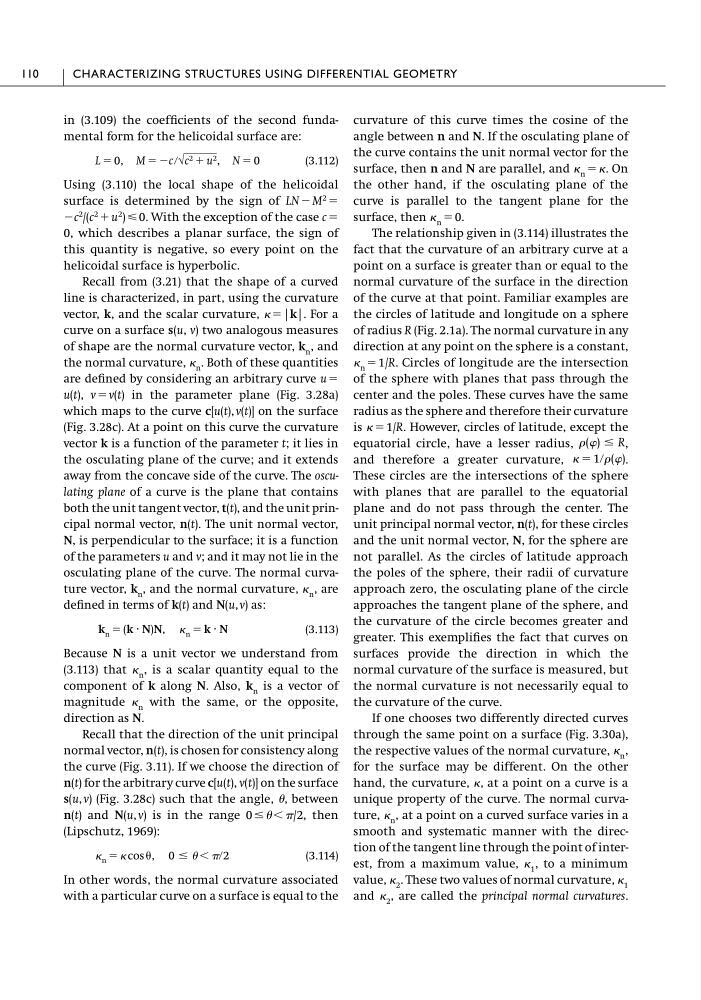
in (3.109) the coefficients of the second fundamental form for the helicoidal surface are:
(3.112)
Using (3.110) the local shape of the helicoidal
surface is determined by the sign of LN Ϫ M
2 ϭ
Ϫc
2 /(c
2 ϩ u
2 ) р 0. With the exception of the case c ϭ
0, which describes a planar surface, the sign of
this quantity is negative, so every point on the
helicoidal surface is hyperbolic.
Recall from (3.21) that the shape of a curved
line is characterized, in part, using the curvature
vector, k, and the scalar curvature, ϭ |k|. For a
curve on a surface s(u, v) two analogous measures
of shape are the normal curvature vector, k n , and
the normal curvature, n . Both of these quantities
are defined by considering an arbitrary curve u ϭ
u(t), v ϭ v(t) in the parameter plane (Fig. 3.28a)
which maps to the curve c[u(t), v(t)] on the surface
(Fig. 3.28c). At a point on this curve the curvature
vector k is a function of the parameter t; it lies in
the osculating plane of the curve; and it extends
away from the concave side of the curve. The osculating plane of a curve is the plane that contains
both the unit tangent vector, t(t), and the unit principal normal vector, n(t). The unit normal vector,
N, is perpendicular to the surface; it is a function
of the parameters u and v; and it may not lie in the
osculating plane of the curve. The normal curvature vector, k n , and the normal curvature, n , are
defined in terms of k(t) and N(u, v) as:
(3.113)
Because N is a unit vector we understand from
(3.113) that n , is a scalar quantity equal to the
component of k along N. Also, k n is a vector of
magnitude n with the same, or the opposite,
direction as N.
Recall that the direction of the unit principal
normal vector, n(t), is chosen for consistency along
the curve (Fig. 3.11). If we choose the direction of
n(t) for the arbitrary curve c[u(t), v(t)] on the surface
s(u, v) (Fig. 3.28c) such that the angle, , between
n(t) and N(u, v) is in the range 0 Յ Ͻ /2, then
(Lipschutz, 1969):
(3.114)
In other words, the normal curvature associated
with a particular curve on a surface is equal to the
n ϭ cos , 0 Յ Ͻ ր2
k n ϭ (k · N)N, n ϭ k · N
L ϭ 0, M ϭ Ϫc ր√c 2 ϩ u 2 , N ϭ 0
curvature of this curve times the cosine of the
angle between n and N. If the osculating plane of
the curve contains the unit normal vector for the
surface, then n and N are parallel, and n ϭ . On
the other hand, if the osculating plane of the
curve is parallel to the tangent plane for the
surface, then n ϭ 0.
The relationship given in (3.114) illustrates the
fact that the curvature of an arbitrary curve at a
point on a surface is greater than or equal to the
normal curvature of the surface in the direction
of the curve at that point. Familiar examples are
the circles of latitude and longitude on a sphere
of radius R (Fig. 2.1a). The normal curvature in any
direction at any point on the sphere is a constant,
n ϭ 1/R. Circles of longitude are the intersection
of the sphere with planes that pass through the
center and the poles. These curves have the same
radius as the sphere and therefore their curvature
is ϭ 1/R. However, circles of latitude, except the
equatorial circle, have a lesser radius,
,
and therefore a greater curvature,
.
These circles are the intersections of the sphere
with planes that are parallel to the equatorial
plane and do not pass through the center. The
unit principal normal vector, n(t), for these circles
and the unit normal vector, N, for the sphere are
not parallel. As the circles of latitude approach
the poles of the sphere, their radii of curvature
approach zero, the osculating plane of the circle
approaches the tangent plane of the sphere, and
the curvature of the circle becomes greater and
greater. This exemplifies the fact that curves on
surfaces provide the direction in which the
normal curvature of the surface is measured, but
the normal curvature is not necessarily equal to
the curvature of the curve.
If one chooses two differently directed curves
through the same point on a surface (Fig. 3.30a),
the respective values of the normal curvature, n ,
for the surface may be different. On the other
hand, the curvature, , at a point on a curve is a
unique property of the curve. The normal curvature, n , at a point on a curved surface varies in a
smooth and systematic manner with the direction of the tangent line through the point of interest, from a maximum value, 1 , to a minimum
value, 2 . These two values of normal curvature, 1
and 2 , are called the principal normal curvatures.
ϭ 1ր()
() Յ R
110
CHARACTERIZING STRUCTURES USING DIFFERENTIAL GEOMETRY
(3.112)
Using (3.110) the local shape of the helicoidal
surface is determined by the sign of LN Ϫ M
2 ϭ
Ϫc
2 /(c
2 ϩ u
2 ) р 0. With the exception of the case c ϭ
0, which describes a planar surface, the sign of
this quantity is negative, so every point on the
helicoidal surface is hyperbolic.
Recall from (3.21) that the shape of a curved
line is characterized, in part, using the curvature
vector, k, and the scalar curvature, ϭ |k|. For a
curve on a surface s(u, v) two analogous measures
of shape are the normal curvature vector, k n , and
the normal curvature, n . Both of these quantities
are defined by considering an arbitrary curve u ϭ
u(t), v ϭ v(t) in the parameter plane (Fig. 3.28a)
which maps to the curve c[u(t), v(t)] on the surface
(Fig. 3.28c). At a point on this curve the curvature
vector k is a function of the parameter t; it lies in
the osculating plane of the curve; and it extends
away from the concave side of the curve. The osculating plane of a curve is the plane that contains
both the unit tangent vector, t(t), and the unit principal normal vector, n(t). The unit normal vector,
N, is perpendicular to the surface; it is a function
of the parameters u and v; and it may not lie in the
osculating plane of the curve. The normal curvature vector, k n , and the normal curvature, n , are
defined in terms of k(t) and N(u, v) as:
(3.113)
Because N is a unit vector we understand from
(3.113) that n , is a scalar quantity equal to the
component of k along N. Also, k n is a vector of
magnitude n with the same, or the opposite,
direction as N.
Recall that the direction of the unit principal
normal vector, n(t), is chosen for consistency along
the curve (Fig. 3.11). If we choose the direction of
n(t) for the arbitrary curve c[u(t), v(t)] on the surface
s(u, v) (Fig. 3.28c) such that the angle, , between
n(t) and N(u, v) is in the range 0 Յ Ͻ /2, then
(Lipschutz, 1969):
(3.114)
In other words, the normal curvature associated
with a particular curve on a surface is equal to the
n ϭ cos , 0 Յ Ͻ ր2
k n ϭ (k · N)N, n ϭ k · N
L ϭ 0, M ϭ Ϫc ր√c 2 ϩ u 2 , N ϭ 0
curvature of this curve times the cosine of the
angle between n and N. If the osculating plane of
the curve contains the unit normal vector for the
surface, then n and N are parallel, and n ϭ . On
the other hand, if the osculating plane of the
curve is parallel to the tangent plane for the
surface, then n ϭ 0.
The relationship given in (3.114) illustrates the
fact that the curvature of an arbitrary curve at a
point on a surface is greater than or equal to the
normal curvature of the surface in the direction
of the curve at that point. Familiar examples are
the circles of latitude and longitude on a sphere
of radius R (Fig. 2.1a). The normal curvature in any
direction at any point on the sphere is a constant,
n ϭ 1/R. Circles of longitude are the intersection
of the sphere with planes that pass through the
center and the poles. These curves have the same
radius as the sphere and therefore their curvature
is ϭ 1/R. However, circles of latitude, except the
equatorial circle, have a lesser radius,
,
and therefore a greater curvature,
.
These circles are the intersections of the sphere
with planes that are parallel to the equatorial
plane and do not pass through the center. The
unit principal normal vector, n(t), for these circles
and the unit normal vector, N, for the sphere are
not parallel. As the circles of latitude approach
the poles of the sphere, their radii of curvature
approach zero, the osculating plane of the circle
approaches the tangent plane of the sphere, and
the curvature of the circle becomes greater and
greater. This exemplifies the fact that curves on
surfaces provide the direction in which the
normal curvature of the surface is measured, but
the normal curvature is not necessarily equal to
the curvature of the curve.
If one chooses two differently directed curves
through the same point on a surface (Fig. 3.30a),
the respective values of the normal curvature, n ,
for the surface may be different. On the other
hand, the curvature, , at a point on a curve is a
unique property of the curve. The normal curvature, n , at a point on a curved surface varies in a
smooth and systematic manner with the direction of the tangent line through the point of interest, from a maximum value, 1 , to a minimum
value, 2 . These two values of normal curvature, 1
and 2 , are called the principal normal curvatures.
ϭ 1ր()
() Յ R
110
CHARACTERIZING STRUCTURES USING DIFFERENTIAL GEOMETRY