

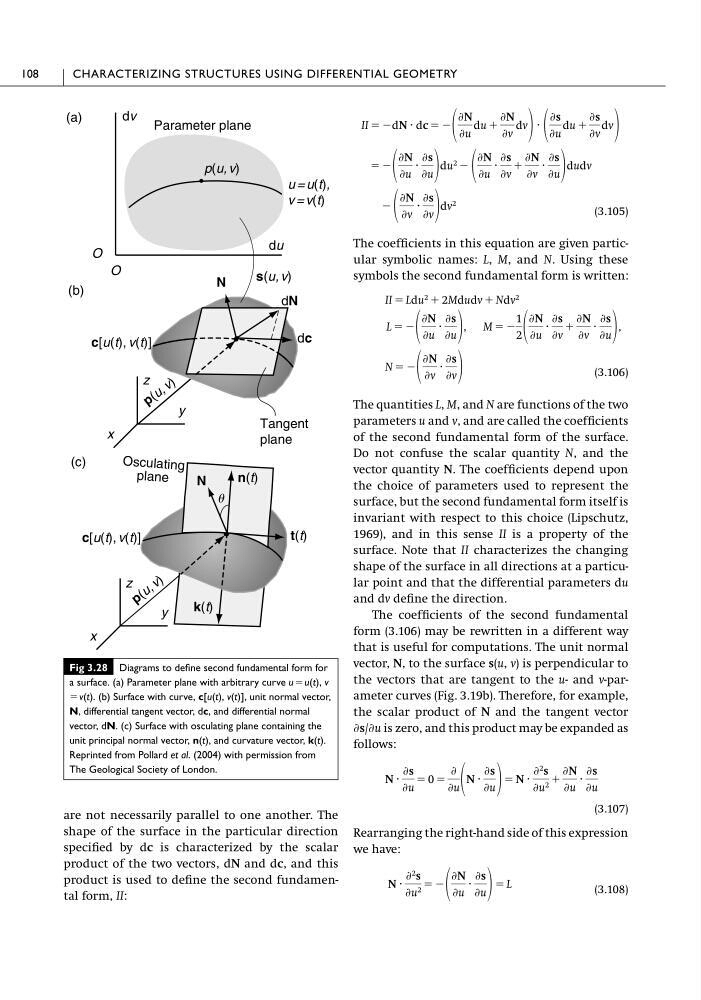
are not necessarily parallel to one another. The
shape of the surface in the particular direction
specified by dc is characterized by the scalar
product of the two vectors, dN and dc, and this
product is used to define the second fundamental form, II:
(3.105)
The coefficients in this equation are given particular symbolic names: L, M, and N. Using these
symbols the second fundamental form is written:
(3.106)
The quantities L, M, and N are functions of the two
parameters u and v, and are called the coefficients
of the second fundamental form of the surface.
Do not confuse the scalar quantity N, and the
vector quantity N. The coefficients depend upon
the choice of parameters used to represent the
surface, but the second fundamental form itself is
invariant with respect to this choice (Lipschutz,
1969), and in this sense II is a property of the
surface. Note that II characterizes the changing
shape of the surface in all directions at a particular point and that the differential parameters du
and dv define the direction.
The coefficients of the second fundamental
form (3.106) may be rewritten in a different way
that is useful for computations. The unit normal
vector, N, to the surface s(u, v) is perpendicular to
the vectors that are tangent to the u- and v-parameter curves (Fig. 3.19b). Therefore, for example,
the scalar product of N and the tangent vector
Ѩs/Ѩu is zero, and this product may be expanded as
follows:
(3.107)
Rearranging the right-hand side of this expression
we have:
(3.108)
N ·
Ѩ
2 s
Ѩu
2
ϭ Ϫ
ѨN
Ѩu
·
Ѩs
Ѩu
ϭ L
N ·
Ѩs
Ѩu
ϭ 0 ϭ
Ѩ
Ѩu N ·
Ѩs
Ѩu ϭ N ·
Ѩ
2
s
Ѩu
2
ϩ
ѨN
Ѩu
·
Ѩs
Ѩu
N ϭ Ϫ
ѨN
Ѩv
·
Ѩs
Ѩv
M ϭ Ϫ
1
2
ѨN
Ѩu
·
Ѩs
Ѩv
ϩ
ѨN
Ѩv
·
Ѩs
Ѩu ,
L ϭ Ϫ
ѨN
Ѩu
·
Ѩs
Ѩu ,
II ϭ Ldu
2 ϩ 2Mdudv ϩ Ndv
2
Ϫ
ѨN
Ѩv
·
Ѩs
Ѩv dv
2
ϭ Ϫ
ѨN
Ѩu
·
Ѩs
Ѩu du
2 Ϫ
ѨN
Ѩu
·
Ѩs
Ѩv
ϩ
ѨN
Ѩv
·
Ѩs
Ѩu dudv
II ϭ ϪdN · dc ϭ Ϫ
ѨN
Ѩu
du ϩ
ѨN
Ѩv
dv
·
Ѩs
Ѩu
du ϩ
Ѩs
Ѩv
dv
108
CHARACTERIZING STRUCTURES USING DIFFERENTIAL GEOMETRY
y
z
x
dc
N
dN
Tangent
plane
(b)
(a)
O
Parameter plane
O
y
z
x
n(t)
N
du
dv
Osc ulat ing
plan e
(c)
u
p(u, v)
s(u, v)
u = u(t),
v = v(t)
c[u(t), v(t)]
p ( u , v )
t(t)
c[u(t), v(t)]
k(t)
p ( u , v )
Fig 3.28 Diagrams to define second fundamental form for
a surface. (a) Parameter plane with arbitrary curve uϭu(t), v
ϭ v(t). (b) Surface with curve, c[u(t), v(t)], unit normal vector,
N, differential tangent vector, dc, and differential normal
vector, dN. (c) Surface with osculating plane containing the
unit principal normal vector, n(t), and curvature vector, k(t).
Reprinted from Pollard et al. (2004) with permission from
The Geological Society of London.
shape of the surface in the particular direction
specified by dc is characterized by the scalar
product of the two vectors, dN and dc, and this
product is used to define the second fundamental form, II:
(3.105)
The coefficients in this equation are given particular symbolic names: L, M, and N. Using these
symbols the second fundamental form is written:
(3.106)
The quantities L, M, and N are functions of the two
parameters u and v, and are called the coefficients
of the second fundamental form of the surface.
Do not confuse the scalar quantity N, and the
vector quantity N. The coefficients depend upon
the choice of parameters used to represent the
surface, but the second fundamental form itself is
invariant with respect to this choice (Lipschutz,
1969), and in this sense II is a property of the
surface. Note that II characterizes the changing
shape of the surface in all directions at a particular point and that the differential parameters du
and dv define the direction.
The coefficients of the second fundamental
form (3.106) may be rewritten in a different way
that is useful for computations. The unit normal
vector, N, to the surface s(u, v) is perpendicular to
the vectors that are tangent to the u- and v-parameter curves (Fig. 3.19b). Therefore, for example,
the scalar product of N and the tangent vector
Ѩs/Ѩu is zero, and this product may be expanded as
follows:
(3.107)
Rearranging the right-hand side of this expression
we have:
(3.108)
N ·
Ѩ
2 s
Ѩu
2
ϭ Ϫ
ѨN
Ѩu
·
Ѩs
Ѩu
ϭ L
N ·
Ѩs
Ѩu
ϭ 0 ϭ
Ѩ
Ѩu N ·
Ѩs
Ѩu ϭ N ·
Ѩ
2
s
Ѩu
2
ϩ
ѨN
Ѩu
·
Ѩs
Ѩu
N ϭ Ϫ
ѨN
Ѩv
·
Ѩs
Ѩv
M ϭ Ϫ
1
2
ѨN
Ѩu
·
Ѩs
Ѩv
ϩ
ѨN
Ѩv
·
Ѩs
Ѩu ,
L ϭ Ϫ
ѨN
Ѩu
·
Ѩs
Ѩu ,
II ϭ Ldu
2 ϩ 2Mdudv ϩ Ndv
2
Ϫ
ѨN
Ѩv
·
Ѩs
Ѩv dv
2
ϭ Ϫ
ѨN
Ѩu
·
Ѩs
Ѩu du
2 Ϫ
ѨN
Ѩu
·
Ѩs
Ѩv
ϩ
ѨN
Ѩv
·
Ѩs
Ѩu dudv
II ϭ ϪdN · dc ϭ Ϫ
ѨN
Ѩu
du ϩ
ѨN
Ѩv
dv
·
Ѩs
Ѩu
du ϩ
Ѩs
Ѩv
dv
108
CHARACTERIZING STRUCTURES USING DIFFERENTIAL GEOMETRY
y
z
x
dc
N
dN
Tangent
plane
(b)
(a)
O
Parameter plane
O
y
z
x
n(t)
N
du
dv
Osc ulat ing
plan e
(c)
u
p(u, v)
s(u, v)
u = u(t),
v = v(t)
c[u(t), v(t)]
p ( u , v )
t(t)
c[u(t), v(t)]
k(t)
p ( u , v )
Fig 3.28 Diagrams to define second fundamental form for
a surface. (a) Parameter plane with arbitrary curve uϭu(t), v
ϭ v(t). (b) Surface with curve, c[u(t), v(t)], unit normal vector,
N, differential tangent vector, dc, and differential normal
vector, dN. (c) Surface with osculating plane containing the
unit principal normal vector, n(t), and curvature vector, k(t).
Reprinted from Pollard et al. (2004) with permission from
The Geological Society of London.