

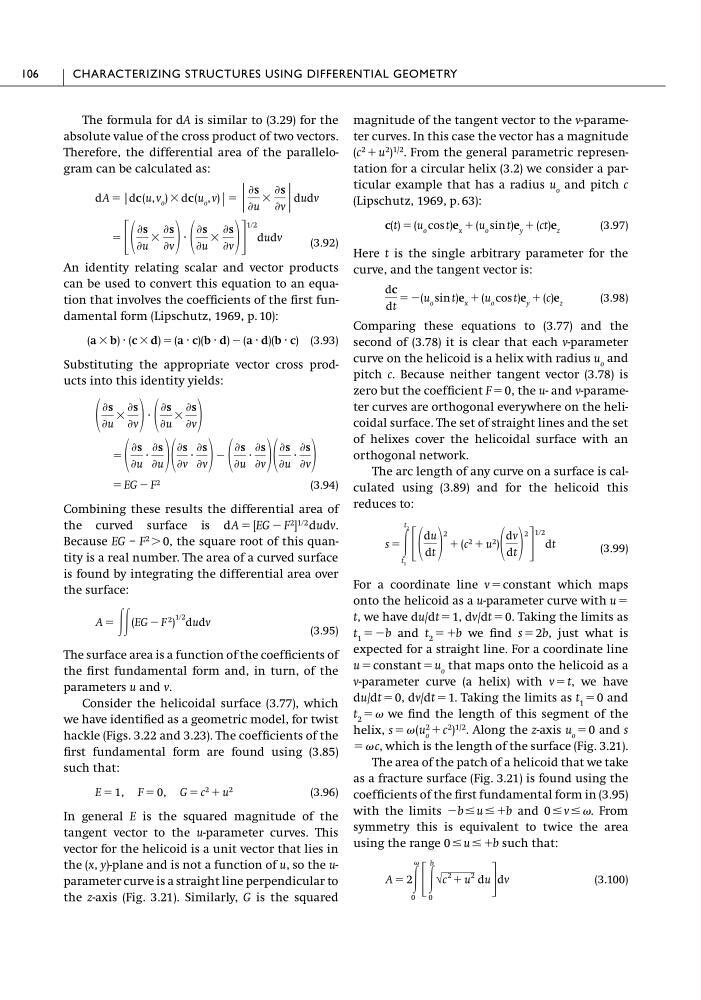
The formula for dA is similar to (3.29) for the
absolute value of the cross product of two vectors.
Therefore, the differential area of the parallelogram can be calculated as:
(3.92)
An identity relating scalar and vector products
can be used to convert this equation to an equation that involves the coefficients of the first fundamental form (Lipschutz, 1969, p. 10):
(3.93)
Substituting the appropriate vector cross products into this identity yields:
(3.94)
Combining these results the differential area of
the curved surface is
.
Because EG – F
2 Ͼ 0, the square root of this quantity is a real number. The area of a curved surface
is found by integrating the differential area over
the surface:
(3.95)
The surface area is a function of the coefficients of
the first fundamental form and, in turn, of the
parameters u and v.
Consider the helicoidal surface (3.77), which
we have identified as a geometric model, for twist
hackle (Figs. 3.22 and 3.23). The coefficients of the
first fundamental form are found using (3.85)
such that:
(3.96)
In general E is the squared magnitude of the
tangent vector to the u-parameter curves. This
vector for the helicoid is a unit vector that lies in
the (x, y)-plane and is not a function of u, so the uparameter curve is a straight line perpendicular to
the z-axis (Fig. 3.21). Similarly, G is the squared
E ϭ 1, F ϭ 0, G ϭ c
2 ϩ u
2
A ϭ ΎΎ (EG Ϫ F
2 )
1ր2 dudv
dA ϭ [EG Ϫ F 2 ] 1ր2 dudv
ϭ EG Ϫ F 2
Ϫ
Ѩs
Ѩu
·
Ѩs
Ѩv
Ѩs
Ѩu
·
Ѩs
Ѩv
ϭ
Ѩs
Ѩu
·
Ѩs
Ѩu
Ѩs
Ѩv
·
Ѩs
Ѩv
Ѩs
Ѩu
ϫ
Ѩs
Ѩv
·
Ѩs
Ѩu
ϫ
Ѩs
Ѩv
(a ϫ b) · (c ϫ d) ϭ (a · c)(b · d) Ϫ (a · d)(b · c)
ϭ ΄
Ѩs
Ѩu
ϫ
Ѩs
Ѩv ·
Ѩs
Ѩu
ϫ
Ѩs
Ѩv ΅
1ր2
dudv
dA ϭ |dc (u, v o ) ϫ dc (u o , v) | ϭ |
Ѩs
Ѩu
ϫ
Ѩs
Ѩv | dudv
magnitude of the tangent vector to the v-parameter curves. In this case the vector has a magnitude
(c
2 ϩ u
2 )
1/2 . From the general parametric representation for a circular helix (3.2) we consider a particular example that has a radius u o and pitch c
(Lipschutz, 1969, p. 63):
(3.97)
Here t is the single arbitrary parameter for the
curve, and the tangent vector is:
(3.98)
Comparing these equations to (3.77) and the
second of (3.78) it is clear that each v-parameter
curve on the helicoid is a helix with radius u o and
pitch c. Because neither tangent vector (3.78) is
zero but the coefficient F ϭ 0, the u- and v-parameter curves are orthogonal everywhere on the helicoidal surface. The set of straight lines and the set
of helixes cover the helicoidal surface with an
orthogonal network.
The arc length of any curve on a surface is calculated using (3.89) and for the helicoid this
reduces to:
(3.99)
For a coordinate line v ϭ constant which maps
onto the helicoid as a u-parameter curve with u ϭ
t, we have du/dt ϭ 1, dv/dt ϭ 0. Taking the limits as
t 1 ϭϪb and t 2 ϭϩb we find s ϭ 2b, just what is
expected for a straight line. For a coordinate line
u ϭ constant ϭ u o that maps onto the helicoid as a
v-parameter curve (a helix) with v ϭ t, we have
du/dt ϭ 0, dv/dt ϭ 1. Taking the limits as t 1 ϭ 0 and
t 2 ϭ we find the length of this segment of the
helix, s ϭ (u o
2 ϩ c
2 )
1/2 . Along the z-axis u o ϭ 0 and s
ϭ c, which is the length of the surface (Fig. 3.21).
The area of the patch of a helicoid that we take
as a fracture surface (Fig. 3.21) is found using the
coefficients of the first fundamental form in (3.95)
with the limits Ϫb Յ u Յϩb and 0 Յ v Յ . From
symmetry this is equivalent to twice the area
using the range 0 Յ u Յϩb such that:
(3.100)
A ϭ 2 Ύ
0
΄ Ύ
b
0
√c
2 ϩ u
2 du ΅ dv
s ϭ Ύ
t 2
t 1
΄
du
dt
2
ϩ (c 2 ϩ u 2 )
dv
dt
2
΅
1ր2
dt
dc
dt
ϭ Ϫ(u o sin t)e x ϩ (u o cos t)e y ϩ (c)e z
c(t) ϭ (u o cos t)e x ϩ (u o sin t)e y ϩ (ct)e z
106
CHARACTERIZING STRUCTURES USING DIFFERENTIAL GEOMETRY
absolute value of the cross product of two vectors.
Therefore, the differential area of the parallelogram can be calculated as:
(3.92)
An identity relating scalar and vector products
can be used to convert this equation to an equation that involves the coefficients of the first fundamental form (Lipschutz, 1969, p. 10):
(3.93)
Substituting the appropriate vector cross products into this identity yields:
(3.94)
Combining these results the differential area of
the curved surface is
.
Because EG – F
2 Ͼ 0, the square root of this quantity is a real number. The area of a curved surface
is found by integrating the differential area over
the surface:
(3.95)
The surface area is a function of the coefficients of
the first fundamental form and, in turn, of the
parameters u and v.
Consider the helicoidal surface (3.77), which
we have identified as a geometric model, for twist
hackle (Figs. 3.22 and 3.23). The coefficients of the
first fundamental form are found using (3.85)
such that:
(3.96)
In general E is the squared magnitude of the
tangent vector to the u-parameter curves. This
vector for the helicoid is a unit vector that lies in
the (x, y)-plane and is not a function of u, so the uparameter curve is a straight line perpendicular to
the z-axis (Fig. 3.21). Similarly, G is the squared
E ϭ 1, F ϭ 0, G ϭ c
2 ϩ u
2
A ϭ ΎΎ (EG Ϫ F
2 )
1ր2 dudv
dA ϭ [EG Ϫ F 2 ] 1ր2 dudv
ϭ EG Ϫ F 2
Ϫ
Ѩs
Ѩu
·
Ѩs
Ѩv
Ѩs
Ѩu
·
Ѩs
Ѩv
ϭ
Ѩs
Ѩu
·
Ѩs
Ѩu
Ѩs
Ѩv
·
Ѩs
Ѩv
Ѩs
Ѩu
ϫ
Ѩs
Ѩv
·
Ѩs
Ѩu
ϫ
Ѩs
Ѩv
(a ϫ b) · (c ϫ d) ϭ (a · c)(b · d) Ϫ (a · d)(b · c)
ϭ ΄
Ѩs
Ѩu
ϫ
Ѩs
Ѩv ·
Ѩs
Ѩu
ϫ
Ѩs
Ѩv ΅
1ր2
dudv
dA ϭ |dc (u, v o ) ϫ dc (u o , v) | ϭ |
Ѩs
Ѩu
ϫ
Ѩs
Ѩv | dudv
magnitude of the tangent vector to the v-parameter curves. In this case the vector has a magnitude
(c
2 ϩ u
2 )
1/2 . From the general parametric representation for a circular helix (3.2) we consider a particular example that has a radius u o and pitch c
(Lipschutz, 1969, p. 63):
(3.97)
Here t is the single arbitrary parameter for the
curve, and the tangent vector is:
(3.98)
Comparing these equations to (3.77) and the
second of (3.78) it is clear that each v-parameter
curve on the helicoid is a helix with radius u o and
pitch c. Because neither tangent vector (3.78) is
zero but the coefficient F ϭ 0, the u- and v-parameter curves are orthogonal everywhere on the helicoidal surface. The set of straight lines and the set
of helixes cover the helicoidal surface with an
orthogonal network.
The arc length of any curve on a surface is calculated using (3.89) and for the helicoid this
reduces to:
(3.99)
For a coordinate line v ϭ constant which maps
onto the helicoid as a u-parameter curve with u ϭ
t, we have du/dt ϭ 1, dv/dt ϭ 0. Taking the limits as
t 1 ϭϪb and t 2 ϭϩb we find s ϭ 2b, just what is
expected for a straight line. For a coordinate line
u ϭ constant ϭ u o that maps onto the helicoid as a
v-parameter curve (a helix) with v ϭ t, we have
du/dt ϭ 0, dv/dt ϭ 1. Taking the limits as t 1 ϭ 0 and
t 2 ϭ we find the length of this segment of the
helix, s ϭ (u o
2 ϩ c
2 )
1/2 . Along the z-axis u o ϭ 0 and s
ϭ c, which is the length of the surface (Fig. 3.21).
The area of the patch of a helicoid that we take
as a fracture surface (Fig. 3.21) is found using the
coefficients of the first fundamental form in (3.95)
with the limits Ϫb Յ u Յϩb and 0 Յ v Յ . From
symmetry this is equivalent to twice the area
using the range 0 Յ u Յϩb such that:
(3.100)
A ϭ 2 Ύ
0
΄ Ύ
b
0
√c
2 ϩ u
2 du ΅ dv
s ϭ Ύ
t 2
t 1
΄
du
dt
2
ϩ (c 2 ϩ u 2 )
dv
dt
2
΅
1ր2
dt
dc
dt
ϭ Ϫ(u o sin t)e x ϩ (u o cos t)e y ϩ (c)e z
c(t) ϭ (u o cos t)e x ϩ (u o sin t)e y ϩ (ct)e z
106
CHARACTERIZING STRUCTURES USING DIFFERENTIAL GEOMETRY