

(3.88)
Where u ϭ 0 we have E ϭ 1, so the tangent vectors
to the u-parameter curves along u ϭ 0 are unit
vectors, a result we illustrated in Fig. 3.18a. A
similar result is found for the v-parameter curves
by noting that G ϭ 1 for v ϭ 0. Because F is not zero,
the u- and v-parameter curves are not orthogonal,
as is readily confirmed by glancing at Fig. 3.17b.
The first fundamental form (3.85) at a point on
a surface, s ϭ f(u, v), is the square of the differential arc length of a curve through that point. To
illustrate the geometric meaning of this quantity
and to show how it is utilized in practical applications consider the points t ϭ a and t ϭ b along the
arbitrary curve u ϭ u(t), v ϭ v(t) in the parameter
plane (Fig. 3.25a). This curve maps onto the
surface as c[u(t), v(t)] and the differential tangent
vector, dc, anywhere along this curve is defined by
(3.83). Integrating the magnitude (length) of the
differential tangent vector, |dc|ϭ |dc/dt|dt, from
a to b we find the arc length, s, of the curve on the
surface (Lipschutz, 1969, p. 173):
(3.89)
Here the magnitude of dc/dt is taken as the square
root of the scalar product of this vector with itself,
and this scalar product is associated with the
coefficients of the first fundamental form using
(3.85). The derivatives du/dt and dv/dt establish the
direction in which the arc length is measured:
they are the direction cosines for the curve in the
parameter plane that maps onto the surface as
c[u(t), v(t)] (Fig. 3.19).
The coefficients of the first fundamental form
also are useful for calculating the area of a surface,
given its parametric representation. Consider
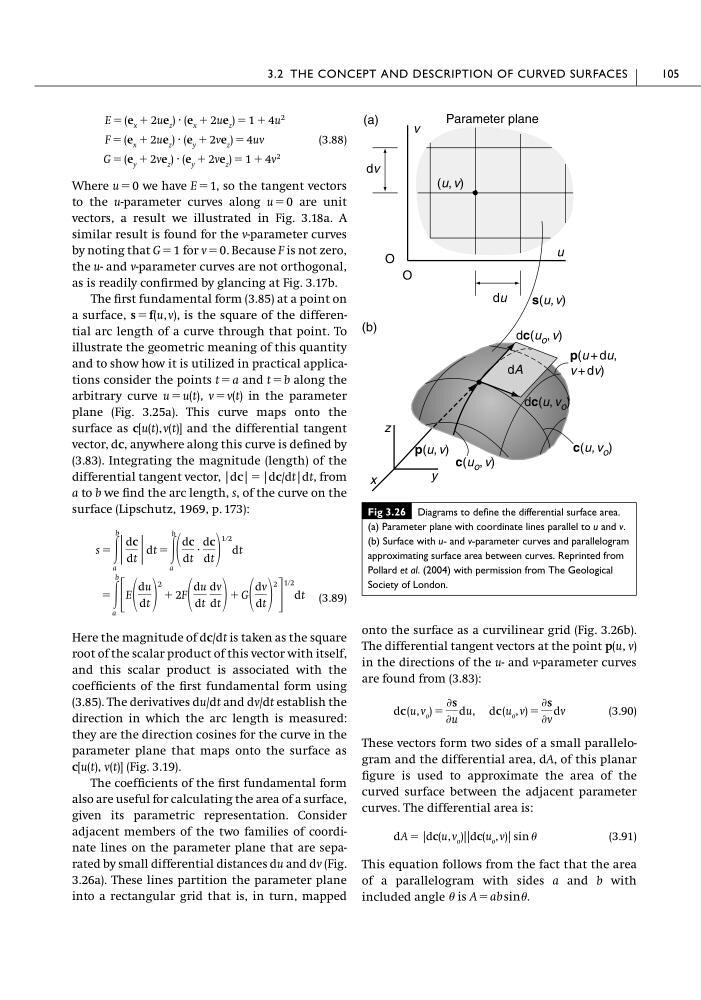
adjacent members of the two families of coordinate lines on the parameter plane that are separated by small differential distances du and dv (Fig.
3.26a). These lines partition the parameter plane
into a rectangular grid that is, in turn, mapped
ϭ Ύ
b
a
΄ E
du
dt
2
ϩ 2F
du
dt
dv
dt ϩ G
dv
dt
2
΅
1ր2
dt
s ϭ Ύ
b
a
|
dc
dt | dt ϭ Ύ
b
a
dc
dt
·
dc
dt
1ր2
dt
G ϭ (e y ϩ 2ve z ) · (e y ϩ 2ve z ) ϭ 1 ϩ 4v
2
F ϭ (e x ϩ 2ue z ) · (e y ϩ 2ve z ) ϭ 4uv
E ϭ (e x ϩ 2ue z ) · (e x ϩ 2ue z ) ϭ 1 ϩ 4u
2
onto the surface as a curvilinear grid (Fig. 3.26b).
The differential tangent vectors at the point p(u, v)
in the directions of the u- and v-parameter curves
are found from (3.83):
(3.90)
These vectors form two sides of a small parallelogram and the differential area, dA, of this planar
figure is used to approximate the area of the
curved surface between the adjacent parameter
curves. The differential area is:
(3.91)
This equation follows from the fact that the area
of a parallelogram with sides a and b with
included angle is A ϭ absin.
dA ϭ |dc(u, v o )||dc(u o , v)| sin
dc (u, v o ) ϭ
Ѩs
Ѩu
du, dc (u o , v) ϭ
Ѩs
Ѩv
dv
3.2 THE CONCEPT AND DESCRIPTION OF CURVED SURFACES
105
Fig 3.26 Diagrams to define the differential surface area.
(a) Parameter plane with coordinate lines parallel to u and v.
(b) Surface with u- and v-parameter curves and parallelogram
approximating surface area between curves. Reprinted from
Pollard et al. (2004) with permission from The Geological
Society of London.
y
z
x
(b)
(a)
du
dv
O
Parameter plane
O
dA
(u, v)
s(u, v)
dc(u o , v)
p(u + du,
v + dv)
p(u, v)
c(u, v o )
c(u o , v)
dc(u, v o )
u
v
Where u ϭ 0 we have E ϭ 1, so the tangent vectors
to the u-parameter curves along u ϭ 0 are unit
vectors, a result we illustrated in Fig. 3.18a. A
similar result is found for the v-parameter curves
by noting that G ϭ 1 for v ϭ 0. Because F is not zero,
the u- and v-parameter curves are not orthogonal,
as is readily confirmed by glancing at Fig. 3.17b.
The first fundamental form (3.85) at a point on
a surface, s ϭ f(u, v), is the square of the differential arc length of a curve through that point. To
illustrate the geometric meaning of this quantity
and to show how it is utilized in practical applications consider the points t ϭ a and t ϭ b along the
arbitrary curve u ϭ u(t), v ϭ v(t) in the parameter
plane (Fig. 3.25a). This curve maps onto the
surface as c[u(t), v(t)] and the differential tangent
vector, dc, anywhere along this curve is defined by
(3.83). Integrating the magnitude (length) of the
differential tangent vector, |dc|ϭ |dc/dt|dt, from
a to b we find the arc length, s, of the curve on the
surface (Lipschutz, 1969, p. 173):
(3.89)
Here the magnitude of dc/dt is taken as the square
root of the scalar product of this vector with itself,
and this scalar product is associated with the
coefficients of the first fundamental form using
(3.85). The derivatives du/dt and dv/dt establish the
direction in which the arc length is measured:
they are the direction cosines for the curve in the
parameter plane that maps onto the surface as
c[u(t), v(t)] (Fig. 3.19).
The coefficients of the first fundamental form
also are useful for calculating the area of a surface,
given its parametric representation. Consider
adjacent members of the two families of coordinate lines on the parameter plane that are separated by small differential distances du and dv (Fig.
3.26a). These lines partition the parameter plane
into a rectangular grid that is, in turn, mapped
ϭ Ύ
b
a
΄ E
du
dt
2
ϩ 2F
du
dt
dv
dt ϩ G
dv
dt
2
΅
1ր2
dt
s ϭ Ύ
b
a
|
dc
dt | dt ϭ Ύ
b
a
dc
dt
·
dc
dt
1ր2
dt
G ϭ (e y ϩ 2ve z ) · (e y ϩ 2ve z ) ϭ 1 ϩ 4v
2
F ϭ (e x ϩ 2ue z ) · (e y ϩ 2ve z ) ϭ 4uv
E ϭ (e x ϩ 2ue z ) · (e x ϩ 2ue z ) ϭ 1 ϩ 4u
2
onto the surface as a curvilinear grid (Fig. 3.26b).
The differential tangent vectors at the point p(u, v)
in the directions of the u- and v-parameter curves
are found from (3.83):
(3.90)
These vectors form two sides of a small parallelogram and the differential area, dA, of this planar
figure is used to approximate the area of the
curved surface between the adjacent parameter
curves. The differential area is:
(3.91)
This equation follows from the fact that the area
of a parallelogram with sides a and b with
included angle is A ϭ absin.
dA ϭ |dc(u, v o )||dc(u o , v)| sin
dc (u, v o ) ϭ
Ѩs
Ѩu
du, dc (u o , v) ϭ
Ѩs
Ѩv
dv
3.2 THE CONCEPT AND DESCRIPTION OF CURVED SURFACES
105
Fig 3.26 Diagrams to define the differential surface area.
(a) Parameter plane with coordinate lines parallel to u and v.
(b) Surface with u- and v-parameter curves and parallelogram
approximating surface area between curves. Reprinted from
Pollard et al. (2004) with permission from The Geological
Society of London.
y
z
x
(b)
(a)
du
dv
O
Parameter plane
O
dA
(u, v)
s(u, v)
dc(u o , v)
p(u + du,
v + dv)
p(u, v)
c(u, v o )
c(u o , v)
dc(u, v o )
u
v