

and area on the curved surface, they are denoted
with the special symbols E, F, and G. Using this
notation the first fundamental form is written
(Lipschutz, 1969, p. 171):
(3.85)
E ϭ
Ѩs
Ѩu
·
Ѩs
Ѩu
, F ϭ
Ѩs
Ѩu
·
Ѩs
Ѩv
, G ϭ
Ѩs
Ѩv
·
Ѩs
Ѩv
I ϭ E du 2 ϩ 2F dudv ϩ G dv 2
The scalar quantities E, F, and G are called the
coefficients of the first fundamental form. The
values of the coefficients depend upon the choice
of parameters used to represent the surface, but
the first fundamental form itself (3.85) is invariant with respect to this choice (Lipschutz, 1969,
p. 172). In this sense I is a property of the surface
and plays a fundamental role in defining arc
lengths on the surface.
Recall that the scalar product of any vector, v,
with itself is equal to the squared magnitude of
the vector: v иv ϭ |v||v| ϭ |v|
2 . Thus, the first fundamental form may be interpreted as:
(3.86)
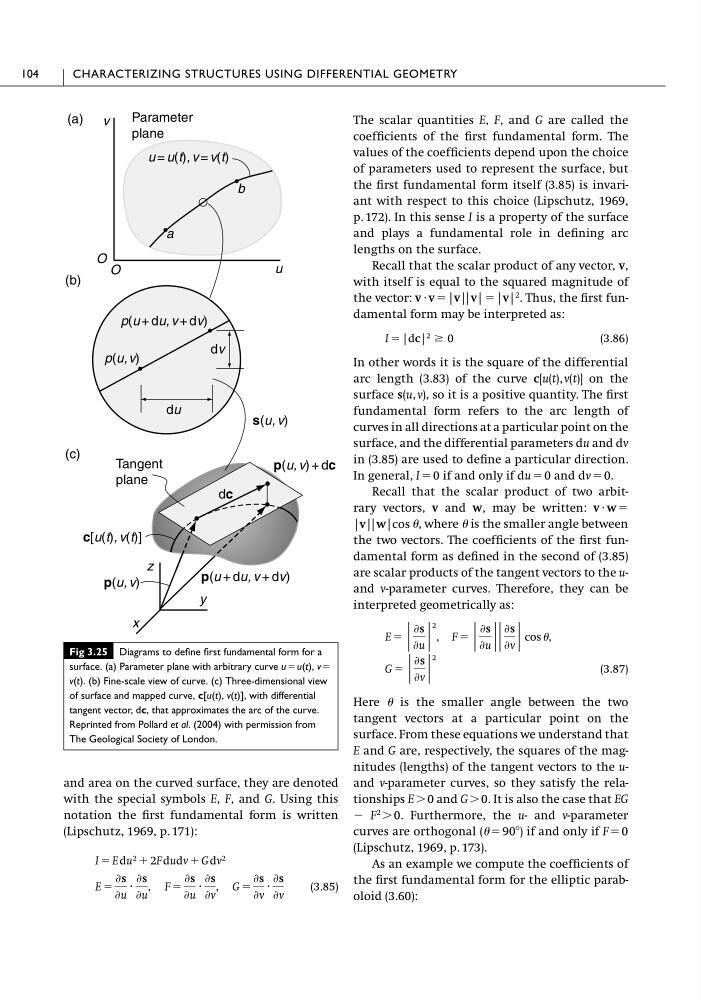
In other words it is the square of the differential
arc length (3.83) of the curve c[u(t), v(t)] on the
surface s(u, v), so it is a positive quantity. The first
fundamental form refers to the arc length of
curves in all directions at a particular point on the
surface, and the differential parameters du and dv
in (3.85) are used to define a particular direction.
In general, I ϭ 0 if and only if du ϭ 0 and dv ϭ 0.
Recall that the scalar product of two arbitrary vectors, v and w, may be written: v иw ϭ
|v||w|cos , where is the smaller angle between
the two vectors. The coefficients of the first fundamental form as defined in the second of (3.85)
are scalar products of the tangent vectors to the uand v-parameter curves. Therefore, they can be
interpreted geometrically as:
(3.87)
Here is the smaller angle between the two
tangent vectors at a particular point on the
surface. From these equations we understand that
E and G are, respectively, the squares of the magnitudes (lengths) of the tangent vectors to the uand v-parameter curves, so they satisfy the relationships E Ͼ 0 and G Ͼ 0. It is also the case that EG
Ϫ F
2 Ͼ 0. Furthermore, the u- and v-parameter
curves are orthogonal ( ϭ 90Њ) if and only if F ϭ 0
(Lipschutz, 1969, p. 173).
As an example we compute the coefficients of
the first fundamental form for the elliptic paraboloid (3.60):
G ϭ |
Ѩs
Ѩv |
2
E ϭ |
Ѩs
Ѩu |
2
, F ϭ |
Ѩs
Ѩu ||
Ѩs
Ѩv | cos ,
I ϭ |dc|
2 Ն 0
104
CHARACTERIZING STRUCTURES USING DIFFERENTIAL GEOMETRY
Fig 3.25 Diagrams to define first fundamental form for a
surface. (a) Parameter plane with arbitrary curve uϭu(t), vϭ
v(t). (b) Fine-scale view of curve. (c) Three-dimensional view
of surface and mapped curve, c[u(t), v(t)], with differential
tangent vector, dc, that approximates the arc of the curve.
Reprinted from Pollard et al. (2004) with permission from
The Geological Society of London.
y
z
x
(c)
(a)
u
v
O
Parameter
plane
O
a
b
dv
du
(b)
Tangent
plane
p(u + du, v + dv)
p(u,v)
s(u, v)
p(u + du, v + dv)
u = u(t), v = v(t)
p(u, v) + dc
c[u(t), v(t)]
p(u, v)
dc
with the special symbols E, F, and G. Using this
notation the first fundamental form is written
(Lipschutz, 1969, p. 171):
(3.85)
E ϭ
Ѩs
Ѩu
·
Ѩs
Ѩu
, F ϭ
Ѩs
Ѩu
·
Ѩs
Ѩv
, G ϭ
Ѩs
Ѩv
·
Ѩs
Ѩv
I ϭ E du 2 ϩ 2F dudv ϩ G dv 2
The scalar quantities E, F, and G are called the
coefficients of the first fundamental form. The
values of the coefficients depend upon the choice
of parameters used to represent the surface, but
the first fundamental form itself (3.85) is invariant with respect to this choice (Lipschutz, 1969,
p. 172). In this sense I is a property of the surface
and plays a fundamental role in defining arc
lengths on the surface.
Recall that the scalar product of any vector, v,
with itself is equal to the squared magnitude of
the vector: v иv ϭ |v||v| ϭ |v|
2 . Thus, the first fundamental form may be interpreted as:
(3.86)
In other words it is the square of the differential
arc length (3.83) of the curve c[u(t), v(t)] on the
surface s(u, v), so it is a positive quantity. The first
fundamental form refers to the arc length of
curves in all directions at a particular point on the
surface, and the differential parameters du and dv
in (3.85) are used to define a particular direction.
In general, I ϭ 0 if and only if du ϭ 0 and dv ϭ 0.
Recall that the scalar product of two arbitrary vectors, v and w, may be written: v иw ϭ
|v||w|cos , where is the smaller angle between
the two vectors. The coefficients of the first fundamental form as defined in the second of (3.85)
are scalar products of the tangent vectors to the uand v-parameter curves. Therefore, they can be
interpreted geometrically as:
(3.87)
Here is the smaller angle between the two
tangent vectors at a particular point on the
surface. From these equations we understand that
E and G are, respectively, the squares of the magnitudes (lengths) of the tangent vectors to the uand v-parameter curves, so they satisfy the relationships E Ͼ 0 and G Ͼ 0. It is also the case that EG
Ϫ F
2 Ͼ 0. Furthermore, the u- and v-parameter
curves are orthogonal ( ϭ 90Њ) if and only if F ϭ 0
(Lipschutz, 1969, p. 173).
As an example we compute the coefficients of
the first fundamental form for the elliptic paraboloid (3.60):
G ϭ |
Ѩs
Ѩv |
2
E ϭ |
Ѩs
Ѩu |
2
, F ϭ |
Ѩs
Ѩu ||
Ѩs
Ѩv | cos ,
I ϭ |dc|
2 Ն 0
104
CHARACTERIZING STRUCTURES USING DIFFERENTIAL GEOMETRY
Fig 3.25 Diagrams to define first fundamental form for a
surface. (a) Parameter plane with arbitrary curve uϭu(t), vϭ
v(t). (b) Fine-scale view of curve. (c) Three-dimensional view
of surface and mapped curve, c[u(t), v(t)], with differential
tangent vector, dc, that approximates the arc of the curve.
Reprinted from Pollard et al. (2004) with permission from
The Geological Society of London.
y
z
x
(c)
(a)
u
v
O
Parameter
plane
O
a
b
dv
du
(b)
Tangent
plane
p(u + du, v + dv)
p(u,v)
s(u, v)
p(u + du, v + dv)
u = u(t), v = v(t)
p(u, v) + dc
c[u(t), v(t)]
p(u, v)
dc