

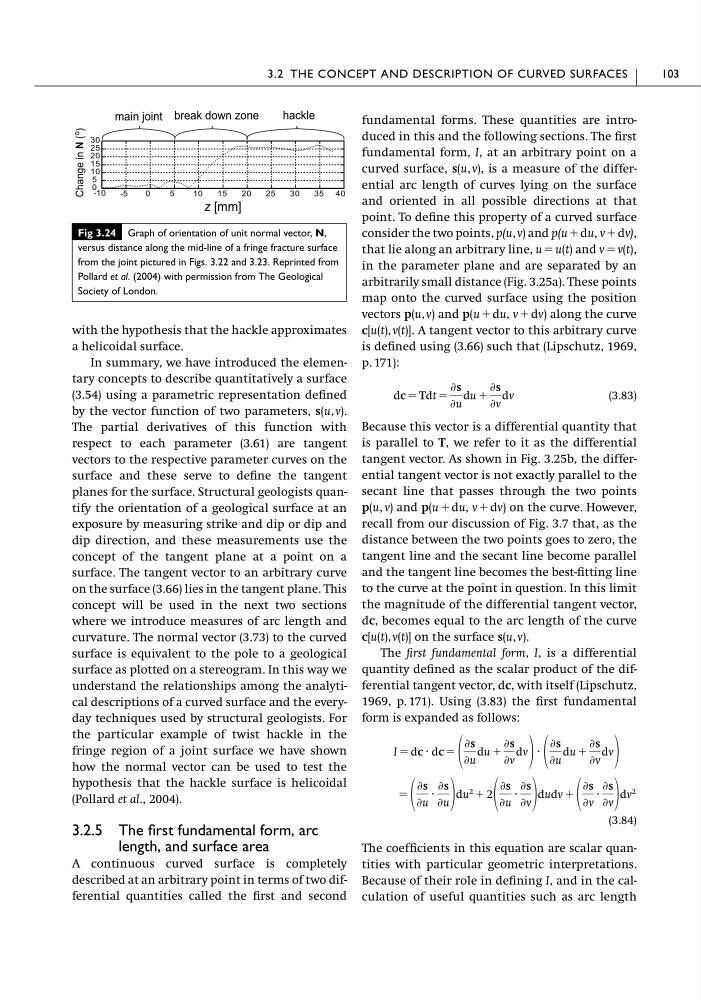
with the hypothesis that the hackle approximates
a helicoidal surface.
In summary, we have introduced the elementary concepts to describe quantitatively a surface
(3.54) using a parametric representation defined
by the vector function of two parameters, s(u, v).
The partial derivatives of this function with
respect to each parameter (3.61) are tangent
vectors to the respective parameter curves on the
surface and these serve to define the tangent
planes for the surface. Structural geologists quantify the orientation of a geological surface at an
exposure by measuring strike and dip or dip and
dip direction, and these measurements use the
concept of the tangent plane at a point on a
surface. The tangent vector to an arbitrary curve
on the surface (3.66) lies in the tangent plane. This
concept will be used in the next two sections
where we introduce measures of arc length and
curvature. The normal vector (3.73) to the curved
surface is equivalent to the pole to a geological
surface as plotted on a stereogram. In this way we
understand the relationships among the analytical descriptions of a curved surface and the everyday techniques used by structural geologists. For
the particular example of twist hackle in the
fringe region of a joint surface we have shown
how the normal vector can be used to test the
hypothesis that the hackle surface is helicoidal
(Pollard et al., 2004).
3.2.5 The first fundamental form, arc
length, and surface area
A continuous curved surface is completely
described at an arbitrary point in terms of two differential quantities called the first and second
fundamental forms. These quantities are introduced in this and the following sections. The first
fundamental form, I, at an arbitrary point on a
curved surface, s(u, v), is a measure of the differential arc length of curves lying on the surface
and oriented in all possible directions at that
point. To define this property of a curved surface
consider the two points, p(u, v) and p(uϩdu, vϩdv),
that lie along an arbitrary line, u ϭ u(t) and v ϭ v(t),
in the parameter plane and are separated by an
arbitrarily small distance (Fig. 3.25a). These points
map onto the curved surface using the position
vectors p(u, v) and p(uϩdu, vϩdv) along the curve
c[u(t), v(t)]. A tangent vector to this arbitrary curve
is defined using (3.66) such that (Lipschutz, 1969,
p. 171):
(3.83)
Because this vector is a differential quantity that
is parallel to T, we refer to it as the differential
tangent vector. As shown in Fig. 3.25b, the differential tangent vector is not exactly parallel to the
secant line that passes through the two points
p(u, v) and p(uϩdu, vϩdv) on the curve. However,
recall from our discussion of Fig. 3.7 that, as the
distance between the two points goes to zero, the
tangent line and the secant line become parallel
and the tangent line becomes the best-fitting line
to the curve at the point in question. In this limit
the magnitude of the differential tangent vector,
dc, becomes equal to the arc length of the curve
c[u(t), v(t)] on the surface s(u, v).
The first fundamental form, I, is a differential
quantity defined as the scalar product of the differential tangent vector, dc, with itself (Lipschutz,
1969, p. 171). Using (3.83) the first fundamental
form is expanded as follows:
(3.84)
The coefficients in this equation are scalar quantities with particular geometric interpretations.
Because of their role in defining I, and in the calculation of useful quantities such as arc length
ϭ
Ѩs
Ѩu
·
Ѩs
Ѩu du
2 ϩ 2
Ѩs
Ѩu
·
Ѩs
Ѩv dudv ϩ
Ѩs
Ѩv
·
Ѩs
Ѩv dv
2
I ϭ dc · dc ϭ
Ѩs
Ѩu
du ϩ
Ѩs
Ѩv
dv
·
Ѩs
Ѩu
du ϩ
Ѩs
Ѩv
dv
dc ϭ Tdt ϭ
Ѩs
Ѩu
du ϩ
Ѩs
Ѩv
dv
3.2 THE CONCEPT AND DESCRIPTION OF CURVED SURFACES
103
Fig 3.24 Graph of orientation of unit normal vector, N,
versus distance along the mid-line of a fringe fracture surface
from the joint pictured in Figs. 3.22 and 3.23. Reprinted from
Pollard et al. (2004) with permission from The Geological
Society of London.
-10
-5
0
5
10
15
20
25
30
35 40
0
5
10
15
20
25
30
Change in N (
o
)
hackle
break down zone
main joint
z [mm]
a helicoidal surface.
In summary, we have introduced the elementary concepts to describe quantitatively a surface
(3.54) using a parametric representation defined
by the vector function of two parameters, s(u, v).
The partial derivatives of this function with
respect to each parameter (3.61) are tangent
vectors to the respective parameter curves on the
surface and these serve to define the tangent
planes for the surface. Structural geologists quantify the orientation of a geological surface at an
exposure by measuring strike and dip or dip and
dip direction, and these measurements use the
concept of the tangent plane at a point on a
surface. The tangent vector to an arbitrary curve
on the surface (3.66) lies in the tangent plane. This
concept will be used in the next two sections
where we introduce measures of arc length and
curvature. The normal vector (3.73) to the curved
surface is equivalent to the pole to a geological
surface as plotted on a stereogram. In this way we
understand the relationships among the analytical descriptions of a curved surface and the everyday techniques used by structural geologists. For
the particular example of twist hackle in the
fringe region of a joint surface we have shown
how the normal vector can be used to test the
hypothesis that the hackle surface is helicoidal
(Pollard et al., 2004).
3.2.5 The first fundamental form, arc
length, and surface area
A continuous curved surface is completely
described at an arbitrary point in terms of two differential quantities called the first and second
fundamental forms. These quantities are introduced in this and the following sections. The first
fundamental form, I, at an arbitrary point on a
curved surface, s(u, v), is a measure of the differential arc length of curves lying on the surface
and oriented in all possible directions at that
point. To define this property of a curved surface
consider the two points, p(u, v) and p(uϩdu, vϩdv),
that lie along an arbitrary line, u ϭ u(t) and v ϭ v(t),
in the parameter plane and are separated by an
arbitrarily small distance (Fig. 3.25a). These points
map onto the curved surface using the position
vectors p(u, v) and p(uϩdu, vϩdv) along the curve
c[u(t), v(t)]. A tangent vector to this arbitrary curve
is defined using (3.66) such that (Lipschutz, 1969,
p. 171):
(3.83)
Because this vector is a differential quantity that
is parallel to T, we refer to it as the differential
tangent vector. As shown in Fig. 3.25b, the differential tangent vector is not exactly parallel to the
secant line that passes through the two points
p(u, v) and p(uϩdu, vϩdv) on the curve. However,
recall from our discussion of Fig. 3.7 that, as the
distance between the two points goes to zero, the
tangent line and the secant line become parallel
and the tangent line becomes the best-fitting line
to the curve at the point in question. In this limit
the magnitude of the differential tangent vector,
dc, becomes equal to the arc length of the curve
c[u(t), v(t)] on the surface s(u, v).
The first fundamental form, I, is a differential
quantity defined as the scalar product of the differential tangent vector, dc, with itself (Lipschutz,
1969, p. 171). Using (3.83) the first fundamental
form is expanded as follows:
(3.84)
The coefficients in this equation are scalar quantities with particular geometric interpretations.
Because of their role in defining I, and in the calculation of useful quantities such as arc length
ϭ
Ѩs
Ѩu
·
Ѩs
Ѩu du
2 ϩ 2
Ѩs
Ѩu
·
Ѩs
Ѩv dudv ϩ
Ѩs
Ѩv
·
Ѩs
Ѩv dv
2
I ϭ dc · dc ϭ
Ѩs
Ѩu
du ϩ
Ѩs
Ѩv
dv
·
Ѩs
Ѩu
du ϩ
Ѩs
Ѩv
dv
dc ϭ Tdt ϭ
Ѩs
Ѩu
du ϩ
Ѩs
Ѩv
dv
3.2 THE CONCEPT AND DESCRIPTION OF CURVED SURFACES
103
Fig 3.24 Graph of orientation of unit normal vector, N,
versus distance along the mid-line of a fringe fracture surface
from the joint pictured in Figs. 3.22 and 3.23. Reprinted from
Pollard et al. (2004) with permission from The Geological
Society of London.
-10
-5
0
5
10
15
20
25
30
35 40
0
5
10
15
20
25
30
Change in N (
o
)
hackle
break down zone
main joint
z [mm]