

For a given value of the constant c, the unit
normal completely determines the orientation of
the surface at any point specified by the parameters u and v.
The patch of a helicoidal surface used to model
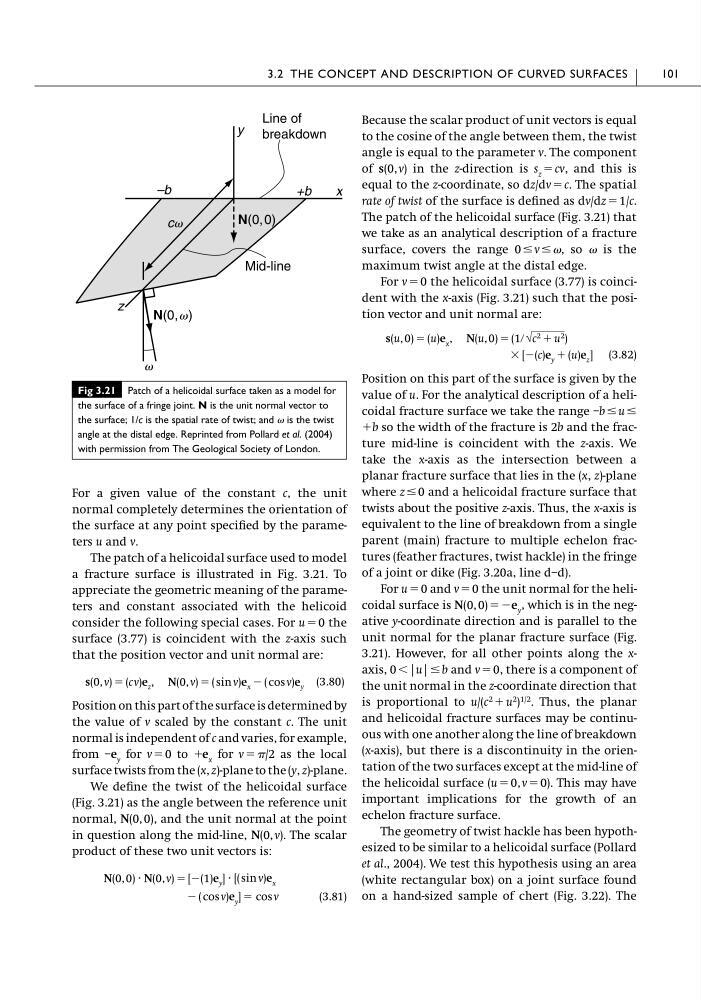
a fracture surface is illustrated in Fig. 3.21. To
appreciate the geometric meaning of the parameters and constant associated with the helicoid
consider the following special cases. For u ϭ 0 the
surface (3.77) is coincident with the z-axis such
that the position vector and unit normal are:
(3.80)
Position on this part of the surface is determined by
the value of v scaled by the constant c. The unit
normal is independent of c and varies, for example,
from –e y for v ϭ 0 to ϩe x for v ϭ /2 as the local
surface twists from the (x, z)-plane to the (y, z)-plane.
We define the twist of the helicoidal surface
(Fig. 3.21) as the angle between the reference unit
normal, N(0, 0), and the unit normal at the point
in question along the mid-line, N(0, v). The scalar
product of these two unit vectors is:
(3.81)
Ϫ ( cos v)e y ] ϭ cos v
[( sin v)e x
N(0, 0) · N(0, v) ϭ [Ϫ(1)e y ] ·
s(0, v) ϭ (cv)e z , N(0, v) ϭ ( sin v)e x Ϫ ( cos v)e y
Because the scalar product of unit vectors is equal
to the cosine of the angle between them, the twist
angle is equal to the parameter v. The component
of s(0, v) in the z-direction is s z ϭ cv, and this is
equal to the z-coordinate, so dz/dv ϭ c. The spatial
rate of twist of the surface is defined as dv/dz ϭ 1/c.
The patch of the helicoidal surface (Fig. 3.21) that
we take as an analytical description of a fracture
surface, covers the range 0 Յ v Յ , so is the
maximum twist angle at the distal edge.
For v ϭ 0 the helicoidal surface (3.77) is coincident with the x-axis (Fig. 3.21) such that the position vector and unit normal are:
(3.82)
Position on this part of the surface is given by the
value of u. For the analytical description of a helicoidal fracture surface we take the range –b Յ u Յ
ϩb so the width of the fracture is 2b and the fracture mid-line is coincident with the z-axis. We
take the x-axis as the intersection between a
planar fracture surface that lies in the (x, z)-plane
where z Յ 0 and a helicoidal fracture surface that
twists about the positive z-axis. Thus, the x-axis is
equivalent to the line of breakdown from a single
parent (main) fracture to multiple echelon fractures (feather fractures, twist hackle) in the fringe
of a joint or dike (Fig. 3.20a, line d–d).
For u ϭ 0 and v ϭ 0 the unit normal for the helicoidal surface is N(0, 0) ϭϪe y , which is in the negative y-coordinate direction and is parallel to the
unit normal for the planar fracture surface (Fig.
3.21). However, for all other points along the xaxis, 0 Ͻ |u| Յ b and v ϭ 0, there is a component of
the unit normal in the z-coordinate direction that
is proportional to u/(c
2 ϩ u
2 )
1/2 . Thus, the planar
and helicoidal fracture surfaces may be continuous with one another along the line of breakdown
(x-axis), but there is a discontinuity in the orientation of the two surfaces except at the mid-line of
the helicoidal surface (u ϭ 0, v ϭ 0). This may have
important implications for the growth of an
echelon fracture surface.
The geometry of twist hackle has been hypothesized to be similar to a helicoidal surface (Pollard
et al., 2004). We test this hypothesis using an area
(white rectangular box) on a joint surface found
on a hand-sized sample of chert (Fig. 3.22). The
ϫ [Ϫ(c)e y ϩ (u)e z ]
s(u, 0) ϭ (u)e x , N(u, 0) ϭ (1ր √c
2 ϩ u
2 )
3.2 THE CONCEPT AND DESCRIPTION OF CURVED SURFACES
101
Fig 3.21 Patch of a helicoidal surface taken as a model for
the surface of a fringe joint. N is the unit normal vector to
the surface; 1/c is the spatial rate of twist; and is the twist
angle at the distal edge. Reprinted from Pollard et al. (2004)
with permission from The Geological Society of London.
–b
+b
y
x
z
N(0,0)
v
cv
Mid-line
Line of
breakdown
N(0, v)
normal completely determines the orientation of
the surface at any point specified by the parameters u and v.
The patch of a helicoidal surface used to model
a fracture surface is illustrated in Fig. 3.21. To
appreciate the geometric meaning of the parameters and constant associated with the helicoid
consider the following special cases. For u ϭ 0 the
surface (3.77) is coincident with the z-axis such
that the position vector and unit normal are:
(3.80)
Position on this part of the surface is determined by
the value of v scaled by the constant c. The unit
normal is independent of c and varies, for example,
from –e y for v ϭ 0 to ϩe x for v ϭ /2 as the local
surface twists from the (x, z)-plane to the (y, z)-plane.
We define the twist of the helicoidal surface
(Fig. 3.21) as the angle between the reference unit
normal, N(0, 0), and the unit normal at the point
in question along the mid-line, N(0, v). The scalar
product of these two unit vectors is:
(3.81)
Ϫ ( cos v)e y ] ϭ cos v
[( sin v)e x
N(0, 0) · N(0, v) ϭ [Ϫ(1)e y ] ·
s(0, v) ϭ (cv)e z , N(0, v) ϭ ( sin v)e x Ϫ ( cos v)e y
Because the scalar product of unit vectors is equal
to the cosine of the angle between them, the twist
angle is equal to the parameter v. The component
of s(0, v) in the z-direction is s z ϭ cv, and this is
equal to the z-coordinate, so dz/dv ϭ c. The spatial
rate of twist of the surface is defined as dv/dz ϭ 1/c.
The patch of the helicoidal surface (Fig. 3.21) that
we take as an analytical description of a fracture
surface, covers the range 0 Յ v Յ , so is the
maximum twist angle at the distal edge.
For v ϭ 0 the helicoidal surface (3.77) is coincident with the x-axis (Fig. 3.21) such that the position vector and unit normal are:
(3.82)
Position on this part of the surface is given by the
value of u. For the analytical description of a helicoidal fracture surface we take the range –b Յ u Յ
ϩb so the width of the fracture is 2b and the fracture mid-line is coincident with the z-axis. We
take the x-axis as the intersection between a
planar fracture surface that lies in the (x, z)-plane
where z Յ 0 and a helicoidal fracture surface that
twists about the positive z-axis. Thus, the x-axis is
equivalent to the line of breakdown from a single
parent (main) fracture to multiple echelon fractures (feather fractures, twist hackle) in the fringe
of a joint or dike (Fig. 3.20a, line d–d).
For u ϭ 0 and v ϭ 0 the unit normal for the helicoidal surface is N(0, 0) ϭϪe y , which is in the negative y-coordinate direction and is parallel to the
unit normal for the planar fracture surface (Fig.
3.21). However, for all other points along the xaxis, 0 Ͻ |u| Յ b and v ϭ 0, there is a component of
the unit normal in the z-coordinate direction that
is proportional to u/(c
2 ϩ u
2 )
1/2 . Thus, the planar
and helicoidal fracture surfaces may be continuous with one another along the line of breakdown
(x-axis), but there is a discontinuity in the orientation of the two surfaces except at the mid-line of
the helicoidal surface (u ϭ 0, v ϭ 0). This may have
important implications for the growth of an
echelon fracture surface.
The geometry of twist hackle has been hypothesized to be similar to a helicoidal surface (Pollard
et al., 2004). We test this hypothesis using an area
(white rectangular box) on a joint surface found
on a hand-sized sample of chert (Fig. 3.22). The
ϫ [Ϫ(c)e y ϩ (u)e z ]
s(u, 0) ϭ (u)e x , N(u, 0) ϭ (1ր √c
2 ϩ u
2 )
3.2 THE CONCEPT AND DESCRIPTION OF CURVED SURFACES
101
Fig 3.21 Patch of a helicoidal surface taken as a model for
the surface of a fringe joint. N is the unit normal vector to
the surface; 1/c is the spatial rate of twist; and is the twist
angle at the distal edge. Reprinted from Pollard et al. (2004)
with permission from The Geological Society of London.
–b
+b
y
x
z
N(0,0)
v
cv
Mid-line
Line of
breakdown
N(0, v)