

At the origin in the parameter plane, u ϭ 0 ϭ v, we
find N ϭ e z . As expected, this is a unit vector
pointed away from the concave side of the surface
along the positive z-axis. For the point p(0.8, 0.7)
shown in Fig. 3.17, we calculate the unit normal
vector as:
(3.76)
Given the signs of the three components or the
visualization of the surface near this point in Fig.
3.18b, one can conclude that N(0.8, 0.7) points
away from the surface on its concave side and that
it obeys the right-hand rule with respect to the
two tangent vectors.
3.2.4 Dike and joint surfaces idealized as
helicoids
Observations and mapping of opening fractures
in rock, including basaltic dikes (Delaney and
Pollard, 1981) and joints (Woodworth, 1896)
suggest that the surfaces of some of these fractures can be idealized as helicoids (Pollard et al.,
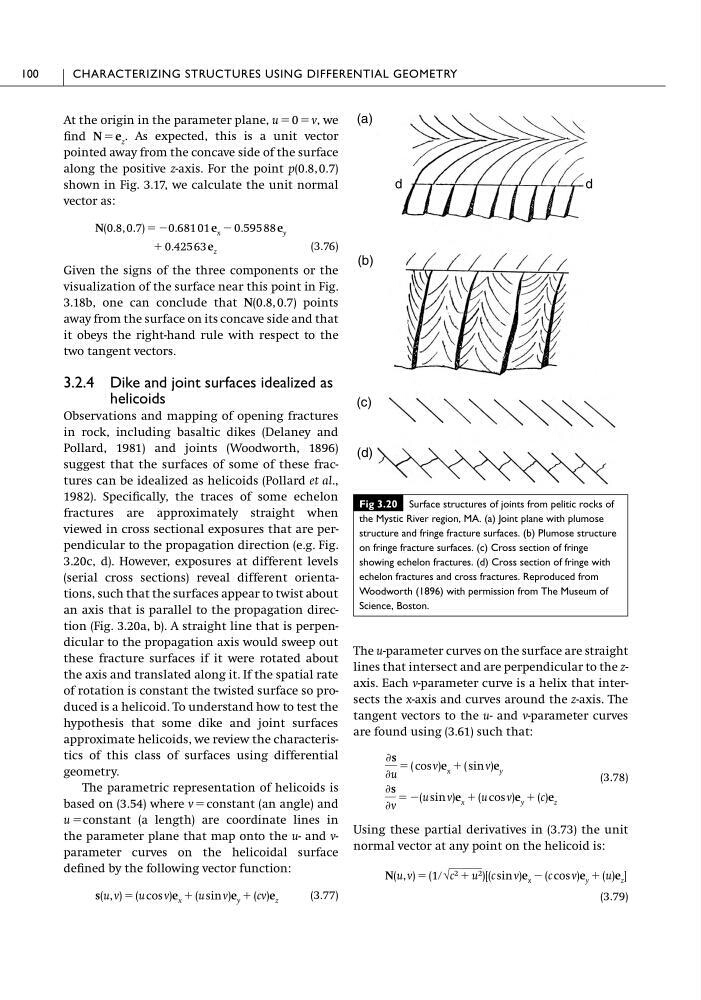
1982). Specifically, the traces of some echelon
fractures are approximately straight when
viewed in cross sectional exposures that are perpendicular to the propagation direction (e.g. Fig.
3.20c, d). However, exposures at different levels
(serial cross sections) reveal different orientations, such that the surfaces appear to twist about
an axis that is parallel to the propagation direction (Fig. 3.20a, b). A straight line that is perpendicular to the propagation axis would sweep out
these fracture surfaces if it were rotated about
the axis and translated along it. If the spatial rate
of rotation is constant the twisted surface so produced is a helicoid. To understand how to test the
hypothesis that some dike and joint surfaces
approximate helicoids, we review the characteristics of this class of surfaces using differential
geometry.
The parametric representation of helicoids is
based on (3.54) where v ϭ constant (an angle) and
uϭconstant (a length) are coordinate lines in
the parameter plane that map onto the u- and vparameter curves on the helicoidal surface
defined by the following vector function:
(3.77)
s(u, v) ϭ (u cos v)e x ϩ (u sin v)e y ϩ (cv)e z
ϩ 0.425 63 e z
N(0.8, 0.7) ϭ Ϫ0.681 01 e x Ϫ 0.595 88 e y
The u-parameter curves on the surface are straight
lines that intersect and are perpendicular to the zaxis. Each v-parameter curve is a helix that intersects the x-axis and curves around the z-axis. The
tangent vectors to the u- and v-parameter curves
are found using (3.61) such that:
(3.78)
Using these partial derivatives in (3.73) the unit
normal vector at any point on the helicoid is:
(3.79)
N(u, v) ϭ (1ր √c 2 ϩ u 2 )[(c sin v)e x Ϫ (c cos v)e y ϩ (u)e z ]
Ѩs
Ѩv
ϭ Ϫ(u sin v)e x ϩ (u cos v)e y ϩ (c)e z
Ѩs
Ѩu
ϭ ( cos v)e x ϩ ( sin v)e y
100
CHARACTERIZING STRUCTURES USING DIFFERENTIAL GEOMETRY
Fig 3.20 Surface structures of joints from pelitic rocks of
the Mystic River region, MA. (a) Joint plane with plumose
structure and fringe fracture surfaces. (b) Plumose structure
on fringe fracture surfaces. (c) Cross section of fringe
showing echelon fractures. (d) Cross section of fringe with
echelon fractures and cross fractures. Reproduced from
Woodworth (1896) with permission from The Museum of
Science, Boston.
(a)
d
d
(b)
(c)
(d)
find N ϭ e z . As expected, this is a unit vector
pointed away from the concave side of the surface
along the positive z-axis. For the point p(0.8, 0.7)
shown in Fig. 3.17, we calculate the unit normal
vector as:
(3.76)
Given the signs of the three components or the
visualization of the surface near this point in Fig.
3.18b, one can conclude that N(0.8, 0.7) points
away from the surface on its concave side and that
it obeys the right-hand rule with respect to the
two tangent vectors.
3.2.4 Dike and joint surfaces idealized as
helicoids
Observations and mapping of opening fractures
in rock, including basaltic dikes (Delaney and
Pollard, 1981) and joints (Woodworth, 1896)
suggest that the surfaces of some of these fractures can be idealized as helicoids (Pollard et al.,
1982). Specifically, the traces of some echelon
fractures are approximately straight when
viewed in cross sectional exposures that are perpendicular to the propagation direction (e.g. Fig.
3.20c, d). However, exposures at different levels
(serial cross sections) reveal different orientations, such that the surfaces appear to twist about
an axis that is parallel to the propagation direction (Fig. 3.20a, b). A straight line that is perpendicular to the propagation axis would sweep out
these fracture surfaces if it were rotated about
the axis and translated along it. If the spatial rate
of rotation is constant the twisted surface so produced is a helicoid. To understand how to test the
hypothesis that some dike and joint surfaces
approximate helicoids, we review the characteristics of this class of surfaces using differential
geometry.
The parametric representation of helicoids is
based on (3.54) where v ϭ constant (an angle) and
uϭconstant (a length) are coordinate lines in
the parameter plane that map onto the u- and vparameter curves on the helicoidal surface
defined by the following vector function:
(3.77)
s(u, v) ϭ (u cos v)e x ϩ (u sin v)e y ϩ (cv)e z
ϩ 0.425 63 e z
N(0.8, 0.7) ϭ Ϫ0.681 01 e x Ϫ 0.595 88 e y
The u-parameter curves on the surface are straight
lines that intersect and are perpendicular to the zaxis. Each v-parameter curve is a helix that intersects the x-axis and curves around the z-axis. The
tangent vectors to the u- and v-parameter curves
are found using (3.61) such that:
(3.78)
Using these partial derivatives in (3.73) the unit
normal vector at any point on the helicoid is:
(3.79)
N(u, v) ϭ (1ր √c 2 ϩ u 2 )[(c sin v)e x Ϫ (c cos v)e y ϩ (u)e z ]
Ѩs
Ѩv
ϭ Ϫ(u sin v)e x ϩ (u cos v)e y ϩ (c)e z
Ѩs
Ѩu
ϭ ( cos v)e x ϩ ( sin v)e y
100
CHARACTERIZING STRUCTURES USING DIFFERENTIAL GEOMETRY
Fig 3.20 Surface structures of joints from pelitic rocks of
the Mystic River region, MA. (a) Joint plane with plumose
structure and fringe fracture surfaces. (b) Plumose structure
on fringe fracture surfaces. (c) Cross section of fringe
showing echelon fractures. (d) Cross section of fringe with
echelon fractures and cross fractures. Reproduced from
Woodworth (1896) with permission from The Museum of
Science, Boston.
(a)
d
d
(b)
(c)
(d)