

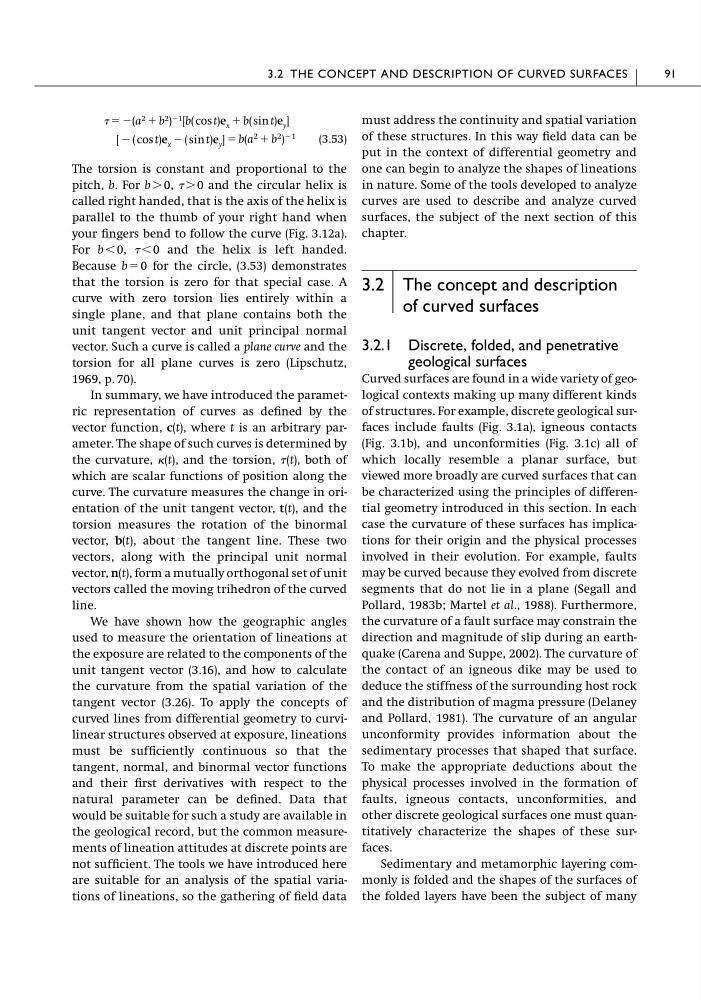
(3.53)
The torsion is constant and proportional to the
pitch, b. For b Ͼ 0, Ͼ 0 and the circular helix is
called right handed, that is the axis of the helix is
parallel to the thumb of your right hand when
your fingers bend to follow the curve (Fig. 3.12a).
For b Ͻ 0, Ͻ 0 and the helix is left handed.
Because b ϭ 0 for the circle, (3.53) demonstrates
that the torsion is zero for that special case. A
curve with zero torsion lies entirely within a
single plane, and that plane contains both the
unit tangent vector and unit principal normal
vector. Such a curve is called a plane curve and the
torsion for all plane curves is zero (Lipschutz,
1969, p. 70).
In summary, we have introduced the parametric representation of curves as defined by the
vector function, c(t), where t is an arbitrary parameter. The shape of such curves is determined by
the curvature, (t), and the torsion, (t), both of
which are scalar functions of position along the
curve. The curvature measures the change in orientation of the unit tangent vector, t(t), and the
torsion measures the rotation of the binormal
vector, b(t), about the tangent line. These two
vectors, along with the principal unit normal
vector, n(t), form a mutually orthogonal set of unit
vectors called the moving trihedron of the curved
line.
We have shown how the geographic angles
used to measure the orientation of lineations at
the exposure are related to the components of the
unit tangent vector (3.16), and how to calculate
the curvature from the spatial variation of the
tangent vector (3.26). To apply the concepts of
curved lines from differential geometry to curvilinear structures observed at exposure, lineations
must be sufficiently continuous so that the
tangent, normal, and binormal vector functions
and their first derivatives with respect to the
natural parameter can be defined. Data that
would be suitable for such a study are available in
the geological record, but the common measurements of lineation attitudes at discrete points are
not sufficient. The tools we have introduced here
are suitable for an analysis of the spatial variations of lineations, so the gathering of field data
ϭ b(a 2 ϩ b 2 ) Ϫ1
[ Ϫ ( cos t)e x Ϫ ( sin t)e y ]
ϭ Ϫ(a 2 ϩ b 2 ) Ϫ1 [b( cos t)e x ϩ b( sin t)e y ]
must address the continuity and spatial variation
of these structures. In this way field data can be
put in the context of differential geometry and
one can begin to analyze the shapes of lineations
in nature. Some of the tools developed to analyze
curves are used to describe and analyze curved
surfaces, the subject of the next section of this
chapter.
3.2 The concept and description
of curved surfaces
3.2.1 Discrete, folded, and penetrative
geological surfaces
Curved surfaces are found in a wide variety of geological contexts making up many different kinds
of structures. For example, discrete geological surfaces include faults (Fig. 3.1a), igneous contacts
(Fig. 3.1b), and unconformities (Fig. 3.1c) all of
which locally resemble a planar surface, but
viewed more broadly are curved surfaces that can
be characterized using the principles of differential geometry introduced in this section. In each
case the curvature of these surfaces has implications for their origin and the physical processes
involved in their evolution. For example, faults
may be curved because they evolved from discrete
segments that do not lie in a plane (Segall and
Pollard, 1983b; Martel et al., 1988). Furthermore,
the curvature of a fault surface may constrain the
direction and magnitude of slip during an earthquake (Carena and Suppe, 2002). The curvature of
the contact of an igneous dike may be used to
deduce the stiffness of the surrounding host rock
and the distribution of magma pressure (Delaney
and Pollard, 1981). The curvature of an angular
unconformity provides information about the
sedimentary processes that shaped that surface.
To make the appropriate deductions about the
physical processes involved in the formation of
faults, igneous contacts, unconformities, and
other discrete geological surfaces one must quantitatively characterize the shapes of these surfaces.
Sedimentary and metamorphic layering commonly is folded and the shapes of the surfaces of
the folded layers have been the subject of many
3.2 THE CONCEPT AND DESCRIPTION OF CURVED SURFACES
91
The torsion is constant and proportional to the
pitch, b. For b Ͼ 0, Ͼ 0 and the circular helix is
called right handed, that is the axis of the helix is
parallel to the thumb of your right hand when
your fingers bend to follow the curve (Fig. 3.12a).
For b Ͻ 0, Ͻ 0 and the helix is left handed.
Because b ϭ 0 for the circle, (3.53) demonstrates
that the torsion is zero for that special case. A
curve with zero torsion lies entirely within a
single plane, and that plane contains both the
unit tangent vector and unit principal normal
vector. Such a curve is called a plane curve and the
torsion for all plane curves is zero (Lipschutz,
1969, p. 70).
In summary, we have introduced the parametric representation of curves as defined by the
vector function, c(t), where t is an arbitrary parameter. The shape of such curves is determined by
the curvature, (t), and the torsion, (t), both of
which are scalar functions of position along the
curve. The curvature measures the change in orientation of the unit tangent vector, t(t), and the
torsion measures the rotation of the binormal
vector, b(t), about the tangent line. These two
vectors, along with the principal unit normal
vector, n(t), form a mutually orthogonal set of unit
vectors called the moving trihedron of the curved
line.
We have shown how the geographic angles
used to measure the orientation of lineations at
the exposure are related to the components of the
unit tangent vector (3.16), and how to calculate
the curvature from the spatial variation of the
tangent vector (3.26). To apply the concepts of
curved lines from differential geometry to curvilinear structures observed at exposure, lineations
must be sufficiently continuous so that the
tangent, normal, and binormal vector functions
and their first derivatives with respect to the
natural parameter can be defined. Data that
would be suitable for such a study are available in
the geological record, but the common measurements of lineation attitudes at discrete points are
not sufficient. The tools we have introduced here
are suitable for an analysis of the spatial variations of lineations, so the gathering of field data
ϭ b(a 2 ϩ b 2 ) Ϫ1
[ Ϫ ( cos t)e x Ϫ ( sin t)e y ]
ϭ Ϫ(a 2 ϩ b 2 ) Ϫ1 [b( cos t)e x ϩ b( sin t)e y ]
must address the continuity and spatial variation
of these structures. In this way field data can be
put in the context of differential geometry and
one can begin to analyze the shapes of lineations
in nature. Some of the tools developed to analyze
curves are used to describe and analyze curved
surfaces, the subject of the next section of this
chapter.
3.2 The concept and description
of curved surfaces
3.2.1 Discrete, folded, and penetrative
geological surfaces
Curved surfaces are found in a wide variety of geological contexts making up many different kinds
of structures. For example, discrete geological surfaces include faults (Fig. 3.1a), igneous contacts
(Fig. 3.1b), and unconformities (Fig. 3.1c) all of
which locally resemble a planar surface, but
viewed more broadly are curved surfaces that can
be characterized using the principles of differential geometry introduced in this section. In each
case the curvature of these surfaces has implications for their origin and the physical processes
involved in their evolution. For example, faults
may be curved because they evolved from discrete
segments that do not lie in a plane (Segall and
Pollard, 1983b; Martel et al., 1988). Furthermore,
the curvature of a fault surface may constrain the
direction and magnitude of slip during an earthquake (Carena and Suppe, 2002). The curvature of
the contact of an igneous dike may be used to
deduce the stiffness of the surrounding host rock
and the distribution of magma pressure (Delaney
and Pollard, 1981). The curvature of an angular
unconformity provides information about the
sedimentary processes that shaped that surface.
To make the appropriate deductions about the
physical processes involved in the formation of
faults, igneous contacts, unconformities, and
other discrete geological surfaces one must quantitatively characterize the shapes of these surfaces.
Sedimentary and metamorphic layering commonly is folded and the shapes of the surfaces of
the folded layers have been the subject of many
3.2 THE CONCEPT AND DESCRIPTION OF CURVED SURFACES
91