

vector is directed following the conventional
right-hand rule for vector (cross) products: curl
the fingers of your right hand from t toward n and
your thumb points in the direction of b.
For an arbitrary parametric representation of
a curve, c(t), the unit binormal vector is the cross
product of the tangent and principal normal
vectors, both written as functions of the parameter t (Lipschutz, 1969, p. 68):
(3.46)
Referring back to (3.29) and recalling that the
tangent vector, t(t), and the principal normal
vector, n(t), are mutually orthogonal, the smaller
angle between them is ϭ /2, so sin ϭ 1.
Furthermore, both of these vectors have unit magnitudes, so the binormal vector, b(t), also is a unit
vector. The moving trihedron (Fig. 3.12b) is composed of three orthogonal unit vectors.
For the circular helix (Fig. 3.12a) the unit
binormal vector is found using (3.11) and (3.44) in
(3.46):
(3.47)
For the special case where b goes to zero, resulting
in a circle, the unit binormal vector is b(t) ϭ e z . The
circle lies in the (x, y)-plane, which also contains
the tangent vector and the principal normal
vector, and the unit binormal vector is parallel to
the z-axis.
3.1.6 The scalar torsion
The unit binormal vector is used to define the
second intrinsic geometric property of curves,
namely the torsion. For the natural parametric representation of a curve, c(s), the torsion is defined
as (Lipschutz, 1969, p. 69):
(3.48)
Because b(s) is a constant (unit) vector function,
the derivative db/ds is orthogonal to b(s), and
therefore lies in the plane containing t(s) and n(s)
(Fig. 3.12b). The scalar product of db/ds and n
determines the component of the vector db/ds on
an axis for which n is the base vector. Thus, the
torsion is a measure of the change in orientation
(s) ϭ Ϫ
db
ds · n
b(t) ϭ (a 2 ϩ b 2 ) Ϫ1ր2 [b( sin t)e x Ϫ b( cos t)e y ϩ ae z ]
b(t) ϭ t(t) ϫ n(t)
of the binormal vector, b, with arc length, s, but
only that part of the change in orientation that
projects onto the plane normal to the tangent
vector, t. In other words the torsion describes the
component of rotation of the binormal vector
about the tangent line with change in position
along the curve. The torsion is called an intrinsic
property of a curve because it serves, along with
the scalar curvature, to define the shape of the
curve uniquely.
For an arbitrary parametric representation of
the curve c(t) the torsion is (Lipschutz, 1969,
pp. 69–70):
(3.49)
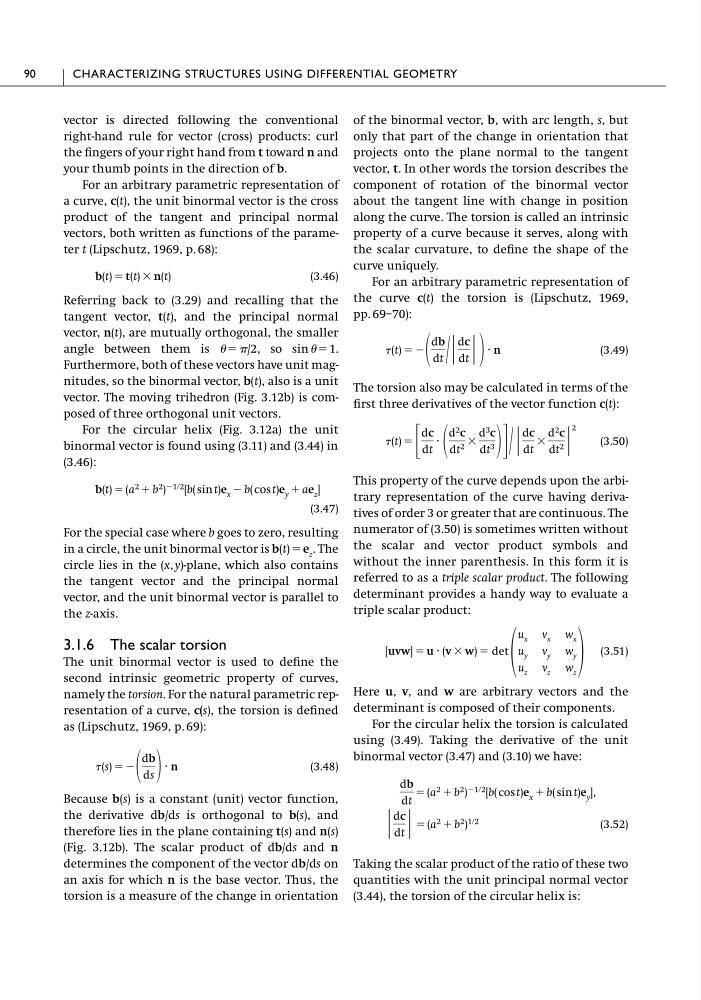
The torsion also may be calculated in terms of the
first three derivatives of the vector function c(t):
(3.50)
This property of the curve depends upon the arbitrary representation of the curve having derivatives of order 3 or greater that are continuous. The
numerator of (3.50) is sometimes written without
the scalar and vector product symbols and
without the inner parenthesis. In this form it is
referred to as a triple scalar product. The following
determinant provides a handy way to evaluate a
triple scalar product:
(3.51)
Here u, v, and w are arbitrary vectors and the
determinant is composed of their components.
For the circular helix the torsion is calculated
using (3.49). Taking the derivative of the unit
binormal vector (3.47) and (3.10) we have:
(3.52)
Taking the scalar product of the ratio of these two
quantities with the unit principal normal vector
(3.44), the torsion of the circular helix is:
|
dc
dt | ϭ (a 2 ϩ b 2 ) 1ր2
db
dt
ϭ (a 2 ϩ b 2 ) Ϫ1ր2 [b( cos t)e x ϩ b( sin t)e y ],
[uvw] ϭ u · (v ϫ w) ϭ det
u x v x w x
u y v y w y
u z v z w z
(t) ϭ ΄
dc
dt
·
d 2 c
dt 2 ϫ
d 3 c
dt 3 ΅ ր |
dc
dt
ϫ
d 2 c
dt 2 |
2
(t) ϭ Ϫ
db
dt ր |
dc
dt | · n
90
CHARACTERIZING STRUCTURES USING DIFFERENTIAL GEOMETRY
right-hand rule for vector (cross) products: curl
the fingers of your right hand from t toward n and
your thumb points in the direction of b.
For an arbitrary parametric representation of
a curve, c(t), the unit binormal vector is the cross
product of the tangent and principal normal
vectors, both written as functions of the parameter t (Lipschutz, 1969, p. 68):
(3.46)
Referring back to (3.29) and recalling that the
tangent vector, t(t), and the principal normal
vector, n(t), are mutually orthogonal, the smaller
angle between them is ϭ /2, so sin ϭ 1.
Furthermore, both of these vectors have unit magnitudes, so the binormal vector, b(t), also is a unit
vector. The moving trihedron (Fig. 3.12b) is composed of three orthogonal unit vectors.
For the circular helix (Fig. 3.12a) the unit
binormal vector is found using (3.11) and (3.44) in
(3.46):
(3.47)
For the special case where b goes to zero, resulting
in a circle, the unit binormal vector is b(t) ϭ e z . The
circle lies in the (x, y)-plane, which also contains
the tangent vector and the principal normal
vector, and the unit binormal vector is parallel to
the z-axis.
3.1.6 The scalar torsion
The unit binormal vector is used to define the
second intrinsic geometric property of curves,
namely the torsion. For the natural parametric representation of a curve, c(s), the torsion is defined
as (Lipschutz, 1969, p. 69):
(3.48)
Because b(s) is a constant (unit) vector function,
the derivative db/ds is orthogonal to b(s), and
therefore lies in the plane containing t(s) and n(s)
(Fig. 3.12b). The scalar product of db/ds and n
determines the component of the vector db/ds on
an axis for which n is the base vector. Thus, the
torsion is a measure of the change in orientation
(s) ϭ Ϫ
db
ds · n
b(t) ϭ (a 2 ϩ b 2 ) Ϫ1ր2 [b( sin t)e x Ϫ b( cos t)e y ϩ ae z ]
b(t) ϭ t(t) ϫ n(t)
of the binormal vector, b, with arc length, s, but
only that part of the change in orientation that
projects onto the plane normal to the tangent
vector, t. In other words the torsion describes the
component of rotation of the binormal vector
about the tangent line with change in position
along the curve. The torsion is called an intrinsic
property of a curve because it serves, along with
the scalar curvature, to define the shape of the
curve uniquely.
For an arbitrary parametric representation of
the curve c(t) the torsion is (Lipschutz, 1969,
pp. 69–70):
(3.49)
The torsion also may be calculated in terms of the
first three derivatives of the vector function c(t):
(3.50)
This property of the curve depends upon the arbitrary representation of the curve having derivatives of order 3 or greater that are continuous. The
numerator of (3.50) is sometimes written without
the scalar and vector product symbols and
without the inner parenthesis. In this form it is
referred to as a triple scalar product. The following
determinant provides a handy way to evaluate a
triple scalar product:
(3.51)
Here u, v, and w are arbitrary vectors and the
determinant is composed of their components.
For the circular helix the torsion is calculated
using (3.49). Taking the derivative of the unit
binormal vector (3.47) and (3.10) we have:
(3.52)
Taking the scalar product of the ratio of these two
quantities with the unit principal normal vector
(3.44), the torsion of the circular helix is:
|
dc
dt | ϭ (a 2 ϩ b 2 ) 1ր2
db
dt
ϭ (a 2 ϩ b 2 ) Ϫ1ր2 [b( cos t)e x ϩ b( sin t)e y ],
[uvw] ϭ u · (v ϫ w) ϭ det
u x v x w x
u y v y w y
u z v z w z
(t) ϭ ΄
dc
dt
·
d 2 c
dt 2 ϫ
d 3 c
dt 3 ΅ ր |
dc
dt
ϫ
d 2 c
dt 2 |
2
(t) ϭ Ϫ
db
dt ր |
dc
dt | · n
90
CHARACTERIZING STRUCTURES USING DIFFERENTIAL GEOMETRY