

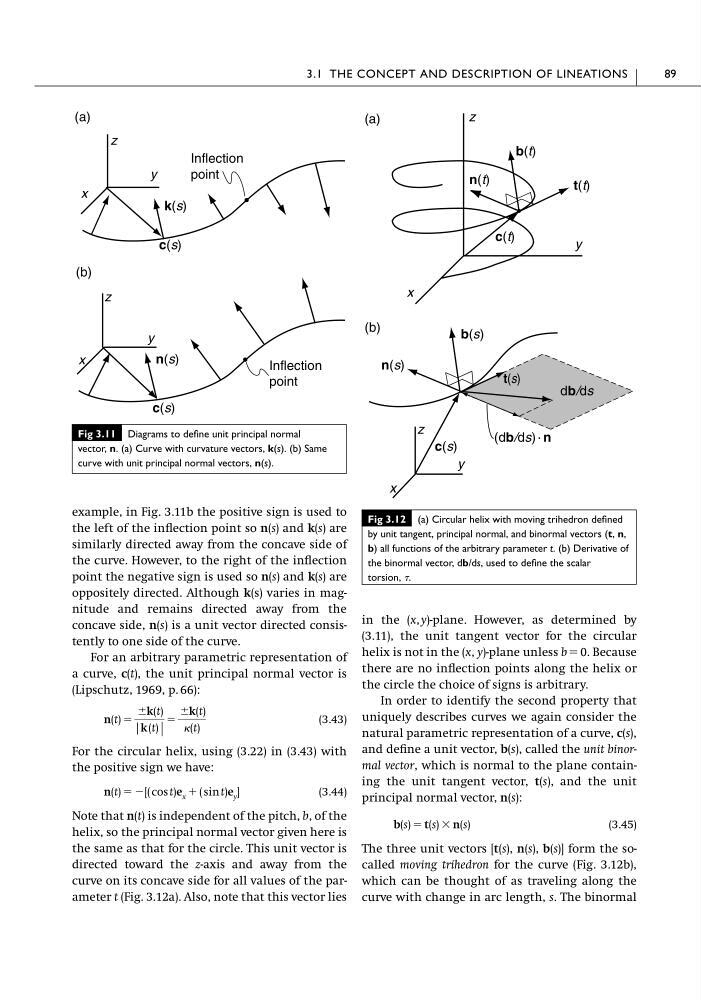
example, in Fig. 3.11b the positive sign is used to
the left of the inflection point so n(s) and k(s) are
similarly directed away from the concave side of
the curve. However, to the right of the inflection
point the negative sign is used so n(s) and k(s) are
oppositely directed. Although k(s) varies in magnitude and remains directed away from the
concave side, n(s) is a unit vector directed consistently to one side of the curve.
For an arbitrary parametric representation of
a curve, c(t), the unit principal normal vector is
(Lipschutz, 1969, p. 66):
(3.43)
For the circular helix, using (3.22) in (3.43) with
the positive sign we have:
(3.44)
Note that n(t) is independent of the pitch, b, of the
helix, so the principal normal vector given here is
the same as that for the circle. This unit vector is
directed toward the z-axis and away from the
curve on its concave side for all values of the parameter t (Fig. 3.12a). Also, note that this vector lies
n(t) ϭ Ϫ[( cos t)e x ϩ ( sin t)e y ]
n(t) ϭ
Ϯk(t)
|k (t) |
ϭ
Ϯk(t)
(t)
in the (x, y)-plane. However, as determined by
(3.11), the unit tangent vector for the circular
helix is not in the (x, y)-plane unless b ϭ 0. Because
there are no inflection points along the helix or
the circle the choice of signs is arbitrary.
In order to identify the second property that
uniquely describes curves we again consider the
natural parametric representation of a curve, c(s),
and define a unit vector, b(s), called the unit binormal vector, which is normal to the plane containing the unit tangent vector, t(s), and the unit
principal normal vector, n(s):
(3.45)
The three unit vectors [t(s), n(s), b(s)] form the socalled moving trihedron for the curve (Fig. 3.12b),
which can be thought of as traveling along the
curve with change in arc length, s. The binormal
b(s) ϭ t(s) ϫ n(s)
3.1 THE CONCEPT AND DESCRIPTION OF LINEATIONS
89
Fig 3.11 Diagrams to define unit principal normal
vector, n. (a) Curve with curvature vectors, k(s). (b) Same
curve with unit principal normal vectors, n(s).
(b)
(a)
x
y
z
x
y
z
Inflection
point
k(s)
c(s)
Inflection
point
n(s)
c(s)
Fig 3.12 (a) Circular helix with moving trihedron defined
by unit tangent, principal normal, and binormal vectors (t, n,
b) all functions of the arbitrary parameter t. (b) Derivative of
the binormal vector, db/ds, used to define the scalar
torsion, .
x
y
z
(b)
(a)
x
y
z
c(t)
db/ds
c(s)
n(t)
t(t)
b(t)
n(s)
b(s)
t(s)
(db/ds) n
the left of the inflection point so n(s) and k(s) are
similarly directed away from the concave side of
the curve. However, to the right of the inflection
point the negative sign is used so n(s) and k(s) are
oppositely directed. Although k(s) varies in magnitude and remains directed away from the
concave side, n(s) is a unit vector directed consistently to one side of the curve.
For an arbitrary parametric representation of
a curve, c(t), the unit principal normal vector is
(Lipschutz, 1969, p. 66):
(3.43)
For the circular helix, using (3.22) in (3.43) with
the positive sign we have:
(3.44)
Note that n(t) is independent of the pitch, b, of the
helix, so the principal normal vector given here is
the same as that for the circle. This unit vector is
directed toward the z-axis and away from the
curve on its concave side for all values of the parameter t (Fig. 3.12a). Also, note that this vector lies
n(t) ϭ Ϫ[( cos t)e x ϩ ( sin t)e y ]
n(t) ϭ
Ϯk(t)
|k (t) |
ϭ
Ϯk(t)
(t)
in the (x, y)-plane. However, as determined by
(3.11), the unit tangent vector for the circular
helix is not in the (x, y)-plane unless b ϭ 0. Because
there are no inflection points along the helix or
the circle the choice of signs is arbitrary.
In order to identify the second property that
uniquely describes curves we again consider the
natural parametric representation of a curve, c(s),
and define a unit vector, b(s), called the unit binormal vector, which is normal to the plane containing the unit tangent vector, t(s), and the unit
principal normal vector, n(s):
(3.45)
The three unit vectors [t(s), n(s), b(s)] form the socalled moving trihedron for the curve (Fig. 3.12b),
which can be thought of as traveling along the
curve with change in arc length, s. The binormal
b(s) ϭ t(s) ϫ n(s)
3.1 THE CONCEPT AND DESCRIPTION OF LINEATIONS
89
Fig 3.11 Diagrams to define unit principal normal
vector, n. (a) Curve with curvature vectors, k(s). (b) Same
curve with unit principal normal vectors, n(s).
(b)
(a)
x
y
z
x
y
z
Inflection
point
k(s)
c(s)
Inflection
point
n(s)
c(s)
Fig 3.12 (a) Circular helix with moving trihedron defined
by unit tangent, principal normal, and binormal vectors (t, n,
b) all functions of the arbitrary parameter t. (b) Derivative of
the binormal vector, db/ds, used to define the scalar
torsion, .
x
y
z
(b)
(a)
x
y
z
c(t)
db/ds
c(s)
n(t)
t(t)
b(t)
n(s)
b(s)
t(s)
(db/ds) n